


Trio Mobil Global Technology Innovation Leader in AI-Based Industrial Safety
Read the Frost & Sullivan Analysis

What Do OSHA Forklift Regulations Require in 2026? A Guide for Warehouse Safety Teams
 Sep 04, 2026
 4 min
4 min 412
412
OSHA’s forklift rules did not suddenly change in 2026. The enforcement environment around warehouse operations did. For safety leaders, that distinction matters.
The core federal requirements governing powered industrial trucks still come primarily from 29 CFR 1910.178, Powered Industrial Trucks. Operator training, truck examinations, safe operation, maintenance, loading and unloading practices, and workplace-specific hazards remain central responsibilities.
What changed in 2026 is the context in which some of those responsibilities are being examined.
On July 31, 2026, OSHA's updated National Emphasis Program on Warehousing and Distribution Center Operations took effect.The program calls for comprehensive safety inspections and specifically identifies powered industrial vehicle operations among the hazards inspectors will examine.
For warehouse and EHS teams, the question is therefore broader than “What new forklift rule did OSHA introduce?”
It is: What should organizations understand about forklift safety requirements and enforcement priorities in 2026?
This guide explains what OSHA currently requires, what actually changed in 2026, what remains under development, and how modern safety technologies can support a broader forklift risk-management strategy.
What Are the OSHA Forklift Regulations in 2026?
OSHA regulates forklifts primarily as powered industrial trucks, or PITs, under 29 CFR 1910.178. The standard covers the design, maintenance and use of forklifts and other powered industrial trucks in general industry.
Most of the fundamental requirements are not new for 2026.
They include areas such as:
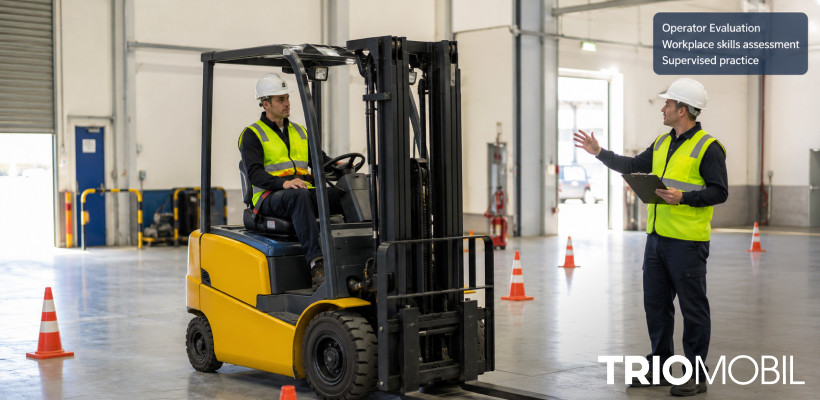
- Operator training and evaluation: Employers must ensure operators are trained and competent before independently operating covered equipment.
- Workplace-specific training: Training must account for the vehicle, operating conditions and hazards present in the workplace.
- Forklift examinations: Powered industrial trucks must be examined before being placed in service, at least daily and after each shift when used continuously.
- Unsafe equipment: Trucks requiring repair or found unsafe must be taken out of service until restored to safe operating condition.
- Safe truck operation: OSHA establishes requirements covering travel, loading, parking and other operational practices.
- Loading and unloading: Dockboards, trailers, railroad cars and related loading environments require specific precautions.
OSHA also requires employers to certify operator training and evaluation. The certification must identify the operator, training date, evaluation date and the person performing the training or evaluation.
The regulatory foundation is therefore familiar.
For a broader overview of the existing requirements around training, inspections, maintenance, and safe forklift operation, see our guide to OSHA forklift safety regulations and compliance.
The major 2026 development is how warehouse hazards are being prioritized through OSHA’s enforcement programs.
What Changed for Forklift Safety in 2026?
The most important change for many warehouse and distribution operations is OSHA's updated National Emphasis Program on Warehousing and Distribution Center Operations, CPL-03-00-026.
The updated directive became effective on July 31, 2026 and replaced the warehousing NEP that had been in effect since July 2023. It applies OSHA-wide and remains effective for five years.
Under the program, inspections are designed as comprehensive safety inspections.
OSHA specifically identifies hazards including:
- Powered industrial vehicle operations
- Material handling and storage
- Walking-working surfaces
- Means of egress
- Heat
- Ergonomics
- Fire protection
This matters because forklift risk rarely exists in isolation.
A pedestrian interaction may involve traffic layout. A loading-dock event may involve trailer movement and walking-working surfaces. A congested aisle may combine material storage, visibility restrictions and vehicle movement.
The updated NEP gives OSHA a framework for looking across those conditions during a comprehensive warehouse inspection.
Why OSHA Continued the Warehousing NEP
OSHA explains that warehousing and distribution operations continue to experience injury and illness rates above the overall private-industry average.
According to the 2026 directive, OSHA identified more than 1,700 violations during the first 18 months of the original warehousing NEP and removed approximately 37,410 workers from identified hazards.
The directive also notes substantial employment growth in warehousing and storage between 2015 and 2025.
The renewed program therefore reflects continued regulatory attention to warehouse hazards, including the interaction between people, powered industrial vehicles, materials and facility infrastructure.
This enforcement focus also connects with patterns visible in OSHA's injury reporting. Our analysis of OSHA's 2024 injury data by industry examines how powered industrial truck events, material handling risks, congestion, and other recurring exposures continue to appear across manufacturing, warehousing, and wholesale operations.
What Does OSHA Require for Forklift Operator Training?
OSHA requires employers to ensure that each powered industrial truck operator is competent to operate the vehicle safely. OSHA's Powered Industrial Truck operator training requirements explain how training should combine instruction, practical training and workplace evaluation.
The training program must reflect both the equipment and the environment in which it will be used.
Relevant subjects can include:
- Vehicle controls and instrumentation
- Steering and maneuvering
- Visibility restrictions
- Load handling and stability
- Surface conditions
- Pedestrian traffic
- Narrow aisles and restricted areas
- Ramps and slopes
- Hazardous operating conditions
Employers must also evaluate each operator’s performance at least once every three years.
Refresher training is required earlier when certain conditions occur, including an accident or near miss, observed unsafe operation, an evaluation revealing unsafe performance, assignment to a different truck type, or a workplace change that may affect safe operation.
Training remains one of the foundations of forklift safety.
At the same time, OSHA itself notes that training is most effective when it is part of a broader powered industrial truck safety program that also includes hazard identification, supervision, operating procedures, maintenance and facility design.
What Are OSHA’s Forklift Inspection Requirements?
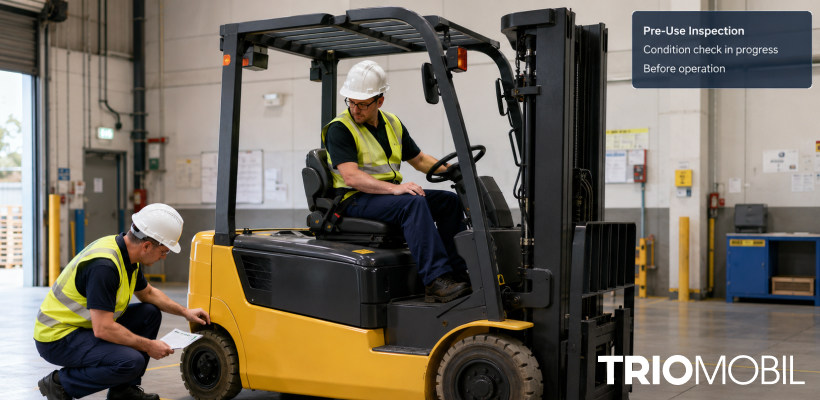
Powered industrial trucks must be examined before they are placed in service. OSHA requires these examinations at least daily and after each shift when trucks operate around the clock.
A specific paper checklist is not mandated by 29 CFR 1910.178.
OSHA has also clarified in its interpretation of powered industrial truck examination requirements that employers are responsible for ensuring trucks have been properly examined, but 29 CFR 1910.178 does not specifically require those examinations to be documented using a particular checklist format.
That distinction is important in 2026.
Some industry commentary describes digital inspections, timestamped forklift records or automated documentation as if OSHA now requires those technologies. The current federal forklift standard does not establish a blanket requirement for digital forklift inspection records.
Digital systems can still be useful for operational consistency, record accessibility and fleet management. They should be viewed as tools that support an organization’s safety process, rather than as technologies specifically mandated by OSHA.
What Does OSHA Require at Loading Docks?
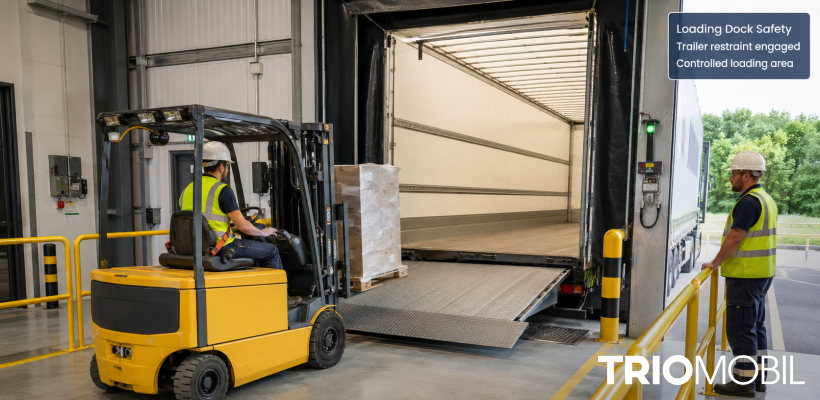
Loading docks combine vehicle movement, trailers, pedestrians, elevation changes and material handling within a relatively small operating area. OSHA therefore addresses several loading and unloading conditions within its powered industrial truck requirements.
The specific controls depend on the operation.
OSHA requirements and guidance address areas such as:
- Preventing highway trucks or trailers from moving during loading and unloading
- Supporting semitrailers where necessary to prevent upending
- Providing protection against railroad-car movement while dockboards or bridge plates are in place
- Using suitable dockboards and bridge plates
- Training forklift operators for the equipment and conditions involved in loading and unloading
OSHA’s loading and unloading resources also emphasize that operator training must account for the conditions present at the specific workplace.
This makes loading docks an important part of a broader forklift risk assessment, particularly where pedestrians, forklifts and external vehicles frequently interact.
What Is Not a New OSHA Forklift Requirement in 2026?
Several developments are being discussed alongside the 2026 regulations, but they should not be confused with requirements already in force.
Distinguishing regulation from emerging practice is especially important when safety teams are planning technology investments.
| Topic | Status in 2026 |
|---|---|
| 29 CFR 1910.178 forklift requirements | Existing and enforceable |
| Updated Warehousing and Distribution Center NEP | Effective July 31, 2026 |
| Mandatory digital forklift inspection records | Not a blanket OSHA requirement |
| Mandatory AI pedestrian detection | Not required by 29 CFR 1910.178 |
| Mandatory UWB proximity warning systems | Not required by 29 CFR 1910.178 |
| Powered Industrial Trucks Design Standard Update | Still listed at Final Rule Stage |
OSHA’s Powered Industrial Trucks Design Standard Update is particularly important to watch.
The proposed rule would modernize references to ANSI B56 standards, including standards covering certain driverless industrial vehicles. As of August 2026, however, OSHA’s Unified Agenda still lists the initiative at the Final Rule Stage. It should therefore not be presented as a new requirement already incorporated into 29 CFR 1910.178.
What Do the 2026 OSHA Penalties Mean for Forklift Safety?
According to OSHA's 2026 Annual Adjustments to OSHA Civil Penalties, the agency did not apply an inflation-based increase to its civil penalty maximums for 2026, so the 2025 maximum amounts remain in effect.
For 2026, maximum penalties include:
- Serious violation: $16,550 per violation
- Other-than-serious violation: $16,550 per violation
- Repeat violation: $165,514 per violation
- Willful violation: $165,514 per violation
- Failure to abate: up to $16,550 per day beyond the abatement date
OSHA’s May 2026 memorandum also reflects revised policies concerning certain penalty reductions and minimum penalties.
Penalties are only one reason forklift safety deserves attention.
Equipment damage, operational disruption, investigations, lost production and worker exposure can create consequences well beyond the citation itself.
That makes proactive risk visibility valuable even where no specific technology is required by regulation.
How Can Technology Support a Broader Forklift Safety Program?
Technology does not replace OSHA-required training, supervision, equipment maintenance or safe operating procedures.
It can, however, provide another layer of information about how forklift risk develops during real operations.
This is where systems such as Trio Safe AI, UWB proximity detection, AI-powered cameras and FleetBridge can support EHS and operations teams, depending on the facility and system configuration.
AI-Based Pedestrian Detection
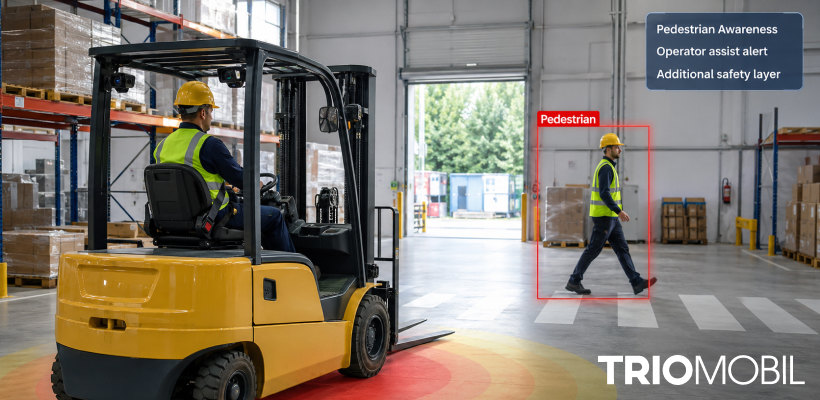
Forklift-mounted AI cameras can help identify pedestrians within their monitored field of view and generate configurable operator alerts when predefined risk conditions are detected.
This can support visibility around areas such as:
- Pedestrian crossings
- Loading areas
- Aisles
- Intersections
- Forklift travel routes
AI detection remains an operator-assist layer. Performance depends on camera placement, environmental conditions, configuration and the monitored field of view.
For a deeper look at this technology, see How Do Pedestrian Detection Forklift Cameras Work?
UWB Proximity Awareness
Ultra-Wideband technology can support proximity awareness between equipped forklifts, pedestrians or other compatible equipment.
Because UWB does not depend on direct visual line of sight between tagged devices, it can be useful in environments containing racking, walls or other visual obstructions.
Depending on configuration and compatible vehicle integration, systems can provide alerts and support configurable vehicle-response functions.
For operations considering multiple detection layers, see how AI and UWB can work together in forklift safety systems.
Operational Risk Monitoring
Individual warnings provide immediate information. Aggregated event data can provide something different: patterns.
Depending on the technologies deployed, safety teams may be able to examine:
- Recurring forklift-pedestrian interactions
- High-activity intersections
- Repeated proximity events
- Zone activity
- Vehicle utilization
- Traffic concentrations
- High-risk periods during a shift
This allows teams to investigate where exposure repeatedly develops and determine whether changes to traffic management, procedures, training or facility design should be considered.
A broader explanation of this approach is available in our guide to forklift monitoring systems.
How Should Safety Teams Prepare for the 2026 Enforcement Environment?
Preparation starts with understanding what the regulation actually requires and then evaluating how those requirements translate into everyday operations.
A practical review can consider several areas:
- Are operators currently trained, evaluated and certified for the trucks they use?
- Are workplace-specific hazards reflected in operator training?
- Are powered industrial trucks examined before being placed into service?
- Is defective equipment consistently removed from service?
- Are loading-dock and trailer controls appropriate for the operation?
- Are pedestrian and forklift traffic patterns periodically reassessed?
- Can recurring near misses or high-risk interactions be identified?
- Have layout or workflow changes introduced new operating conditions?
- Are safety controls being evaluated based on actual operational exposure?
The final question extends beyond minimum compliance.
Policies describe how an operation should work. Operational visibility helps safety teams understand how it is actually working.
From OSHA Requirements to Everyday Risk Visibility
The most important OSHA forklift development in 2026 is not a new requirement to install cameras, UWB systems or digital monitoring technology.
It is the continued focus on warehouse hazards through an updated national enforcement program that explicitly includes powered industrial vehicle operations.
Compliance starts with the fundamentals: competent operators, suitable equipment, proper examinations, safe operating practices and workplace-specific hazard controls. Stronger risk management builds from that foundation by making recurring exposure easier to understand.
Trio Mobil’s forklift safety technologies are designed to support that broader approach through configurable AI-based detection, UWB proximity awareness and operational risk data.
Contact our team to discuss how Trio Mobil can support greater forklift risk visibility across your operation.
Key Takeaways
The 2026 OSHA landscape is easier to understand when existing rules and new enforcement developments are considered separately.
- 29 CFR 1910.178 remains the primary OSHA standard governing powered industrial trucks.
- OSHA’s updated Warehousing and Distribution Center NEP became effective July 31, 2026.
- Powered industrial vehicle operations are specifically included within the NEP’s comprehensive inspection scope.
- Forklift operators must receive appropriate training and workplace evaluation, with performance evaluated at least once every three years.
- Powered industrial trucks must be examined before being placed in service, but OSHA does not mandate a particular paper or digital checklist format.
- AI cameras, UWB systems and digital monitoring are not blanket OSHA requirements for forklifts.
- Safety technology can support a broader risk-management program by helping teams identify recurring interactions and operating patterns.
Frequently Asked Questions
The core requirements of 29 CFR 1910.178 remain in place. The major 2026 development for warehouses is OSHA's updated Warehousing and Distribution Center National Emphasis Program, effective July 31, 2026, which includes powered industrial vehicle operations within comprehensive safety inspections.
OSHA requires each operator’s performance to be evaluated at least once every three years. Refresher training may be required sooner after events such as an accident, near miss, observed unsafe operation or significant change in workplace conditions.
Powered industrial trucks must be examined before being placed in service. OSHA specifies that examinations must occur at least daily and after each shift when trucks are used continuously.
No blanket provision in 29 CFR 1910.178 requires forklift inspection records to be digital. Digital systems may support documentation and fleet-management processes, but they should not be described as a universal OSHA technology requirement.
OSHA does not generally mandate AI cameras, UWB proximity systems or a specific forklift pedestrian-detection technology under 29 CFR 1910.178. These technologies can serve as additional operator-assist layers within a broader workplace safety strategy.
OSHA has proposed updating the powered industrial truck design standard to reference newer ANSI B56 standards. As of August 2026, OSHA's Unified Regulatory Agenda lists the initiative at the Final Rule Stage, so the proposed changes should not yet be described as requirements already in force.
These questions address some of the most common points of confusion surrounding OSHA forklift requirements in 2026.
Disclaimer: Trio Mobil solutions are operator-assist aids. They do not replace safe working practices or prevent all incidents. Performance depends on operating conditions and configuration; see product documentation.

Product Catalogue 2026
Download our catalog and gain access to a wealth of information on how to enhance industrial safety and efficiency. Our latest catalog features a diverse range of products and services that can help you achieve your goals.

Our Latest Blogs


Learn more about Trio Mobil's Solutions
Fill out the form and we'll contact you!