


Trio Mobil Global Technology Innovation Leader in AI-Based Industrial Safety
Read the Frost & Sullivan Analysis

Forklift Blind Spot Detection: A 2026 Guide to UWB-Based Systems
 Sep 04, 2026
 4 min
4 min 444
444
A forklift blind spot is more than an area the operator cannot see. It is a moving risk zone shaped by the load, vehicle direction, aisle layout, and surrounding traffic.
Mirrors, floor markings, horns, spotters, and operator training remain essential. However, each measure depends on the hazard becoming visible or being recognized at the right moment.
UWB-based blind spot detection adds another layer of awareness. As part of a forklift safety and pedestrian collision avoidance system, it can identify a tagged pedestrian or vehicle near a forklift even when shelving, loads, walls, or equipment block the operator’s direct view.
This guide explains how UWB forklift blind spot detection works, where it adds value, its limitations, and what safety teams should evaluate when selecting a system in 2026.
What Is a UWB Forklift Blind Spot Detection System?
A UWB forklift blind spot detection system is an operator-assist technology that uses ultra-wideband radio signals to measure proximity between equipped forklifts, pedestrians, and other mobile assets.
When two configured devices enter a predefined distance threshold, the system can issue alerts. Where compatible vehicle integration is enabled, it may also support a controlled response such as speed reduction.
A typical system includes:
- Forklift-mounted units: Devices that communicate with nearby tags or vehicle units.
- Pedestrian tags: Wearable devices that identify equipped employees.
- Vehicle units: Devices that support forklift-to-forklift awareness.
- Configurable zones: Thresholds for early awareness and higher-risk proximity.
- Real-time alerts: Audible, visual, or vibration warnings.
- Optional control outputs: Connections to compatible vehicle or site controls.
- Event records: Data showing repeated exposure by location, shift, or vehicle.
UWB does not require an optical view of the pedestrian tag to measure proximity. This is central to its value in blind-spot scenarios.
Why Forklift Blind Spots Require Additional Awareness
Forklift visibility changes throughout every movement. A route that appears clear while the truck is unloaded may become obstructed once a pallet is lifted or carried.
Common sources of blind-spot exposure include:
- The load: Tall, wide, or irregular loads can block the operator’s forward view.
- Vehicle structure: The mast, cab, overhead guard, and attachments can limit sightlines.
- Rear swing: The counterweight moves laterally during turns.
- Racking and inventory: Shelving, pallets, and stored materials can hide approaching traffic.
- Cross aisles and doorways: People and vehicles may enter a shared path with little warning.
- Temporary changes: Staged materials or parked equipment can create new blind spots during a shift.
OSHA requires operators to slow down and sound the horn at cross aisles and other locations where vision is obstructed. Its guidance also recommends using a spotter when the operator’s view is blocked and proceeding cautiously around dangerous blind spots.
These practices remain fundamental. UWB can strengthen them by providing another signal when an equipped person or vehicle is nearby but hidden from view.
Blind spots are only one part of the facility risk landscape. Our Invisible Risk Map identifies 10 areas where forklift risk often hides, including intersections, racking zones, doorways, and shared traffic routes.
How Does UWB Forklift Blind Spot Detection Work?
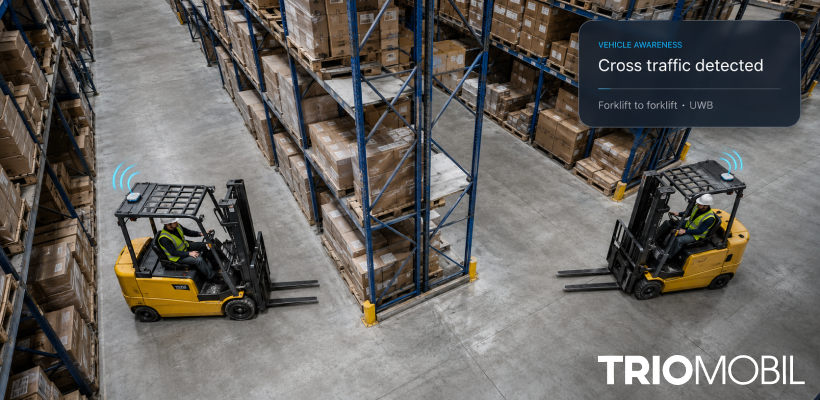
UWB systems exchange short radio pulses between compatible devices to estimate distance. Performance depends on system design, device placement, calibration, and the operating environment.
1. Forklifts and pedestrians are equipped
A UWB unit is installed on the forklift, while employees carry compatible pedestrian tags. Other forklifts may also be equipped for vehicle-to-vehicle awareness.
Because coverage depends on active devices, sites need a reliable process for assigning, charging, inspecting, and replacing tags.
2. Devices measure proximity
The forklift unit exchanges signals with nearby tags or vehicle units. The system uses these exchanges to estimate the distance between them.
Unlike a camera, UWB does not identify a person from an image. It recognizes and ranges a compatible electronic device.
3. Thresholds trigger defined responses
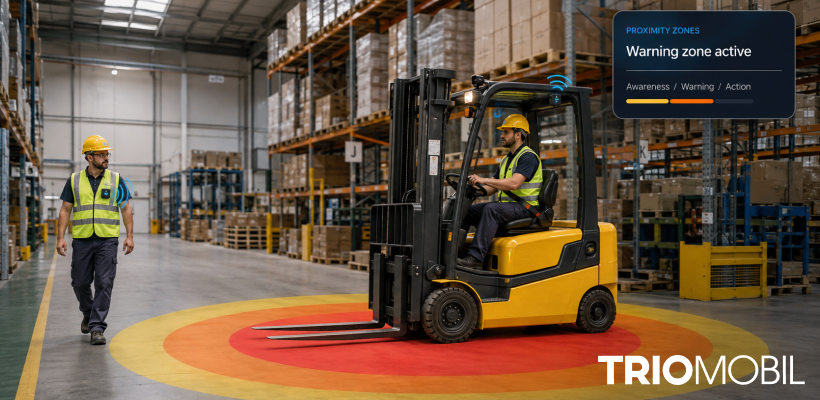
The system compares measured proximity with configured thresholds. Deployments may use multiple zones so warnings escalate as distance closes.
- Awareness zone: An early notification that an equipped person or vehicle is nearby.
- Warning zone: A more urgent alert at closer proximity.
- Action zone: An optional output for a compatible vehicle or site-control response.
Thresholds should reflect vehicle speed, stopping behavior, loads, traffic direction, and site layout. A proximity threshold should never be treated as a universal safe stopping distance.
Where speed-control integration is required, our guide to zone-based forklift speed control explains how location-specific rules can support safer operation in high-risk areas.
4. Events become safety data
Connected systems can record proximity events for analysis. Forklift tracking and monitoring can help safety teams identify recurring exposure by intersection, shift, vehicle, or time of day and use those findings to adjust routes, layouts, procedures, or training.
Where Do UWB Blind Spot Systems Add the Most Value?
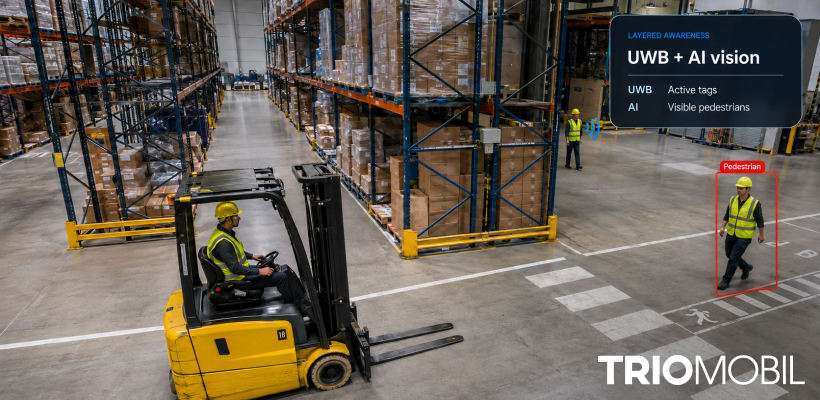
UWB is especially valuable where a known population of workers or vehicles must be detected despite obstructed sightlines. Its strength is proximity awareness between properly equipped devices.
Blind intersections and cross aisles
Racking, walls, and stored materials may prevent an operator and pedestrian from seeing one another. UWB can provide earlier warning when the pedestrian is tagged and enters the configured range.
Doorways and narrow passages
Doorways restrict visibility and compress traffic. A tagged pedestrian approaching from the other side of a wall can remain within the UWB awareness layer while visually hidden.
Dense storage and production areas
Stored goods, machinery, and equipment create changing sightlines. UWB can support awareness when equipped pedestrians or vehicles move close to an active forklift.
Forklift-to-forklift approaches
Two forklifts may approach the same corner without a clear line of sight. Vehicle-mounted UWB units can provide proximity alerts between equipped forklifts, subject to system configuration and operating conditions.
For a closer look at this application, see our guide to forklift-to-forklift collision avoidance systems and implementation practices.
UWB vs. AI Cameras for Forklift Blind Spot Detection
UWB and AI cameras address different scenarios. UWB measures proximity between compatible devices, while an AI camera analyzes its monitored field of view to identify a person or another trained object class.
| Evaluation area | UWB-based detection | AI camera detection |
|---|---|---|
| Detection method | Measures proximity between equipped devices | Analyzes images within the camera view |
| Line of sight | Can detect an equipped device despite visual obstruction | Requires the target to be visible within the monitored view |
| Pedestrian tags | Required | Usually not required for human detection |
| Visitors and contractors | Covered only when carrying a compatible active tag | May be detected without a tag when visible |
| Event context | Provides proximity data | Can provide visual context, subject to privacy settings |
| Primary limitation | Untagged people are outside the layer | Occlusion, lighting, and field of view can affect detection |
Many facilities combine the two because their coverage gaps differ. Layered AI and UWB forklift safety systems can bring tag-based proximity awareness and tagless visual detection into a broader safety strategy, while AI risk monitoring can help teams recognize recurring high-risk interactions across the facility.
What Are the Limitations of UWB Blind Spot Detection?
Understanding system limitations is essential when evaluating technical fit. UWB should operate as one layer within a broader forklift safety program.
- Untagged pedestrians remain outside the tag-based layer: Visitors, contractors, or employees without active tags will not be detected through UWB ranging.
- Proximity does not provide full scene context: UWB does not inherently show whether a person is behind a protective barrier or moving away.
- Tag discipline matters: Missing, damaged, uncharged, or incorrectly assigned tags can reduce coverage.
- Site conditions affect performance: Metal structures, mounting position, antenna orientation, and configuration may influence ranging.
- Traffic controls remain necessary: Training, separation, signage, mirrors, horns, and safe-speed rules continue to play essential roles.
These limits define how UWB should be designed, tested, and combined with other controls.
Does OSHA Require UWB Forklift Blind Spot Detection?
OSHA does not specifically require employers to install UWB forklift blind spot detection. Its powered industrial truck standard addresses safe operation, training, visibility, vehicle condition, and workplace hazards.
Under 29 CFR 1910.178, operators must slow down and sound the horn at cross aisles and other locations where vision is obstructed. When a load obstructs the forward view, the standard generally requires traveling with the load trailing.
OSHA’s forklift traveling and maneuvering guidance also advises operators to ensure the path is clear, use a horn or spotter when the view is obstructed, and proceed cautiously around blind spots.
UWB can support these controls by improving awareness of equipped people and vehicles. It does not establish compliance on its own or replace required training and safe operating practices.
How Trio Mobil Supports UWB-Based Blind Spot Awareness
Trio Mobil uses UWB as part of a configurable forklift and pedestrian safety architecture. The design depends on the layout, vehicle types, traffic rules, worker population, and required response logic.
TRIO SAFE UWB proximity detection
TRIO SAFE forklift safety solutions can use forklift-mounted units and compatible pedestrian or vehicle tags to support awareness where direct sightlines are obstructed.
Configurable zones can trigger operator warnings and pedestrian alerts. When connected to compatible vehicle controls, defined thresholds may also support speed-reduction actions. Actual behavior depends on vehicle compatibility, installation, configuration, and validation.
Trio Safe AI as a complementary layer
Trio Safe AI can add camera-based pedestrian detection within the monitored field of view. This supports awareness of visible people who may not carry a tag, subject to camera placement and operating conditions.
Combining UWB and AI can help address obstructed tag-based interactions and visible tagless scenarios. For a wider comparison read our 2026 forklift safety technology decision guide blog. Connected event data can also reveal repeated exposure across intersections, shifts, and vehicles. FleetBridge forklift fleet management adds visibility into vehicle activity and utilization, while SIF prevention intelligence helps teams connect recurring exposure patterns with serious-injury prevention priorities.
How to Choose a UWB Forklift Safety System in 2026
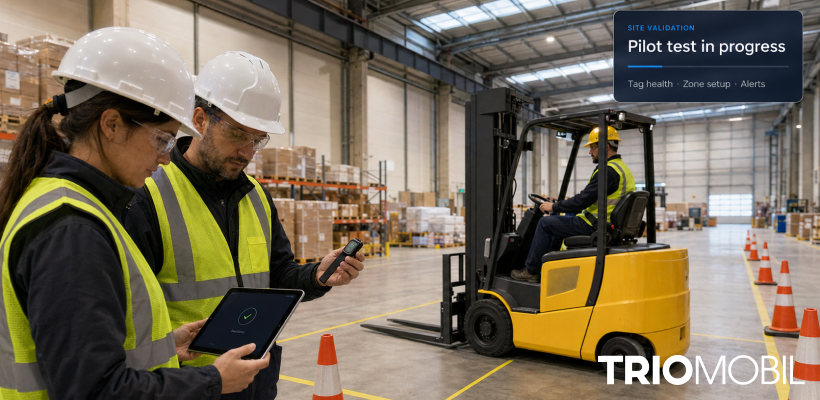
The right system should match the site’s real interaction patterns. A site survey and controlled pilot can show whether the detection geometry, alerts, and tag processes are practical.
Evaluate these questions:
- Who needs to be detected? Does coverage include employees, visitors, contractors, and drivers?
- Which interactions matter most? Is the priority forklift-to-pedestrian, forklift-to-forklift, or both?
- How does it perform on site? Has it been tested around racking, machinery, walls, and dense traffic?
- Can warning zones be configured independently? Can early awareness be separated from urgent warnings and optional actions?
- How are nuisance alerts managed? Can thresholds be optimized without weakening meaningful coverage?
- How are tags maintained? Who assigns, charges, inspects, replaces, and audits them?
- Is device health visible? Can teams identify low batteries or offline units?
- Can it integrate with the fleet? Which forklift models and control interfaces are supported?
- Can event data be analyzed? Does the system reveal recurring exposure by zone, shift, and vehicle?
- Can it scale? Are configuration, maintenance, reporting, and local ownership manageable across sites?
For a wider comparison of detection approaches, deployment considerations, and selection criteria, see our Forklift Pedestrian Detection Systems Buyer’s Guide.
From Hidden Proximity to Actionable Awareness
A blind spot becomes more manageable when an equipped person or vehicle within it can be identified early enough to support a response. UWB creates that additional awareness without depending on direct optical visibility.
Its effectiveness depends on disciplined tag use, site-specific configuration, validated alerts, and integration with established safety controls. Combined with AI vision, traffic management, training, and event analysis, it can contribute to a more complete approach to forklift risk.
Contact our team to discuss how UWB-based forklift blind spot detection could be configured for your facility’s vehicles, traffic patterns, and high-risk zones.
Key Takeaways
The following points summarize what safety teams should know before evaluating a UWB blind spot system.
- UWB measures proximity between equipped devices, even when direct sightlines are obstructed.
- Pedestrian tags define the detection population, so tag management is essential.
- Warning zones require site-specific configuration based on speed, layout, loads, and operating conditions.
- UWB and AI cameras cover different scenarios and can strengthen awareness when deployed together.
- OSHA does not mandate UWB, and the technology does not replace required training or safe operation.
- Event data can expose recurring blind-spot interactions and support targeted improvements.
Frequently Asked Questions
UWB can support proximity awareness without direct optical line of sight when the pedestrian carries a compatible active tag. Performance depends on the obstruction, device placement, signal environment, and configuration, so the scenario should be validated on site.
Every person who must be covered by the tag-based layer needs a compatible active tag. AI cameras can add coverage for visible pedestrians without tags within their monitored field of view.
Some systems can provide an output for speed-reduction actions when integrated with compatible vehicle controls. Functionality depends on the forklift, installation, configuration, and validation.
Accuracy varies by system architecture, device placement, tag position, and operating environment. Buyers should request testing under representative site conditions rather than relying on one nominal figure.
No. UWB is an operator-assist layer. Mirrors, horns, spotters, traffic separation, safe speeds, training, and other site controls remain necessary.
These answers address common questions about UWB forklift blind spot detection.
Disclaimer: Trio Mobil solutions are operator-assist aids. They do not replace safe working practices or prevent all incidents. Performance depends on operating conditions and configuration; see product documentation.

Product Catalogue 2026
Download our catalog and gain access to a wealth of information on how to enhance industrial safety and efficiency. Our latest catalog features a diverse range of products and services that can help you achieve your goals.
Our Latest Blogs


Learn more about Trio Mobil's Solutions
Fill out the form and we'll contact you!