


Trio Mobil Global Technology Innovation Leader in AI-Based Industrial Safety
Read the Frost & Sullivan Analysis

What Is AI for Workplace Safety? Revolutionizing Accident Prevention with Smart Technology
 Sep 11, 2026
 5 min
5 min 501
501
AI for workplace safety is the use of artificial intelligence to analyze information from cameras, sensors, and operational records to help identify hazards and support risk reduction. Depending on the application, it can flag selected conditions, assist with event review, or help teams prioritize corrective actions.
In a busy industrial facility, exposure changes throughout the day. A temporary staging area narrows a walkway, a forklift approaches a crossing, or materials accumulate near an emergency route. Inspections and employee observations provide essential context; connected monitoring can add visibility between those observations.
The practical opportunity is to recognize relevant conditions earlier and give people useful information to act on. This guide explains the main applications, their role in accident prevention, and the decisions that make AI useful within an established safety program.
How Does AI for Workplace Safety Work?

AI systems apply trained models to incoming information and produce outputs such as object detections, event classifications, or risk indicators. The equipment, data sources, and response rules determine what each deployment can support.
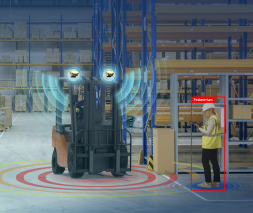
A camera-based application may identify a person within its monitored field of view. Configured logic can then assess whether that person has entered a defined vehicle operating zone. The resulting event may appear in a dashboard or trigger a warning, depending on the system design.
These stages should be evaluated separately. Detection, interpretation, and response each require validation. Recognizing a pedestrian does not establish their intent, a near miss, or the correct response for every situation.
| Application | Potential contribution | What to verify |
|---|---|---|
| Computer vision | Identify selected visible conditions and interactions. | Camera coverage, lighting, occlusion, and validated detection classes. |
| Sensor analytics | Analyze supported equipment or exposure measurements. | Sensor accuracy, available inputs, and operating limits. |
| Pattern analysis | Group recurring events and highlight trends. | Event definitions, comparable exposure, and data completeness. |
| Generative AI | Assist with summaries or draft reports. | Source traceability and qualified human review. |
These tools have different roles. A text assistant used to summarize records should not be assumed suitable for time-critical equipment control.
Where Can AI Support Industrial Workplace Safety?

Useful applications begin with a specific hazard and a realistic monitoring boundary. In warehouses, manufacturing plants, and logistics facilities, several recurring situations provide practical starting points.
Forklift and Pedestrian Interactions
Vehicle-mounted or fixed-camera systems can support awareness of pedestrians and equipment within their validated coverage. Depending on configuration, alerts may help operators or nearby workers recognize a developing interaction.
UWB proximity sensing can complement camera-based detection by measuring proximity between equipped devices. Coverage and performance still depend on deployment conditions. The article on layered AI and UWB forklift safety systems explains how these technologies can support different operating scenarios.
Work Zones, Access Routes, and Visible Conditions
Configured video analytics can flag selected conditions such as an object occupying a monitored emergency route, presence in a defined restricted area, or apparent gaps in specified PPE. Each use case requires suitable views, clear rules, and local testing.
A visual PPE detection cannot establish whether equipment fits correctly or provides the protection a task requires. Similarly, identifying a person near machinery does not replace the assessment, guarding, or isolation measures appropriate to that equipment.
Recurring Exposure and Event Review
Event records can help EHS teams examine where and when selected conditions repeat. Reviewing the sequence around an alert may reveal congestion, temporary storage, or workflow changes that deserve attention.
For a wider view of possible monitoring categories, see what a real-time AI safety platform can monitor. A deployment should prioritize relevant, validated scenarios rather than treating the number of available categories as a measure of effectiveness.
How Does AI Contribute to Accident Prevention?

AI contributes when its outputs inform an effective response or a lasting reduction in exposure. That requires a connection between the event being monitored, the people reviewing it, and the controls available to them.
Consider a hypothetical warehouse where reviewed video events show pedestrians repeatedly entering a vehicle route because temporary stock obstructs their walkway. The team could relocate staging, restore the walking route, and review whether the same interactions continue. Monitoring provides evidence for a practical operational change.
The NIOSH hierarchy of controls prioritizes elimination, substitution, and engineering controls ahead of administrative controls and PPE. Applying that hierarchy means considering how to remove or separate exposure while assessing where AI-assisted monitoring and warnings can add support.
Benefits worth evaluating include earlier awareness of selected hazards, more consistent event documentation, and clearer priorities for corrective action. The value of each benefit should be demonstrated in the facility’s operating conditions.
Measure outcomes with context. Track verified events, response time, recurring locations, and corrective-action completion. For forklift comparisons, events per 100 ignition-on hours can be useful when that denominator is explicitly defined and applied consistently; it should not be described as productive working time.
A higher alert count after installation may reflect wider coverage or changed sensitivity. Review comparable periods, monitored areas, and detection settings before interpreting the change as a shift in risk.
What Are the Limits of AI Safety Technology?
AI performance depends on the task, operating environment, and quality of the available information. A useful evaluation documents both the conditions the system handles and those it may miss.
Camera placement, changing illumination, obstructed views, and dirty lenses can affect visual monitoring. Site tests should assess false alerts and missed events across representative conditions. A single accuracy percentage gives limited guidance unless the supplier explains the test conditions, event categories, and measurement method.
The NIST AI Risk Management Framework provides voluntary guidance for managing AI risks. For a workplace deployment, a practical application is to assign ownership, document intended use, assess performance, and review changes throughout operation.
Worker involvement also matters. EU-OSHA’s research on digitalisation identifies opportunities for monitoring alongside concerns about privacy, effectiveness, and work organization. Explain what information is collected, how it supports safety, who can access it, and how workers can question an interpretation.
NIOSH’s 2026 discussion of workplace AI hazards emphasizes applying established hazard-assessment principles to AI itself. Include potential effects on work practices and reliance on alerts in the assessment, along with software and equipment behavior.
How Trio Mobil Supports AI-Based Workplace Safety
Trio Mobil’s AI risk monitoring solution uses video analytics to support visibility into selected workplace conditions. AI Risk Radar brings configured detections into a central dashboard to assist EHS review, subject to camera compatibility, coverage, and deployment conditions.
Published monitoring applications include pedestrian-vehicle interactions, specified PPE gaps, and obstruction of emergency routes. For each application, teams should agree on the monitored area, event definition, and review process before using the outputs to guide decisions.
For mobile equipment, Trio Mobil’s forklift collision avoidance and pedestrian safety solutions combine AI vision and UWB proximity options. Depending on the installation, these can support configured warnings and speed-control responses where compatible vehicle integration is enabled.
Camera-based sensing requires a suitable view, while UWB proximity functions require equipped devices and appropriate installation. These operator-assist capabilities form one layer within a broader safety strategy.
How Should a Facility Introduce AI for Workplace Safety?

Begin with a clearly defined use case and an agreed review process. A representative pilot should assess technical performance, operational usefulness, and the team’s ability to act on the information.
- Choose the hazard: Identify a meaningful exposure, such as repeated pedestrian presence in a vehicle crossing.
- Define acceptance criteria: Specify coverage, acceptable alert quality, review responsibilities, and how missed events will be assessed.
- Test operating conditions: Include relevant shifts, lighting, traffic, and temporary layout changes using safely planned validation.
- Connect events to action: Assign owners, escalation rules, completion dates, and follow-up checks.
- Review before scaling: Confirm that the information improves decisions and that each additional site can support the required configuration.
OSHA’s hazard prevention and control guidance recommends worker involvement, assigned responsibilities, and follow-up to verify control effectiveness. These practices provide a useful foundation for incorporating AI outputs into existing safety management.
For organizations moving beyond a pilot, the article on turning AI safety pilots into sustained operational practice explores ownership and adoption. Expansion should preserve clear accountability while allowing for differences between facilities.
Make Earlier Visibility Part of Everyday Safety
AI for workplace safety can help teams identify selected risks earlier and make better-informed prevention decisions. Its contribution grows when reliable monitoring is connected to practical controls, worker participation, and consistent follow-through.
Contact our team to explore how Trio Mobil can support AI-based risk visibility and operator assistance across your facilities.
Key Takeaways
These principles help organizations assess AI safety applications and turn useful information into action.
- Defined purpose: Select AI applications around specific workplace hazards.
- Validated coverage: Confirm detection performance under actual operating conditions.
- Appropriate controls: Use monitoring within a broader hazard-control strategy.
- Human review: Interpret events with context before assigning classifications or responsibility.
- Meaningful measures: Compare verified events using consistent coverage and exposure definitions.
- Shared ownership: Connect EHS, operations, IT, maintenance, and workers throughout deployment.
Frequently Asked Questions
One example is video analytics that flags a pedestrian entering a defined vehicle operating zone within a monitored camera view. Depending on configuration, the event can support review or trigger a warning.
No. AI can support hazard recognition and risk reduction within its validated scope. Effective controls, training, supervision, maintenance, and safe working practices remain essential.
Some solutions can analyze compatible existing camera feeds. Suitability depends on image quality, camera position, connectivity, and the specific condition being monitored, so a site assessment is necessary.
No. Many applications assess objects, positions, or interactions without identifying a person’s face. Buyers should confirm the chosen system’s data processing, access controls, and privacy configuration.
Assess detection quality, verified exposure patterns, response times, and completed corrective actions. Compare consistent operating conditions and monitor data gaps; alert volume alone is insufficient evidence of improved safety.
The following answers address common questions about using AI in workplace safety programs.
Disclaimer: Trio Mobil solutions are operator-assist aids. They do not replace safe working practices or prevent all incidents. Performance depends on operating conditions and configuration; see product documentation.

Product Catalogue 2026
Download our catalog and gain access to a wealth of information on how to enhance industrial safety and efficiency. Our latest catalog features a diverse range of products and services that can help you achieve your goals.
Our Latest Blogs


Learn more about Trio Mobil's Solutions
Fill out the form and we'll contact you!