

Trio Mobil Global Technology Innovation Leader in AI-Based Industrial Safety
Read the Frost & Sullivan Analysis

What Is Forklift Telematics and Why It’s a Game Changer for Forklift Fleet Management and Safety
 Sep 11, 2026
 5 min
5 min 478
478
Forklift telematics combines connected devices and software to collect, transmit, and interpret data about forklift use, condition, and selected safety events. It gives fleet and EHS teams a shared basis for understanding how equipment operates across shifts.
A warehouse can experience equipment shortages during dispatch while other trucks remain available elsewhere. Maintenance records, inspections, and supervisors’ observations each reveal part of this picture. Bringing those records together with vehicle data can help teams investigate the underlying causes.
The value comes from connecting a measured condition to a practical decision: reallocating a truck, reviewing a recurring impact, or arranging service. This guide explains how forklift telematics works, which metrics matter, and how to introduce it into fleet management and safety programs.
How Does Forklift Telematics Work?
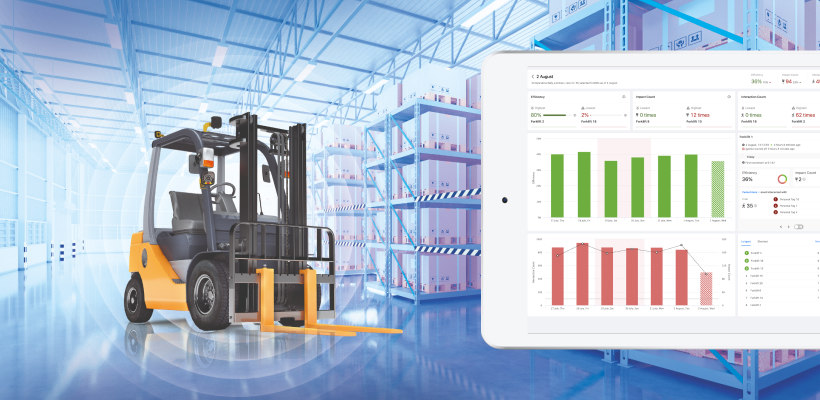
A typical deployment connects vehicle-mounted devices to a software platform through a communications gateway. Available measurements depend on installed sensors, vehicle interfaces, connectivity, and enabled software features.
The workflow has three main stages: capturing equipment signals, transmitting records, and presenting them as reports or alerts. During evaluation, ask which functions operate locally and which depend on a network connection, along with how delayed or missing records appear.
Telemetry usually describes the measurement and transmission of data; telematics commonly includes the wider connected management system. Suppliers sometimes use these terms interchangeably, so buyers should compare actual functions. Trio Mobil’s guide to forklift telemetry and safety explores the operational signals behind this approach.
Location tracking requires particular attention indoors. If aisle-level location is required, ask the supplier to demonstrate its proposed indoor positioning method in the actual facility.
Which Forklift Telematics Metrics Matter?
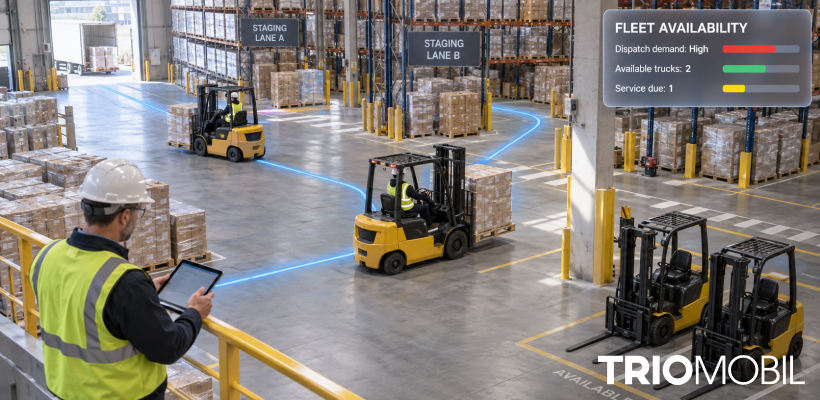
Useful metrics have clear definitions and a decision attached to them. Start with the questions operations, maintenance, and EHS teams need to answer, then verify that the proposed configuration can provide the necessary measurements.
| Metric | Meaning and use |
|---|---|
| Ignition-on hours | Time with ignition enabled; a defined exposure measure for comparing activity. |
| Movement time | Time the truck is moving; useful for reviewing travel and allocation. |
| Productive time | Time meeting an agreed work definition; requires suitable task or load information. |
| Impact alerts | Threshold-triggered sensor events; prompts for inspection and contextual review. |
| Inspection records | Completed checks and reported defects; inputs to maintenance follow-up. |
Ignition-on time, movement time, and productive time measure different things. A truck can remain powered while waiting for a dock, and movement can include necessary empty travel. Reports should explain these distinctions before assigning utilization targets.
Where suitable vehicle interfaces are available, additional battery or diagnostic data may support maintenance analysis. Confirm coverage for each truck model and identify unavailable fields rather than assuming every asset produces the same dataset.
For event comparisons, define the denominator. As an illustrative calculation, 12 verified events over 600 ignition-on hours equals two events per 100 ignition-on hours. Compare similar duties and operating conditions, and keep event definitions and detection settings consistent.
How Does Telematics Improve Forklift Fleet Management?

Telematics can support allocation, service planning, and investment decisions when teams interpret the data alongside workload and site conditions. The following applications provide practical starting points.
Match Equipment Availability to Demand
Review activity by truck type, department, and shift before changing fleet size. An underused specialist truck may be essential for a particular task, while a heavily used truck may be compensating for poor allocation or unavailable equipment.
Consider a hypothetical dispatch area where trucks queue each afternoon. Compare vehicle activity with dock availability and shipment timing, then test a scheduling change. Assess waiting time and throughput together before concluding that additional trucks are needed.
Connect Maintenance to Actual Use
Operating-hour records and inspected impact events can help teams prioritize service within the manufacturer’s maintenance requirements. Link relevant findings to a work order, responsible person, and confirmation that the issue was addressed.
For this use case, the article on forklift telematics in preventive maintenance provides related background. When assessing a platform, distinguish scheduled service reminders from condition monitoring and validated failure prediction; ask the supplier to demonstrate each claimed function.
Build a Measurable Business Case
Use a baseline covering repair spending, downtime, rental costs, and time spent preparing fleet reports. Compare these measures after implementation against similar workload periods, and separate changes attributable to the project from wider operational changes.
Include hardware, subscriptions, installation, integration, and ongoing administration in the cost assessment. Trio Mobil’s discussion of cost-effective forklift fleet management connects these considerations to broader fleet planning.
How Can Telematics Support Forklift Safety?
Safety value depends on the quality of the recorded events and the response they trigger. A useful review process combines sensor records with inspections, operating context, and conversations with the people involved.
An impact alert may warrant an immediate equipment check, depending on severity and site procedures. Review the threshold, mounting, surface conditions, and findings before classifying it as a collision. A recorded alert alone does not establish damage, responsibility, or the complete event sequence.
Look for patterns across locations and tasks. Repeated events at a floor transition may justify a surface inspection; repeated congestion may call for changes to staging or traffic flow. This approach helps teams address working conditions and support operators without drawing unsupported conclusions about individual performance.
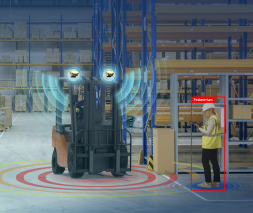
Access controls and digital checklists can support established procedures when correctly configured and maintained. Pedestrian detection and proximity warnings require appropriate sensing technology; basic utilization reporting alone does not establish that those functions are included.
For U.S. general-industry operations within its scope, OSHA 29 CFR 1910.178(q)(7) requires examinations before service, at least daily, and after each shift for round-the-clock use. Defects must be reported and corrected. Paragraph (p)(1) requires unsafe or defective trucks to be removed from service until restored to safe condition.
Telematics can help organize supporting records, depending on configuration. These provisions do not prescribe a telematics platform. A completed digital form cannot substitute for the examination itself, and a reduced-speed setting is insufficient when a truck must be removed from service.
How Trio Mobil Connects Fleet Visibility and Safety
Trio Mobil’s FleetBridge forklift fleet management solution brings operational reporting and selected management functions into a connected platform. Its published capabilities include the following, subject to vehicle integration and deployment configuration.
- Efficiency reporting: Review activity and utilization trends across vehicles, facilities, and shifts.
- Impact management: Use configured impact alerts and related records to support investigation.
- Operator access control: Support authorization procedures through NFC-based access functionality.
- Pre-operation checklists: Record responses and support follow-up through configured workflows.
For operations requiring additional sensing, Trio Mobil’s forklift collision avoidance and pedestrian safety solutions offer AI vision and UWB proximity technologies. AI detection depends on camera coverage and conditions; UWB proximity depends on equipped devices and deployment conditions. Configured alerts, and speed-control functions where compatible integration is enabled, support a broader safety program.
Define the relationship between reporting and operational response during project design. The agreed scope should identify which events reach managers, which warnings reach operators, and which vehicle functions have been validated for the installation.
How to Introduce Forklift Telematics Successfully
Start with a representative pilot and a small set of measurable objectives. Include EHS, operations, maintenance, IT, and operators so technical settings reflect how the facility works.
- Define the baseline: Agree on time measures, event categories, workload context, and success criteria.
- Validate coverage: Check data availability by vehicle, connectivity across work areas, and visibility of data gaps.
- Assign responses: Specify who reviews alerts, who inspects equipment, and how corrective actions are closed.
- Explain data use: Clarify what is collected, who can access it, and how long records are retained.
- Review before expansion: Confirm useful reporting, manageable alert volumes, and consistent procedures across shifts.
Evaluate outcomes alongside adoption. A dashboard may show frequent events while corrective actions remain open. Review both exposure and response completion, then adjust workflows before expanding the deployment.
Turn Forklift Data Into Better Daily Decisions
Forklift telematics creates value when reliable measurements lead to timely, informed action. Clear definitions, appropriate technology, and shared ownership help fleet and safety teams use the same evidence to improve daily operations.
Request a demo from our solution experts to explore a forklift telematics configuration that supports your fleet management and safety priorities.
Key Takeaways
These principles help teams evaluate forklift telematics and use its outputs responsibly.
- Connected visibility: Telematics combines equipment data, communications, and management software.
- Defined metrics: Ignition-on, movement, and productive time require separate definitions.
- Practical decisions: Allocation and maintenance improvements depend on context and follow-through.
- Reviewed events: Impact alerts require investigation before incident classification.
- Appropriate coverage: Pedestrian sensing and control functions depend on the deployed configuration.
- Shared ownership: Effective programs connect EHS, operations, maintenance, IT, and operators.
Frequently Asked Questions
Forklift telematics supports decisions about equipment use, maintenance, and selected safety events. Available functions depend on the installed devices, vehicle interfaces, and software configuration.
Yes, appropriately designed systems can collect and transmit equipment data indoors. Precise indoor location is a separate requirement that should be demonstrated under the facility’s operating conditions.
No. Telematics can support investigation and risk management, while compatible sensing systems may provide warnings or configured control responses within their operating limits. Safe working practices and supervision remain essential.
OSHA 29 CFR 1910.178 does not mandate a telematics platform. It establishes applicable requirements including operator training and evaluation under paragraph (l), alongside inspection, maintenance, and safe operation duties.
Retrofit options depend on the solution and the vehicles involved. Confirm compatibility, supported measurements, installation requirements, and any proposed control integration for each model before rollout.
These answers address common questions about forklift telematics and its role in fleet management.
Disclaimer: Trio Mobil solutions are operator-assist aids. They do not replace safe working practices or prevent all incidents. Performance depends on operating conditions and configuration; see product documentation.

Product Catalogue 2026
Download our catalog and gain access to a wealth of information on how to enhance industrial safety and efficiency. Our latest catalog features a diverse range of products and services that can help you achieve your goals.
Our Latest Blogs


Learn more about Trio Mobil's Solutions
Fill out the form and we'll contact you!