

Trio Mobil Global Technology Innovation Leader in AI-Based Industrial Safety
Read the Frost & Sullivan Analysis

What Does a Real-Time AI Safety Platform Actually Monitor? A 100-Risk-Category Breakdown
 Apr 10, 2026
 5 min
5 min 405
405
Industrial safety is no longer limited by what gets reported. It is limited by what gets seen.
Across complex industrial environments, risk does not appear suddenly. It develops through patterns, interactions, and small deviations that often go unnoticed. Traditional safety systems capture incidents after they occur. Real-time AI safety platforms are designed to capture exposure while it is still forming.
This shift changes a fundamental question. Not “What happened?”, but “What is happening right now across the operation?”
To answer that, a modern AI safety platform must monitor risk across dozens of categories simultaneously. In practice, this expands into a structured, multi-layered risk architecture that can easily exceed 100 distinct risk signals.
In this article, we will explore what a real-time AI safety platform actually monitors, how these risk categories are structured, and why this level of visibility is essential for managing exposure in modern industrial operations.
What Is a Real-Time AI Safety Platform?
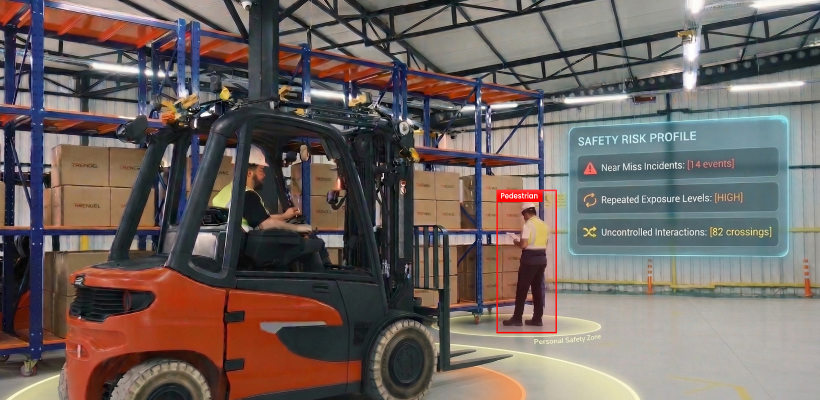
A real-time AI safety platform is a system that continuously monitors operational environments using AI vision, IoT sensors, and spatial technologies such as UWB to detect, analyze, and respond to safety-critical conditions as they occur.
It does not rely on incident reports or manual observations. It creates continuous visibility into risk exposure across people, vehicles, equipment, and the environment.
At its core, it answers three questions in real time:
- Where is risk forming?
- Who or what is involved?
- How severe is the exposure?
Why Risk Monitoring Requires 100+ Categories
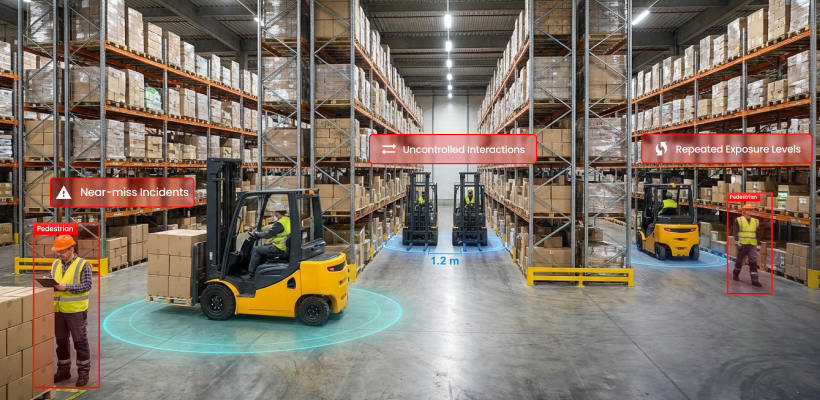
Industrial environments are dynamic systems. Risk is not a single variable. It is the result of multiple interacting factors.
A forklift moving at speed is not inherently unsafe.
A pedestrian walking nearby is not inherently unsafe.
The risk emerges from the interaction.
To capture this, AI systems must monitor combinations, not just events.
This leads to a structured expansion of risk categories:
- Behavior-based risks: Risks arising from how individuals act and move within the environment, including unsafe habits, lack of awareness, or non-compliant behavior.
- Interaction-based risks: Risks created when multiple entities such as pedestrians and vehicles come into proximity or intersect in ways that increase the likelihood of unsafe outcomes.
- Environmental risks: Risks influenced by physical conditions and layout, such as blind spots, congestion zones, or limited visibility areas.
- Equipment state risks: Risks related to how machines are being operated or their current condition, including speed, maneuvering patterns, or improper usage.
- Process deviation risks: Risks that emerge when operations do not follow defined workflows, leading to inconsistent or unsafe execution of tasks.
When these are broken down into measurable signals, the number quickly scales beyond 100 distinct categories.
The 5 Core Risk Domains
A real-time AI safety platform typically organizes monitoring into five primary domains.
1. Human Behavior Risks
These relate to how people move, act, and interact within the environment. Human behavior is often the earliest and most dynamic indicator of emerging risk, especially in mixed-traffic zones. Small deviations such as hesitation, distraction, or unsafe walking paths can quickly escalate into high-exposure situations.
Examples include:
- Pedestrian presence in high-traffic zones
- Unsafe walking paths near vehicles
- Distracted movement or lack of situational awareness
- Unauthorized zone entry
- PPE non-compliance detection
These risks are critical because they represent the first layer where exposure begins to form.
2. Vehicle and Equipment Risks
This domain focuses on how forklifts, AGVs, and other powered industrial vehicles are operated under real conditions. It captures not just isolated events, but driving patterns that indicate operational stress or unsafe habits. Over time, these signals reveal which assets contribute most to risk exposure.
Key monitored signals:
- Speed deviations in restricted zones
- Harsh braking or sudden acceleration
- Unsafe turning behavior at intersections
- Proximity violations between vehicles
- Equipment usage outside defined operating zones
These insights help shift focus from incident review to proactive control of equipment behavior.
3. Interaction Risks
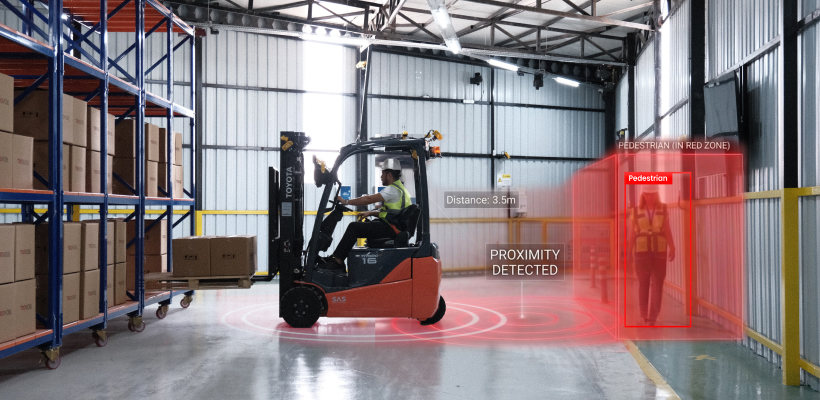
This is the most critical domain for SIF exposure, as risk is often created through interaction rather than isolated presence. It focuses on how people, vehicles, and equipment converge in shared spaces. This interaction-based visibility is especially critical for forklift safety, where most high-severity incidents emerge not from isolated vehicle movement but from dynamic pedestrian–vehicle convergence in shared operational zones.
Examples:
- Pedestrian to forklift proximity events
- Forklift to forklift crossing risks
- Blind spot entry during vehicle movement
- Simultaneous presence in high-risk intersections
- Near-miss detection based on trajectory overlap
This domain transforms safety from object detection into understanding dynamic risk relationships.
4. Environmental and Zone Risks
The physical layout and conditions of a facility play a significant role in shaping how risk develops. Certain zones naturally concentrate exposure due to visibility limitations, traffic density, or structural constraints. These risks are often persistent and repeatable, yet difficult to detect without continuous monitoring.
AI systems monitor:
- Blind spot zones at racking intersections
- Loading dock activity and edge proximity
- Doorway crossings and transition points
- Congestion buildup in aisles
- Lighting or visibility constraints impacting detection
Making these zones visible allows safety teams to redesign or control high-risk areas more effectively.
5. Process and Operational Risks
This domain focuses on how work is actually performed compared to how it is designed. Risk often emerges when real-world operations drift from defined procedures, especially under time pressure or high workload. These deviations are typically systemic and repeatable rather than isolated incidents.
Examples include:
- Unauthorized workflow shortcuts
- Unsafe load handling or stacking
- Deviations in traffic flow patterns
- Improper parking or idle positioning
- Unexpected congestion during peak operations
These signals provide a deeper view into operational discipline and highlight where process improvements are needed.
Breaking Down the 100 Risk Categories
When these five domains are expanded into measurable signals, a real-time AI platform can monitor a highly granular risk structure.
A simplified breakdown:
Human Behavior (20+ categories)
- Pedestrian zone violations
- Unsafe crossing patterns
- PPE detection states
- Stationary presence in active zones
- Unexpected movement patterns
Vehicle and Equipment (20+ categories)
- Speed thresholds by zone
- Turning radius violations
- Forklift idle time in unsafe locations
- Equipment misuse indicators
- Load instability signals
Interaction Risks (25+ categories)
- Pedestrian vehicle proximity tiers
- Time-to-collision estimates
- Intersection conflict detection
- Blind spot entry events
- Multi-entity interaction density
Environmental Risks (15+ categories)
- High-risk zone occupancy
- Dock edge exposure
- Congestion heatmaps
- Visibility constraints
- Dynamic risk zone activation
Process Risks (20+ categories)
- Workflow deviation patterns
- Repeated unsafe behaviors
- Shift-based risk fluctuations
- Peak-hour exposure spikes
- Non-compliant operational sequences
Together, these form a continuously evolving risk map of the facility.
How AI Translates Data Into Action
Monitoring alone does not improve safety.
Interpretation and response do.
Modern AI platforms do more than detect objects or events. They structure raw data into meaningful, decision-ready insight by layering analytics on top of continuous detection. This allows safety teams to move beyond observation and into active risk management.
AI systems enable:
- Risk scoring for forklifts, zones, and operations: Each asset and area is continuously evaluated based on exposure levels, allowing teams to identify where risk is concentrated.
- Identification of repeat exposure patterns: Instead of isolated incidents, AI reveals recurring behaviors and interactions that consistently generate risk.
- Prioritization of high-severity risk clusters: Not all risks are equal. AI helps focus attention on high-energy, high-impact exposures that are most critical.
- Time-based trend analysis across shifts and sites: Risk is not static. AI tracks how exposure changes over time, across different shifts, facilities, and operational conditions.
This enables:
- Earlier intervention before conditions escalate into incidents
- Data-driven safety decisions based on real exposure, not assumptions
- Targeted operational improvements where they have the highest impact
Instead of reviewing incidents after the fact, teams begin actively managing exposure as it develops.
Benefits of Multi-Category Risk Monitoring
A platform that monitors 100+ risk categories enables a fundamentally different safety approach.
Traditional safety systems rely on limited signals and lagging indicators. Multi-category monitoring creates a comprehensive, real-time understanding of how risk forms across the operation.
Key outcomes include:
- Visibility into leading indicators, not just lagging metrics: Organizations gain insight into the conditions that lead to incidents, not just the outcomes.
- Early detection of high-energy hazard exposure: Critical risks such as pedestrian-vehicle interactions are identified while they are still developing.
- Identification of systemic risk patterns across sites: Repeated exposure trends can be tracked across multiple facilities, revealing structural issues.
- Improved control over forklift and pedestrian interactions: High-risk interactions become measurable, manageable, and controllable in real time.
- Data-driven prioritization of safety investments: Resources can be directed toward the areas and behaviors that contribute most to overall risk.
This is not an incremental improvement. It represents a shift from reactive safety management to continuous, intelligence-driven control of risk.
Implementation Considerations
Not all AI safety platforms provide the same level of depth or capability.
Many systems focus on detection alone, without the ability to interpret or contextualize risk. When evaluating platforms, it is critical to assess whether they can move beyond visibility into actionable intelligence.
Key considerations include:
- Does the platform detect interactions or only objects? True risk emerges from interaction. Systems that only detect presence provide limited value.
- Can it differentiate between risk levels or only flag events? Effective platforms prioritize severity, helping teams focus on what matters most.
- Does it combine AI vision with spatial technologies like UWB? Multi-layered sensing improves accuracy and enables detection in complex environments.
- Can it generate risk scores and trend analysis? Without structured analytics, data remains fragmented and difficult to act on.
- Is it scalable across multiple facilities? Safety visibility should extend beyond a single site to support enterprise-level decision-making.
A platform that monitors fewer categories may still detect events, but it will not provide the depth required for full operational risk visibility and control.
How Trio Mobil Translates Risk Monitoring into Action
The capabilities described throughout this article only create value when they are connected into a single, continuous system.
This is how Trio Mobil’s AI Risk Platform is structured.
At the center is AI Risk Radar, which monitors 100+ EHS risk categories in real time, transforming visual data into structured, actionable insight. Instead of relying on periodic observation, it provides continuous visibility into workplace activity and emerging risk conditions.
AI Risk Radar detects SIF precursor conditions such as:
- Pedestrian to forklift close calls
- Unsafe lifting and operational behaviors
- Smoking and other non-compliant actions
It then organizes these signals into a centralized system that enables:
- AI-based risk scoring to quantify exposure levels
- Severity classification (high, medium, low) to prioritize action
- Real-time alerts for immediate awareness
- Video-based context for faster investigation and response
Beyond individual events, the platform provides trend analysis across zones, shifts, and facilities, helping identify recurring unsafe behaviors and high-risk areas over time.
By working with existing camera infrastructure, AI Risk Radar creates a continuous digital safety layer across operations, enabling organizations to monitor, analyze, and respond to risk without disruption.
From Visibility to Control
Industrial safety is entering a new phase. The challenge is no longer collecting data. It is understanding exposure while it is still developing.
A real-time AI safety platform does not just monitor the environment. It maps risk across hundreds of signals, interactions, and behaviors. This is what enables a shift from reactive safety to proactive control.
Because in modern operations, safety is not defined by what is reported. It is defined by what is continuously understood.
If you are evaluating how to gain real-time visibility into operational risk, understand where exposure is forming, or move from incident tracking to proactive risk management, Trio Mobil’s AI-powered safety platform can support your next phase of safety maturity.
Connect with the Trio Mobil team to explore how AI Risk Radar and multi-layered safety technologies can help you monitor, prioritize, and act on risk across your operations.
Frequently Asked Questions
There is no fixed number, but effective platforms typically monitor dozens to hundreds of distinct risk signals across behavior, interaction, and environment.
Because risk emerges from interaction. Detecting a forklift or a pedestrian alone does not indicate danger. Detecting their interaction does.
No. They enhance them by providing real-time visibility and leading indicators that traditional systems cannot capture.
Near-miss detection identifies events that almost resulted in an incident. Risk monitoring identifies the conditions that lead to those events.
Disclaimer: Trio Mobil solutions are operator-assist aids. They do not replace safe working practices or prevent all incidents. Performance depends on operating conditions and configuration; see product documentation.

Product Catalogue 2026
Download our catalog and gain access to a wealth of information on how to enhance industrial safety and efficiency. Our latest catalog features a diverse range of products and services that can help you achieve your goals.
Our Latest Blogs


Learn more about Trio Mobil's Solutions
Fill out the form and we'll contact you!