


Trio Mobil Global Technology Innovation Leader in AI-Based Industrial Safety
Read the Frost & Sullivan Analysis

Forklift-AGV Collision Avoidance: Integrating Safety with Automated Systems
 Apr 30, 2026
 3 min
3 min 455
455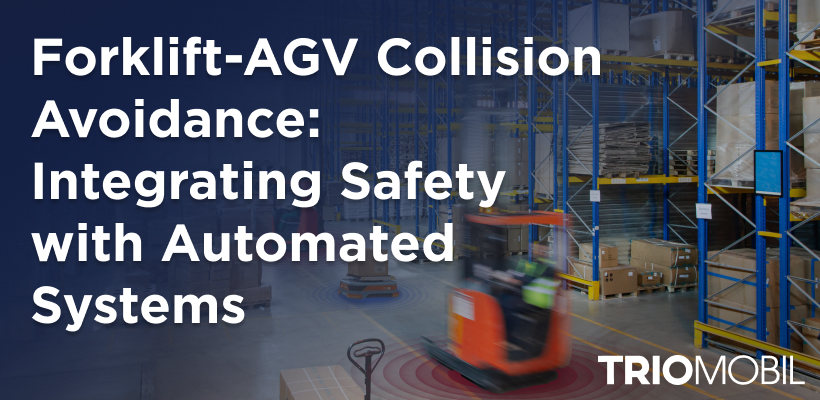
Automated Guided Vehicles (AGVs) have become integral to modern warehouses and manufacturing facilities, revolutionizing material handling alongside traditional forklifts. While they enhance efficiency and precision, the simultaneous operation of AGVs and forklifts introduces significant safety challenges, especially the risk of collisions. Implementing advanced collision avoidance systems is crucial to address these issues and lead to a safer working environment.
In this article, we will examine the necessity of these systems, the innovative technologies behind them, and the best practices for their successful implementation.
The Rise of Automation and AGVs in Material Handling
Material handling has undergone a significant transformation with the advent of automation. Forklifts have been the backbone of warehouse operations for decades, offering reliability and versatility. These manually operated vehicles have been essential in transporting heavy loads, stacking materials, and managing inventory within warehouses, factories, and distribution centres. Forklifts' robustness and adaptability have made them a cornerstone of material handling processes. However, the introduction of Automated Guided Vehicles (AGVs) has further revolutionized these operations, bringing about a new era of efficiency and precision.
AGVs are designed to transport materials without direct human intervention. They follow predetermined paths and use various navigation technologies, such as lasers, magnets, or GPS. Due to their numerous advantages, these vehicles have become increasingly popular in modern industrial settings.
The benefits of AGVs include:
- Efficiency: AGVs operate continuously, reducing downtime and increasing productivity. Unlike human operators, AGVs do not require breaks, shifts, or rest periods, allowing them to work around the clock. This continuous operation significantly enhances the throughput of material handling processes.
- Precision: Automated systems provide precise placement and handling of materials. AGVs follow exact routes and perform tasks with high accuracy, minimizing the risk of human error. This precision is particularly valuable in industries where the exact placement and handling of materials are critical, such as automotive manufacturing or pharmaceuticals.
- Cost Savings: Reduced labor costs and minimized errors lead to significant financial savings. While the initial investment in AGV technology can be substantial, the long-term benefits include lower operational costs due to reduced labor requirements, fewer errors, and less damage to products and infrastructure. Additionally, AGVs can be deployed in environments that may be hazardous or uncomfortable for human workers, further enhancing safety and reducing costs associated with workplace injuries.
Understanding Forklift-AGV Collision Risks
Integrating forklifts and Automated Guided Vehicles (AGVs) in the same operational environment presents unique collision risks. Understanding these risks is the first step towards mitigating them. While forklifts have been a mainstay in material handling, the addition of AGVs, with their automated nature, introduces a new layer of complexity to safety management. Identifying and addressing the potential collision scenarios between forklifts and AGVs is crucial for maintaining a safe and efficient workplace.
Forklift-AGV Collision Scenarios
| Forklift-AGV Collision Scenarios | Explanation | Trio Mobil's Solutions |
|---|---|---|
| Blind Spots | Forklifts and AGVs have blind spots that can lead to accidents if not properly monitored. | Trio Mobil’s TRUE AI cameras and UWB-based proximity detection eliminate blind spots by providing real-time alerts only when there is an actual risk. |
| Intersections | Intersections where pathways of forklifts and AGVs cross are high-risk zones, especially when automated and manual vehicles share space. | Trio Mobil systems improve intersection safety through real-time proximity detection, audiovisual alerts, and automatic forklift speed reduction in high-risk zones. |
| Human Error | Human operators can make mistakes, leading to collisions with AGVs, especially due to distractions or insufficient training. | Trio Mobil reduces human error by providing real-time alerts and automated safety responses, helping operators react faster and operate more safely. |
| Environmental Factors | Poor lighting, narrow aisles, and obstructions increase collision risks. | Trio Mobil enhances safety in challenging environments using AI-based detection and real-time alerts, and can integrate with external warning systems such as lights and alarms when needed. |
| Speed Variations | AGVs operate at constant speeds, while forklifts vary, leading to unexpected interactions. | Trio Mobil eliminates awareness gaps by providing real-time location and proximity data, ensuring forklift operators are instantly alerted to nearby AGVs and risks. |
| Communication Gaps | Lack of effective communication between forklift operators and AGV systems can result in collisions. | Trio Mobil improves safety in complex layouts through real-time detection, zone-based controls, and automated alerts that help operators navigate high-risk areas safely. |
| Complex Layouts | Complex layouts with multiple intersecting pathways pose higher collision risks. | Trio Mobil improves safety in complex layouts through real-time detection, zone-based controls, and automated alerts in high-risk areas. |
Advanced Forklift-AGV Collision Avoidance Systems
Various advanced technologies have been developed to mitigate collision risks. These technologies work in tandem to create a comprehensive collision avoidance system.
Sensors
Sensors are fundamental in detecting the presence of objects and preventing collisions.
These include:
| Features | How It Works | For AGVs | For Forklifts |
|---|---|---|---|
| Proximity Sensors | Detect objects within a certain range and trigger warnings or automatic stops using electromagnetic fields or beams of electromagnetic radiation. Types include inductive, capacitive, and infrared sensors. | Help AGVs avoid collisions by stopping when an object is detected. | Alert operators to nearby AGVs, enabling them to take corrective actions and prevent collisions. |
Cameras
Cameras visually monitor the surroundings, offering real-time data to operators and automated systems.
These include:
| Features | How It Works | For AGVs | For Forklifts |
|---|---|---|---|
| 360-Degree Cameras | Mounted on forklifts and AGVs, these cameras provide a comprehensive view of the environment, eliminating blind spots. | Enable AGVs to fully view their surroundings, preventing collisions by detecting obstacles from all directions. | Help forklift operators by providing a clear and comprehensive view of nearby AGVs, reducing blind spots and preventing collisions. |
| AI-Powered Vision | Advanced camera systems with AI algorithms can identify and classify objects, enhancing decision-making. | Allow AGVs to identify and classify objects in real time, making informed navigation decisions to avoid collisions. | Assist forklift operators by detecting and classifying AGVs and other objects, providing real-time data to avoid collisions. |
Software Solutions
Advanced software solutions play a critical role in integrating and managing these technologies.
These include:
| Features | How It Works | For AGVs | For Forklifts |
|---|---|---|---|
| Real-Time Monitoring & Alerts | The system processes real-time data from UWB devices, AI cameras (TRUE AI), and IoT infrastructure to detect risks instantly and trigger alerts. | Improves safety in shared environments by ensuring AGVs are detectable and accounted for within the system. | Provides instant audiovisual alerts and awareness of nearby AGVs, pedestrians, and hazards. |
| Rule-Based Safety Automation | Predefined safety rules (e.g., proximity thresholds, zone-based triggers) automatically activate responses such as speed reduction. | Ensures safer interaction with forklifts by reducing risk in shared zones without directly controlling AGV behavior. | Automatically slows forklifts based on proximity or entry into high-risk zones, reducing collision risks. |
| Data Analytics & Reporting | The system collects and analyzes operational and safety data to identify trends, high-risk zones, and improvement opportunities. | Supports safer facility planning by highlighting risk areas in mixed-traffic environments. | Helps optimize forklift operations, improve safety compliance, and reduce near-miss incidents over time. |
| System Integration Capability | Integrates with external systems such as warning lights, doors, or alarms to trigger additional safety actions when needed. | Enhances overall safety infrastructure in AGV environments through coordinated responses. | Enables extended safety measures such as visual alerts and automated environmental responses. |
Trio Mobil's Forklift-AGV Collision Avoidance Systems
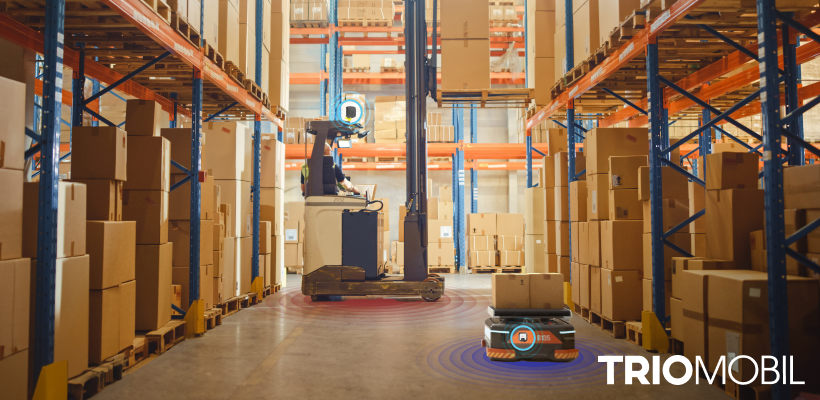
Managing collision risks between forklifts and AGVs requires reliable real-time awareness and safety support systems. Trio Mobil addresses these needs through a combination of UWB-based proximity detection, AI-powered vision (TRUE AI), and zone-based speed control.
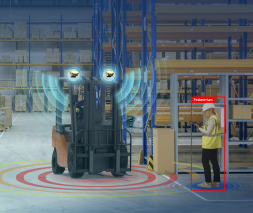
These technologies are designed to monitor distances between forklifts, AGVs, and pedestrians and to provide timely audiovisual alerts and automated responses, such as forklift speed reduction, when predefined safety thresholds are approached.
The system supports operator awareness by delivering real-time, risk-based notifications, helping operators respond more effectively to nearby hazards. AI-based camera systems can assist in reducing blind spots, while proximity detection helps improve visibility of surrounding moving assets. Trio Mobil solutions are intended to enhance safety conditions without directly controlling AGV navigation or behavior.
Trio Mobil's modular and plug-and-play systems are designed to seamlessly integrate into existing operations, providing immediate benefits without extensive setup or downtime.
For more detailed information about our innovative solutions for forklift-AGV collision avoidance, visit our website or request a demo to see how our systems can transform your workplace safety and efficiency.
Disclaimer: Trio Mobil solutions are operator-assist aids. They do not replace safe working practices or prevent all incidents. Performance depends on operating conditions and configuration; see product documentation.

Product Catalogue 2026
Download our catalog and gain access to a wealth of information on how to enhance industrial safety and efficiency. Our latest catalog features a diverse range of products and services that can help you achieve your goals.
Our Latest Blogs


Learn more about Trio Mobil's Solutions
Fill out the form and we'll contact you!