


Trio Mobil Global Technology Innovation Leader in AI-Based Industrial Safety
Read the Frost & Sullivan Analysis

The Invisible Risk Map: 10 Areas Where Forklift Risk Often Hides
 Jul 30, 2026
 5 min
5 min 444
444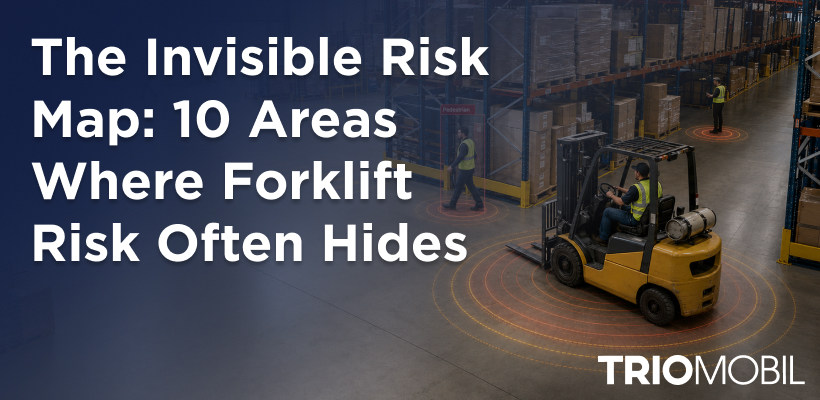
Forklift incidents rarely occur in the middle of an open warehouse floor. More often, they happen in predictable locations where visibility is limited, traffic patterns intersect, and operators must make rapid decisions in dynamic environments.
Many facilities invest heavily in operator training, safety signage, floor markings, and workplace procedures. Yet near misses and safety incidents can still occur because some of the highest-risk areas are embedded within everyday operations.
By identifying these often-overlooked risk zones and applying the appropriate safety technologies, organizations can improve visibility into operational risks while supporting both safety and productivity.
Here are 10 areas where forklift risk commonly hides and how Trio Mobil helps organizations reduce and manage those risks.
1. Blind Intersections
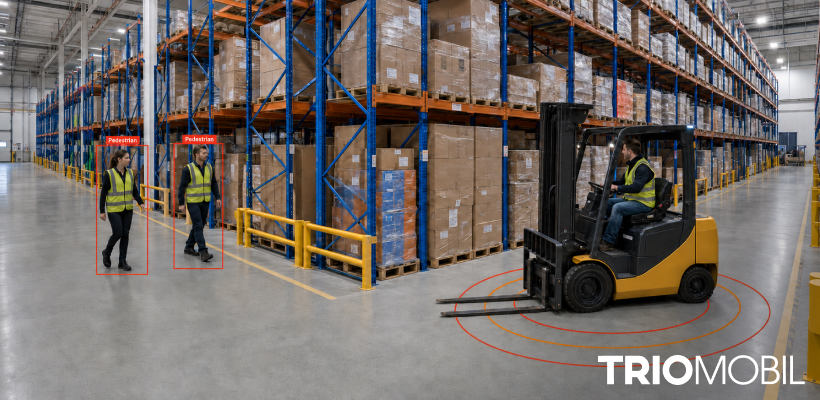
Industrial facility layouts inherently balance storage efficiency with spatial flow, but this optimization often comes at the expense of clear sightlines. High-density racking systems, structural columns, and temporary staging areas frequently create blind corners at critical crossing points. These structural obstructions force material handling operators and floor personnel to rely on reactive habits rather than clear visual confirmation. Consequently, these areas become permanent high-risk zones where the margin for error is significantly reduced during peak operational hours.
The Risk
Blind corners are among the most challenging areas in warehouses and production facilities. Racking, stored materials, walls, and equipment can obstruct visibility, making it difficult for forklift operators and pedestrians to detect one another until they are in close proximity.
Limited visibility is a common contributing factor in forklift-related incidents, particularly in environments where pedestrians, forklifts, and other equipment frequently interact.
The Trio Mobil Solution
TRIO SAFE UWB Forklift-Pedestrian and Forklift-Forklift Collision Avoidance
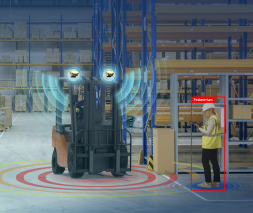
Using high-precision Ultra-Wideband (UWB) technology, TRIO SAFE detects pedestrians, forklifts, and other material handling equipment, even when they are outside an operator's direct line of sight. The system provides audiovisual alerts and, on supported equipment, can trigger configurable speed reduction actions.
Real-World Example
At Vaillant Group, Trio Mobil deployed UWB-based forklift-pedestrian and forklift-forklift collision avoidance systems to improve visibility and help address blind spot risks within a busy warehouse environment. The solution generated alerts and supported proactive risk management when potentially hazardous proximity situations occurred.
2. Pedestrian Crossings
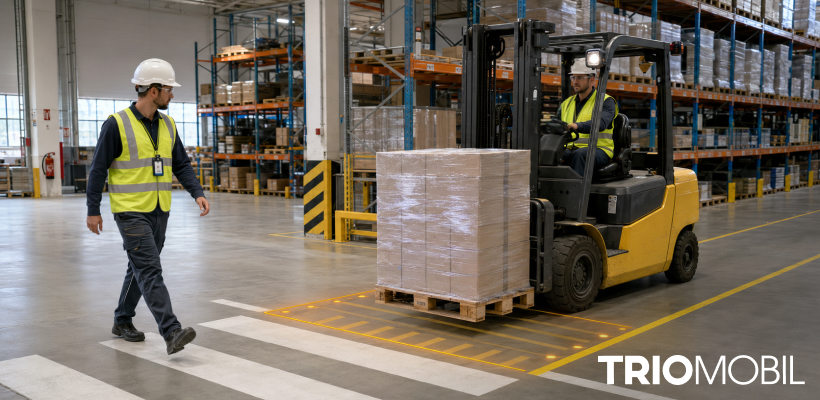
Designated crossing points are established to impose order on shared industrial floors, yet they inherently consolidate traffic into high-probability conflict zones. While structural markings attempt to regulate behavior, they rely entirely on constant, flawless compliance from two different moving parts: active machinery and foot traffic. The fundamental challenge is that a painted line cannot physically alter an operator's blind spot or compensate for a pedestrian's momentary lapse in situational awareness. As a result, these intersections remain a critical vulnerability in facility layouts, where the safety of a moving employee hinges on continuous, perfect visibility that rarely exists in a dynamic workplace.
The Risk
Pedestrian walkways and forklift routes frequently intersect at designated crossing points. Even with floor markings and signage, workers may become distracted, while forklift operators may have limited visibility depending on the load being transported.
The Trio Mobil Solution
TRIO SAFE Forklift-Pedestrian Safety System
Pedestrians carry safety tags that communicate with forklift-mounted UWB readers. When a pedestrian enters a predefined risk zone, the forklift operator receives immediate warnings and, on supported equipment, configurable speed reduction actions can be activated.
Real-World Example
At Haier, Trio Mobil implemented UWB-based forklift-pedestrian safety systems featuring pedestrian tags and forklift safety sets to improve awareness of pedestrian interactions and support safer material handling operations.
3. Loading Docks
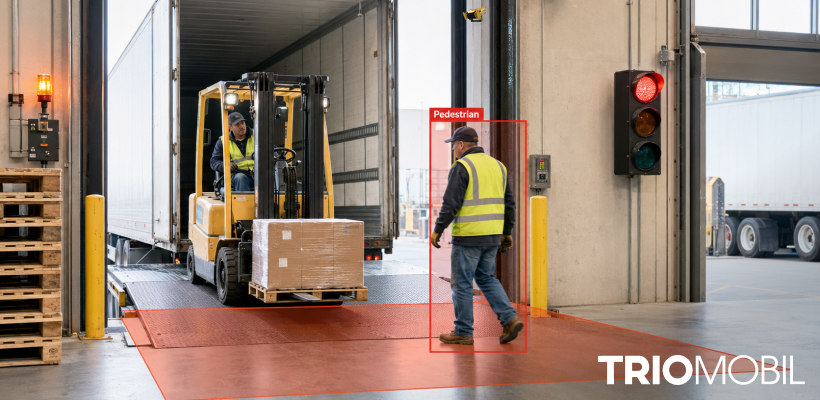
Loading docks represent the ultimate convergence point of internal facility logistics and external transport networks, making them exceptionally complex to secure. Unlike interior warehouse aisles, the dock environment is subject to external variables, including third-party drivers, fluctuating weather conditions, and irregular trailer configurations. This constant influx of fluid, unpredictable elements disrupts standard facility rhythms and creates a high-velocity workspace where mechanical hazards and human activity are tightly compressed. Because these areas act as a physical bridge between two distinct operational zones, they require an approach to safety that accounts for continuous environmental and behavioral changes.
The Risk
Loading docks combine vehicle traffic, pedestrians, forklifts, trailers, and changing environmental conditions. Risks may include trailer movement, unexpected pedestrian activity, dock approach hazards, and operational coordination challenges.
The Trio Mobil Solution
TRUE AI Loading Dock Safety System
TRUE AI uses real-time video analytics to monitor critical loading dock areas and detect predefined safety scenarios. Through relay-based integrations, the system can support traffic lights, audio warnings, door controls, and other site-specific safety mechanisms to help reduce operational risk.
Key Benefit
Rather than relying solely on procedural controls, the system continuously monitors activity and can trigger predefined safety actions in real time when configured conditions are detected.
4. Production Line Entrances
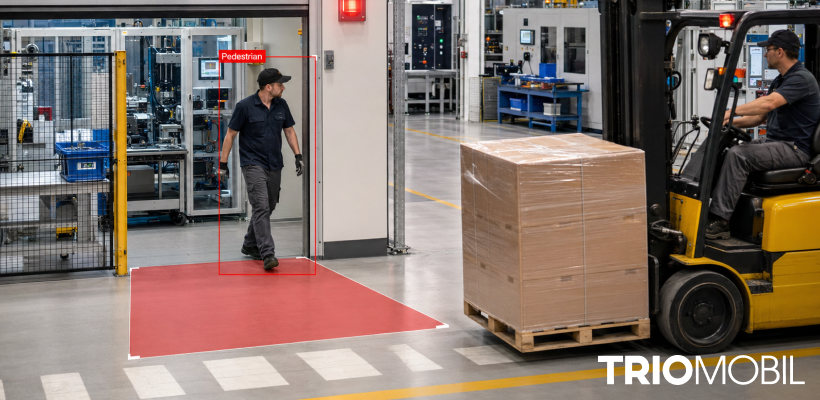
The boundary between specialized manufacturing zones and general facility thoroughfares is one of the most volatile areas on a plant floor. In these specific transition points, the predictable rhythm of automated or stationary production line machinery suddenly collides with the variable movement of logistics traffic. Personnel stepping out of specialized work cells are often focused on complex manufacturing tasks, leaving them highly vulnerable to fast-moving material handling equipment operating just outside the zone entrance. Because these thresholds mark a sudden shift in both environmental noise and spatial hazards, they demand safety measures that bridge the gap between fixed production spaces and fluid internal transport lanes.
The Risk
Production environments often involve frequent interactions between forklift operators, maintenance personnel, production staff, and automated equipment. Employees entering or exiting production zones may encounter forklift traffic unexpectedly.
The Trio Mobil Solution
TRUE AI Zone Monitoring
TRUE AI cameras continuously monitor designated areas and detect predefined safety scenarios involving pedestrians, vehicles, or equipment. When a potential risk is identified, the system can trigger alarms, notifications, or additional safety actions based on site requirements.
Real-World Example
At Dunapack, Trio Mobil deployed TRUE AI technology to monitor production and machine areas, helping improve visibility into pedestrian activity within designated risk zones and supporting proactive safety management. To explore how these visual monitoring technologies adapt to specific operational landscapes, read our analysis of Pedestrian Detection Camera Solutions for Different Industries.
5. Warehouse Entry & Exit Doors
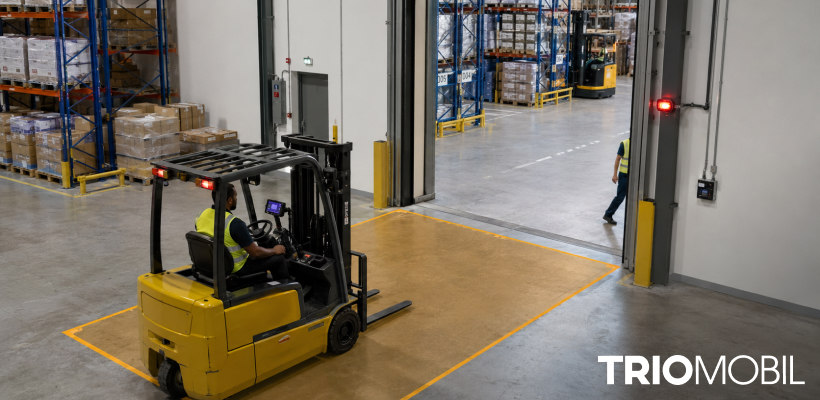
Industrial thresholds serve as physical bottlenecks that compress facility traffic while forcing operators to adapt to immediate physical changes. Moving through a major warehouse doorway introduces a sudden shift in ambient noise, lighting levels, and spatial layouts, all of which temporarily degrade an operator's situational awareness. These structural portals often force heavy machinery and foot traffic through the exact same narrow clearing, turning a standard transition point into a concentrated friction zone. Because these areas act as the primary conduit between distinct facility ecosystems, they require specialized control measures to stabilize vehicle behavior before an asset ever crosses the threshold.
The Risk
Doorways often create sudden visibility changes. Forklifts moving between indoor and outdoor environments or between warehouse sections may encounter unexpected pedestrian or vehicle traffic.
Sectional doors can also become congestion points where visibility and reaction times are reduced.
The Trio Mobil Solution
Zone-Based Forklift Speed Control
Zone Anchors create virtual safety zones around warehouse doors and other designated areas. When forklifts enter these zones, configurable speed reduction rules can be activated on supported equipment. The system can also support automated door-opening scenarios where applicable.
Real-World Example
At Vaillant Group, Trio Mobil implemented zone-based speed control around sectional doors, helping standardize forklift behavior in high-traffic transition areas.
6. Rack Ends & Cross Aisles
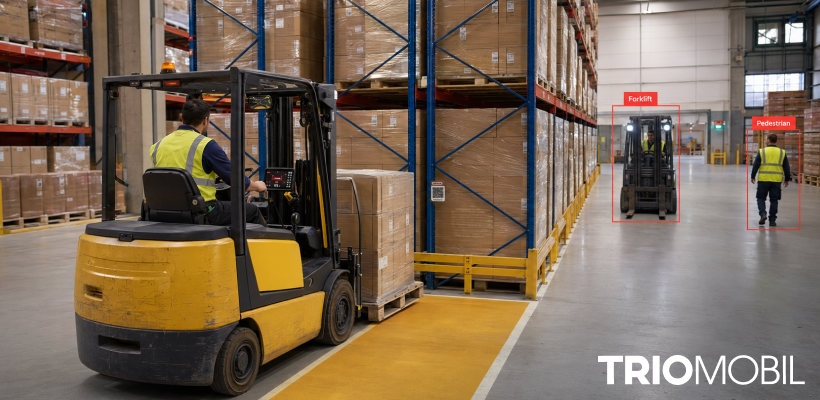
The structural architecture of a modern warehouse relies on dense, parallel shelving systems that inherently restrict lateral vision. While this configuration maximizes cubic storage capacity, it transforms every cross aisle and rack end into a blind junction where orthogonal traffic flows intersect without warning. Operators navigating these corridors are frequently managed by cognitive dual-tasking, as they must balance vehicle steering with complex load handling and inventory scanning. Consequently, these narrow transition points become critical operational friction zones where the physical environment severely limits spatial awareness precisely when technical focus is highest.
The Risk
Rack ends and cross aisles are common interaction points where operators may unexpectedly encounter cross traffic. Visibility can be limited, and operators are often focused on load handling activities.
The Trio Mobil Solution
TRIO SAFE Collision Prevention and Zone-Based Speed Control
UWB proximity detection helps identify approaching forklifts or pedestrians beyond direct visual range, while speed control zones support safer vehicle movement in high-risk crossing areas.
Real-World Example
Large-scale implementations at BSH included hundreds of forklifts and speed-controlled zones designed to improve visibility and manage risk across complex intralogistics operations.
7. Narrow Aisles
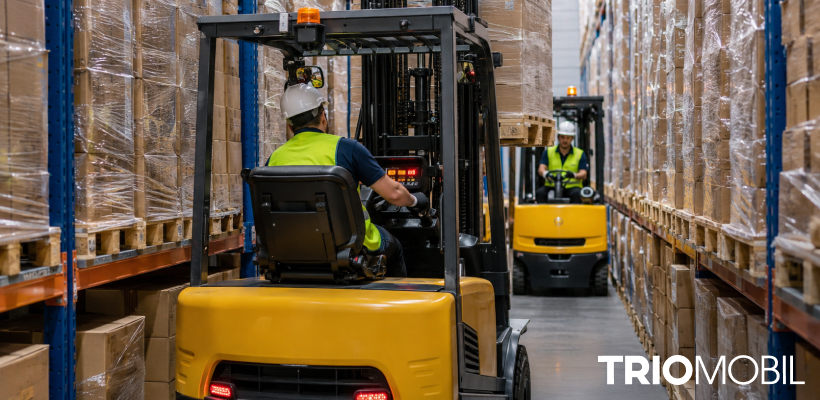
High-density storage strategies frequently utilize narrow aisle configurations to optimize building footprints, leaving virtually no margin for operational variance. Within these tight spatial constraints, a single piece of machinery completely dominates the thoroughfare, eliminating any physical escape routes or bypass lanes for oncoming traffic. The psychological and physical pressure on operators increases exponentially as they manipulate heavy payloads at extreme heights, where even minor steering corrections can lead to equipment contact. Because these specialized corridors compress the operational environment to its absolute limit, standard defensive driving tactics become impossible to execute without technological intervention.
The Risk
Narrow aisles increase the likelihood of forklift-to-forklift encounters while reducing available maneuvering space. These challenges become more pronounced when handling loads at height or operating in busy warehouse environments.
The Trio Mobil Solution
Forklift-Forklift Collision Avoidance
TRIO SAFE continuously measures distance between forklifts using high-precision UWB technology. When vehicles enter predefined proximity thresholds, alerts can be generated and configurable speed reduction actions can be applied on supported equipment.
Real-World Example
At Vaillant Group, the system provided audiovisual alerts and supported risk reduction by notifying operators when another vehicle approached within configured safety distances.
8. Staging and Buffer Areas
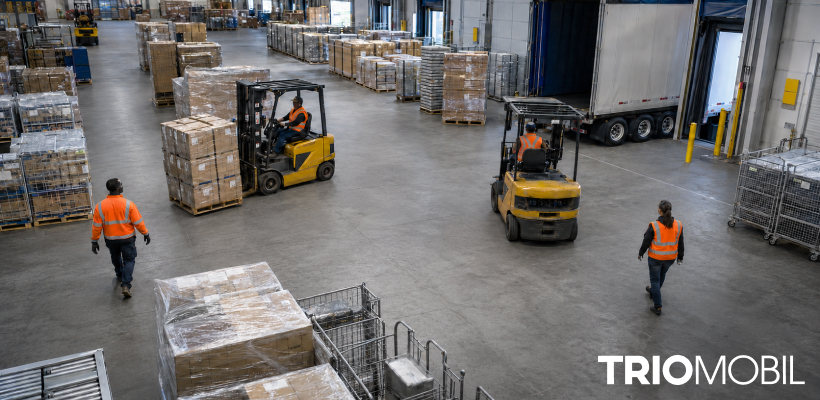
As the primary intake and dispatch zones of a facility, staging areas function as dynamic logistics nodes characterized by fluid, unregulated movement. Unlike structured warehouse aisles with predictable linear paths, buffer zones adapt continuously to changing cargo volumes, resulting in shifting traffic patterns that vary by the hour. The simultaneous convergence of over-the-road trucks, internal industrial fleets, floor personnel, and static freight creates a highly chaotic environment where spatial tracking becomes incredibly difficult. Because these zones serve as the chaotic clearinghouse for the entire supply chain network, static safety protocols quickly break down, requiring a more fluid framework to monitor active operational density.
The Risk
Staging areas often become temporary congestion points where forklifts, pallets, pedestrians, and trucks interact simultaneously. Traffic patterns can shift rapidly throughout the day, making risk difficult to identify through observation alone.
The Trio Mobil Solution
FleetBridge, RTLS, and Zone Management
Trio Mobil combines Real-Time Location Tracking (RTLS) and FleetBridge analytics to provide visibility into forklift movements, traffic density, congestion patterns, and operational bottlenecks. This data supports both safety improvement initiatives and operational optimization efforts.
Real-World Example
At Ford, RTLS technology was deployed across a large manufacturing environment to improve visibility into intralogistics operations and support both efficiency and workplace safety objectives.
9. AGV and AMR Shared Zones
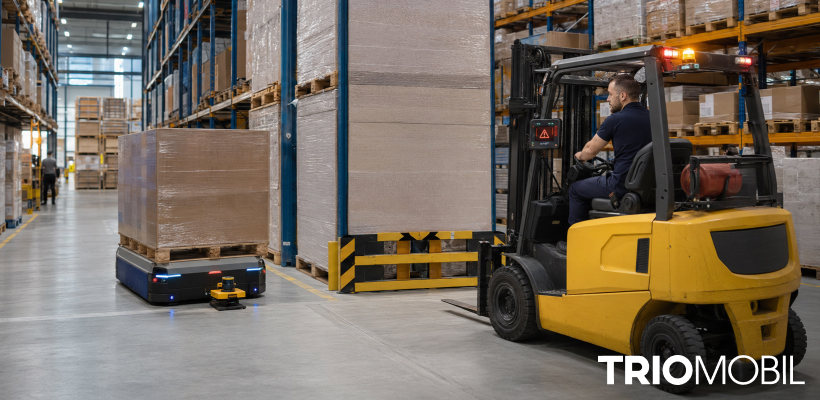
The integration of autonomous systems into legacy industrial environments creates a complex hybrid dynamic, forcing two fundamentally different operational models into the same spatial footprint. Manually operated forklifts rely on human intuition, adaptive decision-making, and variable reaction times, while Autonomous Guided Vehicles (AGVs) and Autonomous Mobile Robots (AMRs) operate via rigid algorithms, fixed sensory inputs, and predictable, pre-programmed paths. This technological disparity creates a unique systemic friction, as human operators frequently struggle to anticipate the exact stopping distances or sudden path-correction behaviors of robotic fleets, while autonomous sensors can be overwhelmed by erratic human maneuvering. Consequently, these shared transit zones become critical testing grounds where traditional safety assumptions fail, requiring a unified communication framework to bridge the gap between human and machine logic.
The Risk
As facilities adopt Autonomous Guided Vehicles (AGVs) and Autonomous Mobile Robots (AMRs), interactions between autonomous systems and manually operated forklifts become increasingly common. These mixed-traffic environments introduce new operational safety challenges.
The Trio Mobil Solution
Forklift-AGV Risk Management
TRIO SAFE can be configured to detect AGVs and other mobile assets equipped with compatible positioning technology. When predefined proximity thresholds are reached, alerts and configurable safety actions can be activated based on operational requirements.
Why It Matters
The solution helps create an additional layer of visibility across both autonomous and manually operated material handling equipment, supporting safer operations in hybrid logistics environments. For a detailed breakdown on managing these technical dynamics, read our comprehensive guide on Forklift-AGV Collision Avoidance: Integrating Safety with Automated Systems.
10. Forklift Parking and Handover Areas
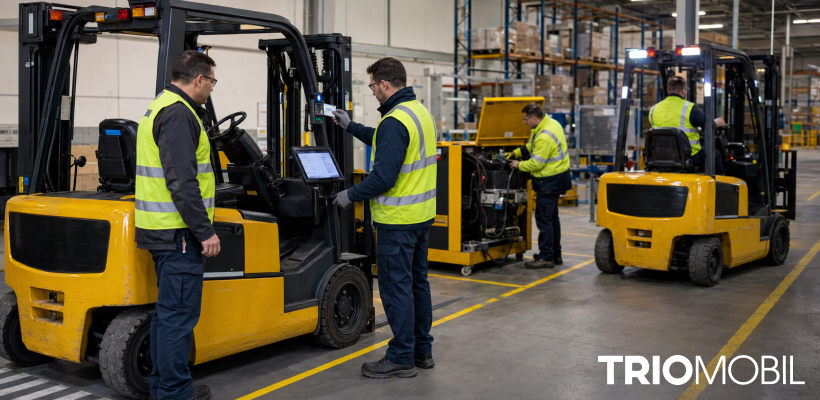
While active thoroughfares command the majority of risk-mitigation focus, stationary staging nodes represent an entirely different category of vulnerability on the shop floor. Parking and handover areas act as organizational pivot points where operational custody changes, forcing operators out of protective cabins and onto the ground as pedestrians. This constant flux of unmounted drivers, maintenance technicians, and utility staff occurs around heavy machinery that is cycling through startups, battery exchanges, and mechanical inspections. Because these zones are often perceived as low-velocity safe havens, cognitive vigilance drops precisely when the density of loose foot traffic and vulnerable, unseated personnel reaches its peak.
The Risk
Parking and handover areas are often overlooked because forklifts may be stationary. However, operator changes, maintenance activities, battery replacement procedures, inspections, and startup processes can create frequent interactions between people and equipment.
The Trio Mobil Solution
FleetBridge Fleet Management Platform
FleetBridge supports safer forklift operations through capabilities such as:
- Operator access control
- Digital pre-operation checklists
- Impact detection
- Real-time notifications
- Operator accountability
- Productivity and safety reporting
These features help organizations ensure that only authorized operators use equipment and that key operational checks are completed before forklifts enter service.
From Hidden Risks to Visible Control
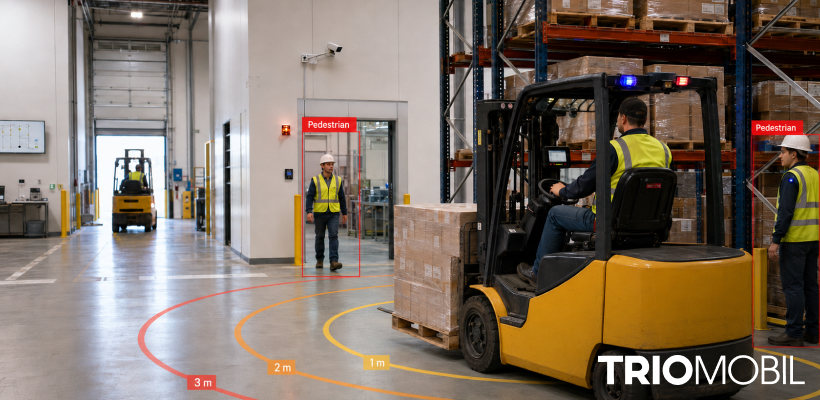
Most forklift-related incidents do not occur randomly. They tend to emerge in recurring operational scenarios where visibility constraints, traffic density, environmental conditions, and human behavior intersect.
No single technology addresses every forklift safety challenge. Effective risk reduction often requires a layered approach that combines proximity detection, AI-powered visibility, zone-based controls, location intelligence, and operational analytics based on the specific risks present within a facility.
Organizations that identify and map these hidden risk zones gain a significant advantage. By combining UWB proximity detection, AI-powered video analytics, zone-based speed control, real-time location tracking, and fleet management tools, facilities can move beyond reactive safety measures and build more proactive risk management strategies.
This approach has been adopted by global manufacturers including BSH, Ford, Haier, Beko, Vaillant Group, Dunapack, and Smurfit Westrock to improve visibility into operational risks and support safer, more informed safety decisions.
At Smurfit Westrock, for example, Trio Mobil's TRUE AI solution improved visibility in previously difficult-to-monitor areas and alerted forklift operators when pedestrians entered designated risk zones. This helped provide more relevant warnings while supporting both safety and operational efficiency.
The risks may be hidden. With the right combination of visibility, data, and technology, they do not have to remain invisible.
Mapping out your facility's high-risk areas is the first step toward achieving total floor visibility. Contact our industrial safety experts today to discuss your specific operational challenges and discover how Trio Mobil's layered safety solutions can protect your workforce and optimize your logistics.
Disclaimer: Trio Mobil solutions are operator-assist aids. They do not replace safe working practices or prevent all incidents. Performance depends on operating conditions and configuration; see product documentation.

Product Catalogue 2026
Download our catalog and gain access to a wealth of information on how to enhance industrial safety and efficiency. Our latest catalog features a diverse range of products and services that can help you achieve your goals.
Our Latest Blogs


Learn more about Trio Mobil's Solutions
Fill out the form and we'll contact you!