


Trio Mobil Global Technology Innovation Leader in AI-Based Industrial Safety
Read the Frost & Sullivan Analysis

Choosing Forklift Safety Technology in 2026: A Decision Guide for Safety Leaders
 Jul 29, 2026
 3 min
3 min 512
512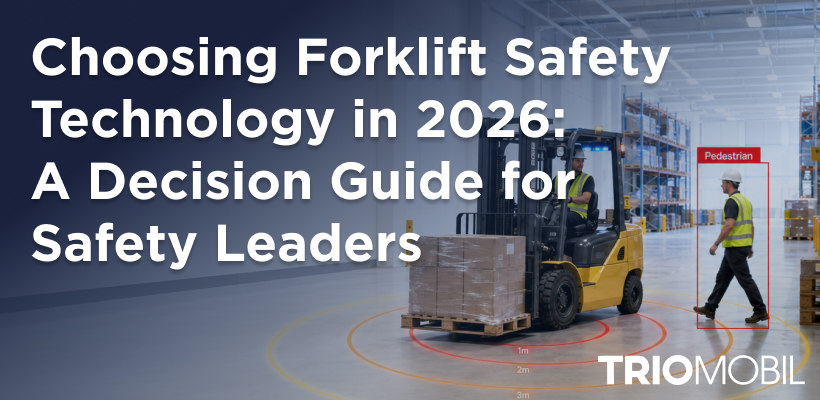
To choose forklift safety technology in 2026, match the technology layer to the risk: multi-sensor detection (AI cameras plus UWB proximity) for pedestrian interaction, automatic speed control for intervention, telematics for operator accountability, and exposure analytics for continuous improvement. In mixed-traffic facilities, no single sensor type is sufficient — the deciding factors are detection reliability, the ability to intervene rather than just alert, and integration into one platform.
Forklift safety technology has moved from a niche purchase to a core capital priority for warehouse and manufacturing operations. The market is crowded: ultrasonic sensors, radar, LiDAR, magnetic-field systems, RFID tags, AI vision cameras, ultra-wideband (UWB) proximity, telematics, zone controls, and full platforms that combine them. For safety managers and operations leaders, the question is no longer whether to invest in industrial vehicle safety, but which combination actually reduces risk in their environment.
This guide compares the main technology categories and sensor types, explains the difference between alert-only and intervention systems, and gives a practical evaluation checklist for mixed-traffic facilities.
Why 2026 Is a Decision Point for Forklift Safety
The incident numbers are not improving on their own. In 2024, 84 U.S. workers died in incidents involving forklifts, order pickers, or platform trucks, with over 25,000 nonfatal forklift injuries in the most recent reporting year (National Safety Council / BLS). About 36% of forklift-related fatalities are pedestrians (OSHA).
Regulation is tightening. The EU Machinery Regulation (2023/1230) applies from 20 January 2027, with explicit requirements for digital and AI-supported machinery — equipment decisions made in 2026 should anticipate it. In the U.S., powered industrial trucks (29 CFR 1910.178) remain a fixture of OSHA’s top-10 most-cited standards.
ESG reporting now covers safety. Under CSRD, large companies operating in Europe must report workforce safety metrics — pushing safety data from paper logs to measurable, auditable systems.
The technology matured. AI vision and UWB have moved from pilots to deployments across thousands of sites, and automatic speed control is now OEM-integrated rather than experimental. Waiting no longer buys a better generation of technology; it buys another year of unmeasured exposure.
The Four Layers of Forklift Safety Technology
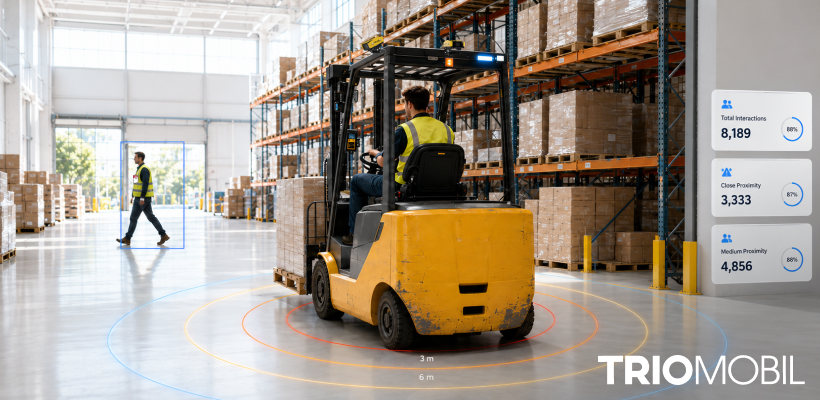
Most workplace safety equipment for forklifts falls into four functional layers. A complete program needs all four; most point products cover only one.
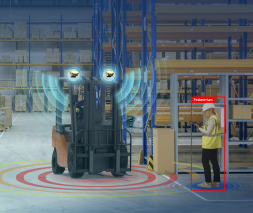
Detection — knowing where people and vehicles are. Forklift-mounted sensors and cameras, pedestrian tags, and fixed cameras at intersections detect proximity and unsafe interactions in real time.
Intervention — changing the outcome in the moment. In-cabin alerts, pedestrian tag alerts, automatic speed reduction, zone-based speed enforcement, and LED/door controls act on what detection sees.
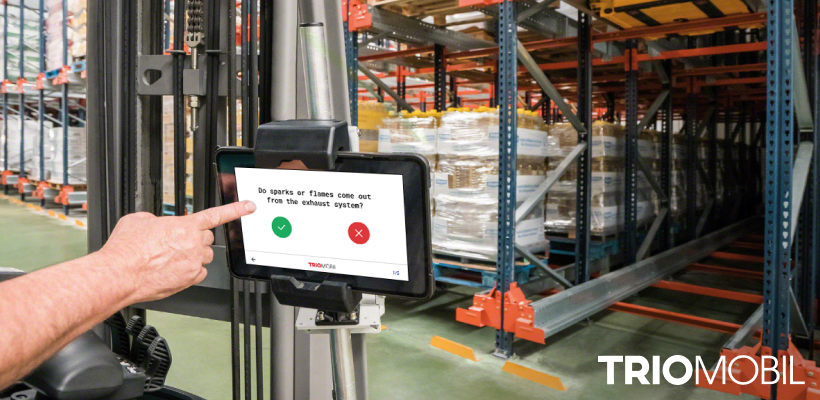
Accountability — managing the fleet and operators. Telematics: operator access control, pre-shift safety checklists, impact detection, utilization and maintenance data.
Intelligence — reducing risk structurally. Exposure analytics that aggregate every interaction into severity-weighted metrics, revealing hotspots for layout and process changes. This is where material handling safety shifts from reacting to events to reducing measured exposure. (See: What is SIF exposure?)
Comparing Forklift Sensors: Which Detection Technology Fits Your Facility?
Detection is where sensor choice matters most — and where mixed-traffic facilities are most often let down by single-technology systems.
| Sensor type | How it works | Strengths | Limitations |
|---|---|---|---|
| Ultrasonic / radar | Detects any object within range | Inexpensive; simple | Cannot distinguish people from pallets or racking; alarm fatigue in busy aisles |
| LiDAR | Laser-based distance mapping | Precise ranging; good for AGVs | Object detection, not person recognition; cost; sensitive to dust in some environments |
| Magnetic field / RFID tags | Alarm when a tagged person enters a generated field | Works through obstructions; simple logic | Fixed detection radius; no direction or speed context; untagged people invisible |
| AI vision cameras | Deep learning recognizes pedestrians and vehicles visually | Detects untagged people; understands context (person vs object); evidence clips | Needs line of sight; performance depends on camera placement |
| UWB proximity | Ultra-wideband tags give precise, 360° person-to-vehicle distance | Centimeter accuracy; unaffected by lighting, dust, fog; blind-spot coverage | Requires tags; visitors and contractors need tag issuance process |
| Hybrid (AI vision + UWB) | Sensor fusion of both layers | Each covers the other's gaps; highest detection reliability in mixed traffic | Higher initial investment than single-sensor point products |
For mixed-traffic facilities — where forklifts, pedestrians, contractors, AGVs, and trucks share space — the practical answer in 2026 is hybrid detection. Camera-only systems miss what they cannot see; tag-only systems miss whoever is untagged. Fusing AI vision with UWB removes the single point of failure.
Collision Avoidance Systems: Alert-Only vs. Active Intervention
The most consequential distinction among collision avoidance systems is not the sensor — it is what happens after detection.
Alert-only systems warn the operator and pedestrian and stop there. They help attentive operators, but the last safety barrier is still a human reacting under time pressure — the exact failure mode that causes collisions.
Active intervention systems physically reduce forklift speed when risk crosses a threshold, typically in a two-phase protocol integrated with the vehicle’s drive system, and enforce zone-based speed limits automatically. In the hierarchy of controls, this is an engineering control rather than an administrative one.
Published deployment results reflect the difference: alert-only detection platforms are generally associated with meaningful but partial risk reduction, while closed-loop systems combining alerts with automatic speed control have measured up to 85–95% reductions in high-risk exposure events in selected deployments (results vary by site and scope). For the mechanism details, see How AI reduces forklift-pedestrian collision risk.
Beyond Collision Avoidance: Telematics and Facility-Wide Monitoring
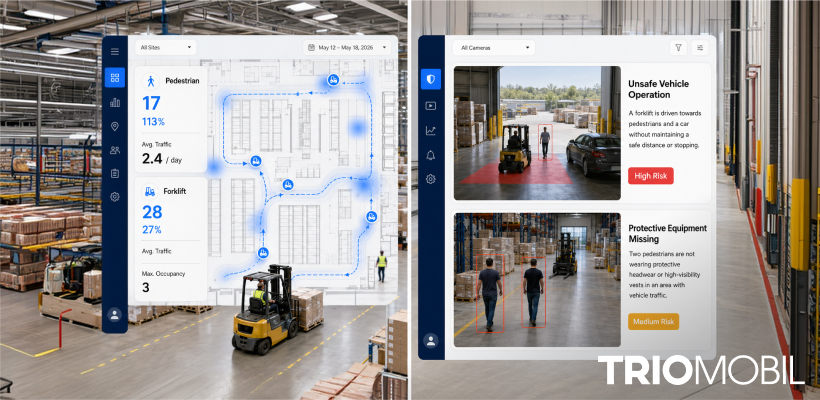
Two layers are frequently overlooked in technology evaluations:
Fleet telematics (forklift fleet management) ties safety to accountability: only trained operators can start vehicles, pre-shift checklists are enforced digitally, impacts are detected and attributed, and utilization data supports right-sizing the fleet — fewer vehicles moving means less exposure.
AI facility monitoring (AI risk monitoring) runs on existing CCTV to detect risks beyond the forklift itself: blocked exits, PPE non-compliance, unsafe pedestrian routes, housekeeping hazards. It extends the safety investment across the whole operation without new hardware.
Evaluation Checklist: Seven Questions Before You Buy
Does it distinguish people from objects? If the sensor cannot tell a pedestrian from a pallet, operators will learn to ignore it.
Does it cover blind spots in all conditions? Ask how detection performs in low light, dust, cold storage, and around corners — and whether untagged visitors are covered.
Can it intervene, or only alert? Automatic speed reduction is the single biggest differentiator in outcomes.
Does it integrate with your fleet and infrastructure? OEM speed-control integration, mixed-brand fleets, AGV coexistence, doors and LED signals.
Does it measure exposure, not just count alerts? Severity-weighted interaction data per zone and shift is what turns the system into a management tool.
Is it one platform or a stack of point products? Separate vendors for detection, telematics, and analytics mean separate dashboards and integration risk.
Does it meet privacy requirements? GDPR-aligned options — blurring, retention controls, purpose limitation — are essential for European sites and works-council approval.
For a deeper dive specifically on pedestrian detection selection, see our Forklift Pedestrian Detection Systems: A Buyer’s Guide.
How Trio Mobil Fits This Framework
Trio Mobil builds all four layers in-house as one platform: Trio Safe AI (forklift-mounted AI camera with UWB proximity and OEM-integrated two-phase speed reduction), TRUE-AI fixed cameras with LED and door control, Trio Safe UWB pedestrian tags with 360° coverage, FleetBridge telematics, and AI Risk Radar for CCTV-based facility monitoring — unified in the SIF Prevention Intelligence Platform with exposure analytics and cross-site benchmarking. It is deployed across 2,000+ enterprise sites in 65+ countries, including operations of Toyota, Ford, Mercedes-Benz, Coca-Cola, PepsiCo, and Unilever.
Frequently Asked Questions
A hybrid system combining AI vision cameras with UWB proximity detection, backed by automatic speed reduction. Cameras detect untagged people; UWB covers blind spots and poor visibility; speed control changes the outcome when warnings are not enough. Single-sensor systems leave gaps in mixed traffic.
Sensors are the detection component — ultrasonic, radar, LiDAR, RFID, AI cameras, or UWB. A collision avoidance system is the complete loop: sensors plus risk logic, operator and pedestrian alerts, and ideally automatic intervention such as speed reduction.
They are better than nothing, but they leave the human reaction as the last barrier. Systems with automatic speed reduction address the moments when the operator does not react in time — which is precisely when collisions happen.
Yes. Leading systems mount on existing forklifts of any brand, integrate with major OEM drive systems for speed control, and can use existing CCTV for facility monitoring — so fleet replacement is not required.
Pricing varies by fleet size, sensor mix, and intervention scope, from a few hundred dollars per vehicle for basic proximity alarms to complete per-vehicle platforms with speed control and analytics. Evaluate cost against exposure reduction: a single serious forklift injury typically costs far more than instrumenting an entire fleet.
No regulation mandates a specific product, but the direction is clear: the EU Machinery Regulation (2023/1230) applies from January 2027 with requirements for digital and AI-supported machinery, CSRD requires auditable safety metrics, and OSHA continues to cite powered industrial truck violations heavily. Technology adopted in 2026 should be chosen with those frameworks in mind.
The Bottom Line
Choosing forklift safety technology in 2026 is no longer a sensor decision — it is a platform decision. The facilities getting measurable results combine hybrid detection, automatic intervention, fleet accountability, and exposure analytics in one system, then use the data to engineer risk out of their layouts. Start from your highest-severity exposure — almost always forklift-pedestrian interaction — and choose technology that can prove, in numbers, that the risk went down.
Want a baseline of your facility’s current exposure? Request a demo.
Disclaimer: Trio Mobil solutions are operator-assist aids. They do not replace safe working practices or prevent all incidents. Performance depends on operating conditions and configuration.
Sources
National Safety Council — Injury Facts: Forklifts
OSHA — Powered Industrial Trucks (29 CFR 1910.178)
EU Machinery Regulation 2023/1230 — EUR-Lex summary

Product Catalogue 2026
Download our catalog and gain access to a wealth of information on how to enhance industrial safety and efficiency. Our latest catalog features a diverse range of products and services that can help you achieve your goals.
Our Latest Blogs


Learn more about Trio Mobil's Solutions
Fill out the form and we'll contact you!