


Trio Mobil Global Technology Innovation Leader in AI-Based Industrial Safety
Read the Frost & Sullivan Analysis

Forklift Pedestrian Detection Systems: A Buyer's Guide
 Jun 30, 2026
 4 min
4 min 433
433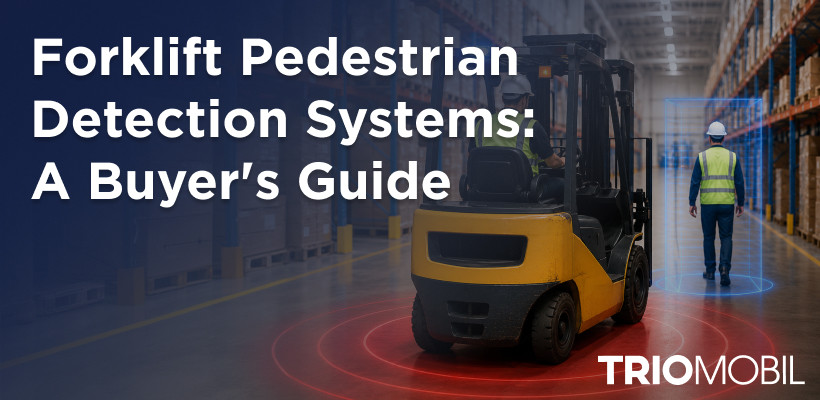
What EHS Directors and Operations Managers need to know before selecting, buying, and deploying a pedestrian detection system for forklift environments.
Forklift pedestrian detection systems have moved from a niche product category to a core procurement priority for warehouse, manufacturing, and distribution operations. Forklift-pedestrian incidents remain one of the leading causes of Serious Injury and Fatality (SIF) events in industrial environments, and physical controls alone are no longer considered sufficient by either regulators or risk insurers.
This guide is written from direct experience of deploying detection technology across automotive, logistics, and distribution environments. It covers what the technology landscape actually looks like, the questions that reveal whether a vendor is credible, how to build the internal business case, and what deployment genuinely requires.
| WHO THIS GUIDE IS FOR Organizations operating 10 or more powered industrial trucks across one or more sites with regular pedestrian co-working zones. It applies to automotive, logistics, food and beverage, retail distribution, and general manufacturing environments in the EU and United States. |
|---|
What Is a Forklift Pedestrian Detection System?
A forklift pedestrian detection system is technology installed on powered industrial trucks that detects the presence of pedestrians within a defined zone and issues a real-time warning to the operator, the pedestrian, or both, to prevent collisions before they occur.
Systems range from basic proximity sensors to AI-powered computer vision platforms that classify pedestrians, track unsafe behaviors, and generate fleet-wide safety analytics. The distinction matters: detection tells you a pedestrian is present. Intelligence tells you why your operation keeps generating the same near-miss events at the same locations,and what to do about it.
Why Detection Technology Is No Longer Optional
The traditional approach to forklift-pedestrian safety relies on three controls: physical segregation, speed limits, and operator training. These remain necessary, but they are no longer sufficient. Regulators in the EU and North America are making this explicit, and the world's most safety-conscious industrial organisations have already moved beyond compliance-driven thinking toward prevention-first safety architectures.
EU Machinery Regulation 2023/1230
The EU Machinery Regulation 2023/1230, applicable from January 2027, introduces heightened requirements for equipment operating in shared human-machine zones. Passive controls, floor markings, signage, training records, are no longer sufficient as standalone evidence of compliance. Organizations must demonstrate active, technology-backed risk mitigation. Detection and monitoring systems that generate auditable safety data are now the expected standard in any formal risk assessment for environments with regular pedestrian-forklift interaction.
OSHA (United States)
OSHA's powered industrial truck standard (29 CFR 1910.178) continues to evolve. Recent citation patterns show increasing focus on proximity management and active risk control, not equipment condition or operator licensing alone. Organisations that deploy AI-powered detection and near-miss monitoring are building the most defensible evidence base available under current enforcement posture.
The question is no longer whether detection technology is warranted. It is which system is capable of moving your organisation from reactive incident management to proactive SIF prevention, and which vendor has proven it at scale.
The Financial Case
A single serious forklift-pedestrian incident generates direct and indirect costs that typically far exceed the annual cost of a detection system deployed across an entire fleet. Direct costs include workers' compensation, medical expenses, equipment damage, and legal fees. Indirect costs, four to ten times direct costs, include production downtime, investigation, retraining, and reputational impact. Global manufacturers, FMCG operators, and logistics companies that have modeled this exposure and deployed layered detection consistently report that the investment case is resolved long before deployment is complete.
A growing body of industrial safety research suggests that the greatest challenge is not the absence of safety programs, but the inability of traditional approaches to identify and control the specific precursors of serious injuries and fatalities before an incident occurs. This is one reason why many organisations are complementing training and procedural controls with technology that provides real-time visibility into exposure and risk patterns. For a deeper examination of this shift, see Why Traditional Safety Programs Struggle to Prevent Serious Injuries.
Types of Forklift Pedestrian Detection Systems
The market segments into five technology categories. Understanding what each solves, and where each falls short, is the foundation of a sound purchasing decision.
1. Ultrasonic and Proximity Sensors
Ultrasonic sensors detect reflections from objects within range. They are low-cost and easy to install. They cannot distinguish between a pedestrian, a pallet, or a racking upright. In dense warehouse environments, false alarm rates are high, and false alarms are the documented mechanism by which detection systems fail in practice. When operators begin ignoring alerts, the system provides a false sense of security rather than actual protection.
Best for: Low-traffic environments where pedestrian-forklift interaction is infrequent and predictable. Not suitable as a primary safety layer in active operations.
2. Radar-Based Detection
Radar sensors detect movement reliably in low-light and dusty conditions and are more robust than ultrasonic systems. They still face challenges distinguishing human from non-human movement, particularly in environments with dense shelving, high traffic density, or narrow aisles. They generate alerts; they do not generate understanding of why incidents occur.
Best for: Outdoor or semi-outdoor environments and conditions where camera-based systems face consistent lighting challenges. Not suited to environments requiring behavioral analytics or fleet-level SIF exposure data.
3. Standalone Tag-Based Systems (RFID / UWB)
Standalone tag-based systems create a proximity link between a device carried by the pedestrian and a reader on the forklift. In environments with stable, well-managed workforces, these systems deliver reliable proximity detection, particularly in enclosed areas and blind spots where physical geometry limits line-of-sight detection. The fundamental constraint is that effectiveness is entirely contingent on every pedestrian carrying a tag at all times. A single untagged contractor, visitor, or temporary worker represents a gap in protection. Deployed in isolation, tag-based systems also generate no behavioral data and no fleet-level analytics.
Best for: Controlled environments with a fixed, fully managed workforce as one component of a broader safety architecture, not as a standalone solution.
4. AI-Powered Computer Vision
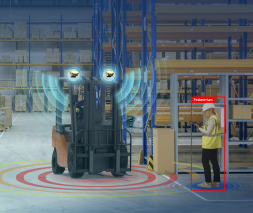
Camera-based systems using AI and machine learning detect and classify pedestrians with high accuracy, no tags, no wearables, no compliance dependencies. Leading platforms detect unsafe behaviors in real time, generate near-miss logs, and produce fleet-level data that reveals structural risk patterns across an operation. Modern systems process detection on the vehicle itself via edge computing, maintaining full functionality without network connectivity.
Best for: Complex environments with variable pedestrian traffic, contractor access, or multi-site operations where compliance-independent detection and exposure intelligence are both required.
5. AI Computer Vision + UWB Tag: The Layered Detection
The most comprehensive protection architecture combines AI computer vision with UWB tag-based proximity detection in a single integrated system. The AI camera handles tagless pedestrian detection and behavioral monitoring across the full operating zone. The UWB tag layer adds high-precision blind spot protection in areas where the forklift's physical structure limits camera coverage, junctions, rear approach zones, and narrow aisle entries where camera angles are constrained.
This distinction matters because the performance data is clear. Single-layer detection systems reduce forklift-pedestrian risk by approximately 45%. Multi-layered configurations combining AI vision with UWB proximity detection expand protection coverage to approximately 90–95%. The difference is not marginal, it reflects the structural limitation of any single technology operating without a complementary layer.
Global deployments across automotive manufacturing, FMCG, and distribution operations at scale consistently demonstrate that layered architectures outperform single-layer systems on every meaningful safety metric: near-miss reduction, incident rate, and regulatory defensibility.
Best for: Organizations with complex environments, high pedestrian traffic variability, or multi-site rollouts where maximum protection coverage and full SIF exposure intelligence are both priorities.
While detection technology selection is important, deployment requirements can vary significantly across industries. Warehouses, manufacturing plants, logistics hubs, ports, and construction sites each present different visibility challenges, traffic patterns, and pedestrian exposure risks. Understanding how pedestrian detection solutions are adapted to specific operational environments can help organizations identify the most appropriate technology mix for their facilities. These industry-specific deployment considerations are explored further in our guide to Pedestrian Detection Camera Solutions for Different Industries.
Technology Comparison at a Glance
| Technology | Tag-Free | Person vs. Object | Behavioral Data | Fleet Analytics | AI-Powered | Blind Spot Coverage |
|---|---|---|---|---|---|---|
| Ultrasonic | Yes | No | No | No | No | Partial |
| Radar | Yes | Partial | No | No | No | Partial |
| Standalone RFID / UWB | No | Yes | No | Limited | No | Yes |
| AI Computer Vision | Yes | Yes | Yes | Yes | Yes | Partial |
| AI + UWB Layered | Yes | Yes | Yes | Yes | Yes | Yes |
5 Questions to Ask Every Forklift Detection Vendor
These questions are designed to surface the difference between systems that perform in controlled demonstrations and systems that deliver sustained SIF risk reduction in live industrial environments. A vendor operating at genuine scale answers all five with specific data, not estimates.
1. Can the system detect pedestrians without requiring them to carry anything?
Tagless detection is not a feature, it is an architectural requirement for any environment with contractors, visitors, agency workers, or variable personnel. The right answer is a system that identifies pedestrians via AI computer vision regardless of what they are wearing or carrying, with UWB tag-based proximity as an enhancement layer for blind spot coverage, not as the primary detection mechanism. Ask whether both capabilities are integrated in a single platform or require separate systems from separate vendors.
2. What is the false alarm rate in a live comparable deployment and can you show it over time?
Alert fatigue is the primary mechanism by which detection systems fail in practice. Request false positive rate data at 30, 60, and 90 days post-deployment in environments comparable to yours. A credible vendor tracks this data continuously and publishes it internally. Ask specifically how the system handles occluded environments, back-lit conditions, and high object density, the scenarios where most systems degrade. Edge AI processing, developed in-house and tuned for industrial environments, is what separates high-accuracy platforms from systems that perform well only in clean conditions.
3. What does the analytics platform show and how does it help reduce SIF exposure over time?
Detection alerts prevent individual incidents. Analytics prevent the conditions that generate incidents. The right platform translates thousands of daily safety signals into leading indicators: SIF risk scores by operator, shift, and site; near-miss trend analysis identifying recurring high-risk locations; and a global safety dashboard enabling site-by-site benchmarking across multi-country operations. Ask the vendor to demonstrate what the dashboard shows after 90 days of live deployment and what corrective actions customers have taken based on that data.
4. Who are your reference customers and at what scale?
Reference customers in comparable industries at comparable scale are the most reliable indicator of deployment capability. Global automotive OEMs, multinational FMCG manufacturers, and international logistics operators operating across dozens of sites and thousands of forklifts represent a different deployment complexity than single-site references. Ask for direct conversations with EHS or Operations Managers,not marketing contacts, at customers operating in environments comparable to yours. Ask specifically about multi-country rollout experience, multi-site configuration management, and post-deployment support quality.
How to Build the Internal Business Case
The EHS or Operations Manager who advocates for this investment needs to speak the language of financial risk and measurable safety outcomes. The most effective internal cases combine quantified incident cost, a structured SIF exposure map, and reference outcomes from comparable organisations that have already deployed.
Step 1: Quantify the incident cost
Calculate the direct and indirect cost of a serious forklift-pedestrian incident at your specific facility. Use your own incident history or published benchmarks. Apply the four-to-ten times indirect cost multiplier to direct costs. This is the figure that moves budget conversations, not the cost of the system, but the financial exposure the organisation carries per incident while detection technology remains undeployed.
If your facility has no recent serious incident on record, that is not evidence of low exposure.
Many organizations approaching this step find their incident log shows no serious forklift-pedestrian events in recent years. This is frequently interpreted as confirmation that exposure is under control. The data does not support that interpretation.
Across hundreds of industrial sites, facilities with zero recordable forklift incidents have been measured carrying 20, 40, or over 80 high-risk forklift-pedestrian interactions per 100 operating hours — interactions that did not result in injury, but represent the same physical conditions that precede SIF events. The absence of a recorded incident reflects probability, not the absence of exposure.
For facilities without a recent serious incident, the financial model shifts: instead of calculating the cost of what has happened, calculate the cost of what is statistically present. Use your daily forklift operating hours, apply the industry median of 21 high-risk interactions per 100 hours from Trio Mobil's benchmark dataset, and ask how many of those interactions your current program can see, classify, and act on before one of them escalates. If the answer is none, the exposure is unquantified — not absent.
The organizations most vulnerable to a first serious SIF event are often those whose safety records have created internal confidence that the risk is managed. A clean incident log is a lagging indicator. Exposure is present now.
Step 2: Map your SIF exposure
Document the pedestrian-forklift interaction points in your facility: how many, how frequently, what controls currently exist, and where blind spots concentrate risk. This creates a SIF exposure map that makes structural risk visible, often for the first time at senior leadership level. In automotive and logistics environments where this exercise has been conducted formally, the number of daily uncontrolled pedestrian-forklift interactions is typically two to five times higher than operations managers estimate before the mapping exercise begins.
| REFERENCE OUTCOME At Beko,one of the world's leading home appliance manufacturers, 35% of all SIF events were forklift-related before deployment. After deploying a layered AI + UWB safety architecture across 32 sites in 6 countries with 1,250 forklifts and 35,000 pedestrian tags, the recorded forklift pedestrian accident count reached zero. The deployment was recognised internally as a global best practice. |
|---|
Step 3: Model cost vs. risk reduction and reference comparable deployments
Compare the three-year total cost of a layered detection system against the avoided cost of a single serious incident. Add insurance premium implications and regulatory compliance cost avoidance. Then supplement the financial model with peer outcomes: global consumer goods manufacturers have reported near-miss reductions of up to 80% following deployment. A leading chemical industry warehouse reached a 90% reduction in near-miss events. A global automotive manufacturer improved factory efficiency by 3% as a direct result of fleet intelligence data. These outcomes come from organisations that moved from single-layer or no-layer detection to a prevention-first safety architecture.
Vendor Evaluation Checklist
The criteria below reflect what separates systems that deliver sustained SIF risk reduction from systems that generate alerts without generating safety improvement. Use this checklist when shortlisting or formally evaluating vendors.
Layered detection architecture: The system combines AI computer vision (tagless) with UWB proximity detection (blind spot coverage) in a single integrated platform. Single-layer systems reach approximately 45% risk reduction. Layered systems reach approximately 90–95%.
In-house AI development: The AI model is developed and continuously improved internally — not sourced from a third-party library. In-house edge AI tuned for industrial environments delivers higher accuracy and lower false alarm rates in dense, variable conditions.
100+ monitored risk behaviours: The platform monitors unsafe behaviours beyond pedestrian-forklift proximity: PPE non-compliance, mobile phone use, improper zone entry, electrical hazards, fire risks, and contractor behaviour in restricted areas.
Global safety dashboard with leading indicators: SIF risk scores by operator, shift, and site. Near-miss trend analytics. Site-by-site and country-by-country benchmarking. Exportable for EHS management systems, regulatory reporting, and ESG disclosure.
Safety Copilot AI agent: An AI-driven conversational assistant that translates fleet safety data into actionable insights accessible to EHS teams without requiring manual data analysis.
Brand-agnostic, plug-and-play deployment: Compatible with all MHE brands and types. No proprietary hardware lock-in. Scalable from a single site to multi-country fleet rollouts.
EU Machinery Regulation documentation support: Vendor supports risk assessment records and compliance documentation for EU Machinery Regulation 2023/1230 requirements.
Multi-country deployment track record: Reference customers operating across multiple countries and sites in comparable industries,automotive, FMCG, logistics, food and beverage, with verifiable near-miss and incident reduction outcomes.
Structured pilot with defined success metrics: Vendor offers a site assessment, structured pilot programme, and performance benchmarks established before full deployment commitment.
Structured monthly SIF intelligence reporting: Vendor provides a monthly/quarterly SIF Exposure Intelligence Report combining AI-generated detection data with dedicated Customer Success analysis, covering interaction classification, forklift-level risk rankings, peak-hour patterns, and site-specific SIF precursor cases with corrective action recommendations.
Industry benchmark from live fleet data: Vendor delivers comparative benchmark data drawn from thousands of forklifts and hundreds of industrial sites, normalised by operating hours, enabling direct comparison of SIF exposure rates against automotive, logistics, FMCG, and food and beverage industry peers.
Beyond Detection: Why SIF Exposure Intelligence Is the Real Differentiator
Most detection systems solve the alert problem. The most advanced platforms solve the exposure problem which is fundamentally different and delivers compounding value over the lifetime of the deployment.
An alert tells an operator a pedestrian is present. SIF exposure intelligence tells the operations team that a specific intersection generates near-miss events on night shifts at a rate three times higher than any other location in the facility and has done so for six months without anyone quantifying it. A leading platform translates thousands of daily safety signals into a SIF Risk Index scored from 0–10 for every operator, team, and site. It identifies recurring unsafe behaviours, high-risk locations, and the shifts most exposed to SIF events before those events materialise.
This level of analytics also directly supports ESG disclosure and board-level reporting. Measurable, auditable proof of proactive SIF management, near-miss trends, risk score trajectories, incident rate comparisons, is increasingly required by investors, insurers, and regulatory bodies. A global safety dashboard that enables site-by-site and country-by-country benchmarking gives EHS leadership the evidence base to demonstrate safety maturity progression at every level of the organisation.
The AI Safety Copilot takes this further: an AI-driven conversational assistant that answers questions such as "What were the highest-risk interactions this week?" or "Which operators have the highest SIF exposure score?" by turning complex safety data into decisions that non-specialist managers can act on immediately.
The focus on exposure intelligence reflects a broader shift in industrial safety management toward preventing serious injuries and fatalities rather than simply responding to incidents after they occur. By identifying high-risk interactions, recurring exposure patterns, and leading indicators of severe events, organisations can prioritise interventions where they have the greatest impact. To learn more about this approach, read What Is SIF Prevention and Why Is It Critical in Forklift Operations?.
Deployment: What Actually Determines Success
The systems that fail in deployment are rarely the wrong technology. They are the right technology, poorly implemented. The organisations that achieve the sharpest SIF reduction, zero forklift pedestrian accidents at Beko across 32 sites, zero incidents at Coca-Cola Hellenic Bottling Company across 23 facilities in 11 countries within the first year, share four deployment practices in common.
Site-based risk assessment before configuration begins
Effective deployment starts with a formal site assessment that uses real operational data to identify location-specific hazards, traffic patterns, and blind spot concentrations. Detection zones, alert thresholds, and Flex Zone configurations are designed around how the facility actually operates, not a generic default. This assessment also produces the documentation required for EU Machinery Regulation risk assessment records.
Operator acceptance as a deployment prerequisite
Operators who perceive the system as surveillance find ways to circumvent it. Structured pre-deployment briefings that frame the technology as a safety support tool, and establish clear, transparent expectations about how safety data will and will not be used in performance management are not optional. The adoption rate difference between organisations that run these briefings and those that skip them is material and measurable.
Calibration as an ongoing process, not a one-time event
Initial calibration is site-specific and requires tuning against live operating conditions. Flex Zone technology allows detection zones to be shaped as rectangles rather than fixed circles by aligning safety zones with real movement patterns and preventing unnecessary slowdowns in high-traffic areas where the forklift poses no actual risk. Allow four to eight weeks before measuring performance against benchmarks, and schedule calibration reviews at regular intervals as environments and traffic patterns evolve.
Multi-site configuration discipline for global rollouts
Every site requires adapted configuration. A system optimised for a high-ceiling cross-dock will need different settings in a low-clearance cold store or a narrow-aisle picking facility. The organisations that achieve the fastest multi-site rollouts, including global deployments across dozens of countries, document site-specific configurations formally and use each successive deployment to refine the rollout playbook. Configuration time decreases materially after the first two or three sites when this discipline is in place.
Frequently Asked Questions
A proximity sensor detects any object within range without distinguishing between a pedestrian, a pallet, or a structural element. This generates high false alarm rates and alert fatigue. An AI-powered pedestrian detection system identifies and classifies human presence specifically by dramatically reducing false alarms and generating the behavioral data needed for proactive SIF exposure management. The practical difference in live deployment is that proximity sensors are frequently ignored; AI detection systems with low false alarm rates are used consistently.
It depends on the architecture. Pure tag-based systems require every pedestrian to carry a device, creating a compliance dependency that breaks down whenever an untagged contractor, visitor, or agency worker enters the facility. AI computer vision systems detect pedestrians without any tags or wearables. The most effective architecture combines both: AI camera for tagless detection across the full operating zone, with UWB tags providing enhanced blind spot coverage where camera angles are physically constrained. This layered approach delivers approximately 90–95% protection coverage compared to approximately 45% for single-layer systems.
The EU Machinery Regulation 2023/1230, applicable from January 2027, substantially increases the obligation to demonstrate active risk mitigation for equipment operating in shared human-machine zones. Passive controls alone are no longer sufficient as standalone evidence of compliance. Detection and monitoring systems that generate auditable near-miss data and risk assessments are the most defensible control measure available and are increasingly the expected standard in formal risk assessments across the EU.
Verified outcomes from industrial deployments include: a global consumer goods manufacturer reporting an 80% reduction in near-miss events; a leading food production company reducing near misses by 80%; a chemical industry warehouse reaching a 100% reduction in near-miss events; a boiler and air conditioner manufacturer eliminating near misses entirely. At Beko, 35% of all SIF events were forklift-related before deployment after full deployment across 32 sites in 6 countries, zero forklift pedestrian accidents were recorded.
Effective multi-country deployment begins with a site assessment that uses real operational data to identify site-specific hazards and configure detection zones accordingly. A pilot site establishes performance benchmarks before full fleet commitment. Configuration is then documented and adapted for each successive site with deployment time decreasing materially after the first two or three locations. Organisations with 200 or more sites across multiple countries have deployed successfully using this rollout model, with brand-agnostic hardware compatible across all MHE types and manufacturers.
A global safety dashboard that tracks SIF risk scores, near-miss trends, and incident rates by operator, site, and country produces the measurable, auditable evidence base that ESG disclosure and board-level safety reporting requires. The system quantifies safety maturity progression over time,from reactive to proactive to predictive, and generates the leading indicator data that demonstrates active SIF management to investors, insurers, and regulatory bodies. Several global manufacturers have incorporated this data directly into board-level ESG strategy and annual safety reporting.
About Trio Mobil
Trio Mobil is a prevention-first industrial safety platform deployed across automotive, logistics, food and beverage, and distribution operations in more than 65 countries. With over 1 million connected devices and 2,000+ customers globally, Trio Mobil serves organisations including Ford, Coca-Cola, Unilever, Saint-Gobain, Mercedes-Benz, Nestlé, and Bridgestone.
For a 20-minute site-specific walkthrough of how Trio Safe AI is deployed in an environment comparable to yours, contact your regional Trio Mobil representative or visit triomobil.com.

Product Catalogue 2026
Download our catalog and gain access to a wealth of information on how to enhance industrial safety and efficiency. Our latest catalog features a diverse range of products and services that can help you achieve your goals.

Our Latest Blogs


Learn more about Trio Mobil's Solutions
Fill out the form and we'll contact you!