

Trio Mobil Global Technology Innovation Leader in AI-Based Industrial Safety
Read the Frost & Sullivan Analysis

What Is a Forklift Monitoring System and Why Your Warehouse Needs One
 Aug 04, 2026
 4 min
4 min 487
487
A forklift monitoring system is more than a tool for tracking vehicles. Modern platforms combine AI, RTLS, telematics, and IoT technologies to provide continuous visibility into forklift activity, workplace interactions, traffic flow, and operational performance.
In this guide, we'll explore what a forklift monitoring system is, how it works, how it differs from forklift telematics, and how it helps organizations improve operational visibility, fleet management, and warehouse efficiency.
What Is a Forklift Monitoring System?
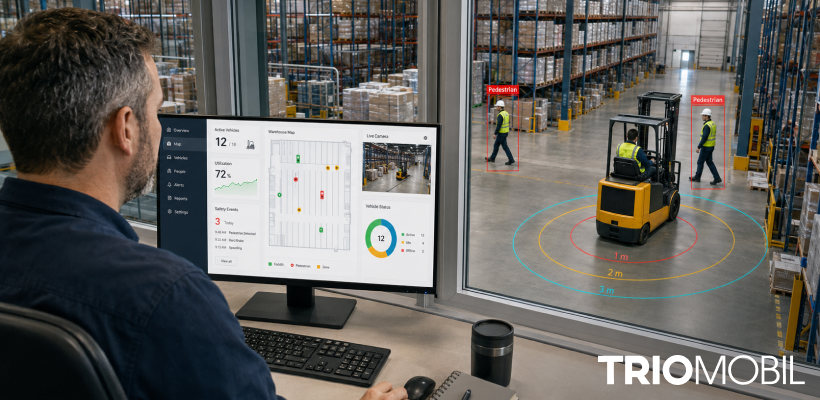
A forklift monitoring system is a technology platform that continuously collects and analyzes data related to forklift activity within industrial facilities. Its purpose is to provide organizations with greater visibility into equipment movements, operational workflows, workplace interactions, and fleet performance.
Unlike traditional approaches that rely primarily on manual observations, periodic inspections, or incident reporting, forklift monitoring systems provide continuous operational visibility by combining data from technologies such as AI-powered video analytics, real-time location systems (RTLS), IoT sensors, telematics, and cloud-based analytics platforms.
Rather than focusing on a single forklift, these systems help organizations understand how forklifts interact with people, assets, infrastructure, and production processes throughout an entire facility.
Depending on the technologies deployed, a forklift monitoring system may provide insights into:
- Equipment movements and travel routes
- Forklift utilization and idle time
- Traffic density and congestion
- Loading dock activity
- Pedestrian and vehicle interactions
- Zone occupancy
- Operational bottlenecks
- Warehouse traffic patterns
- Fleet performance trends
The objective is not simply to monitor forklifts. It is to transform operational activity into actionable intelligence that supports safer, more efficient, and better-informed industrial operations.
Why Forklift Monitoring Matters Today
Warehouse operations are evolving rapidly.
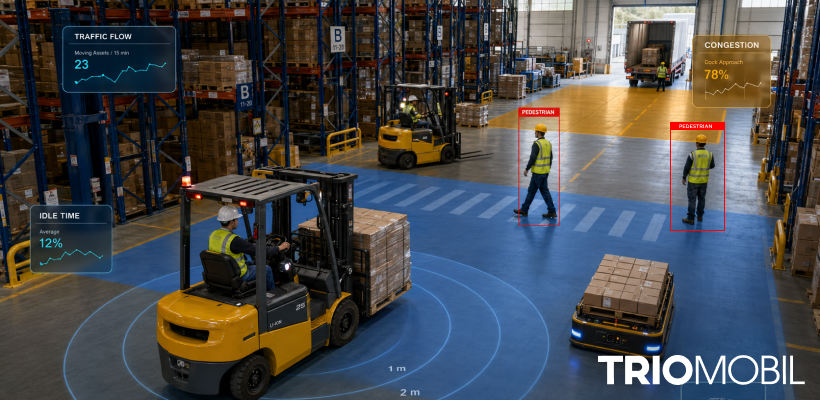
Higher throughput expectations, labor shortages, growing levels of automation, and increasingly complex material flows are changing how industrial facilities operate. Forklifts now share the same environment with pedestrians, contractors, automated guided vehicles (AGVs), autonomous mobile robots (AMRs), and other mobile equipment, creating more dynamic and interconnected workplaces.
Many organizations have already implemented essential safety controls, including:
- Operator training
- Traffic management plans
- Speed limits
- Pedestrian walkways
- Safety signage
- PPE requirements
- Standard operating procedures
These measures remain fundamental to warehouse safety. However, they often provide limited visibility into how operations actually unfold throughout the day.
For example:
- Where do forklifts and pedestrians interact most frequently?
- Which intersections experience recurring congestion?
- Which travel routes generate the highest equipment traffic?
- Are forklifts spending excessive time idling?
- Which loading docks experience operational delays?
- Where are high-risk interactions consistently occurring?
- How do traffic patterns change between shifts?
Without continuous monitoring, many of these questions can only be answered through manual observations or after an operational issue has already become apparent.
A forklift monitoring system helps organizations move beyond isolated observations by providing continuous operational visibility across the warehouse. Instead of relying solely on lagging information such as incident reports, organizations can better understand daily operational patterns, identify recurring areas of concern, and support data-informed decision-making.
For many organizations, forklift monitoring has become not only an operational efficiency initiative but also an important component of broader operational visibility, risk visibility, and continuous improvement strategies.
Forklift Monitoring vs. Forklift Telematics
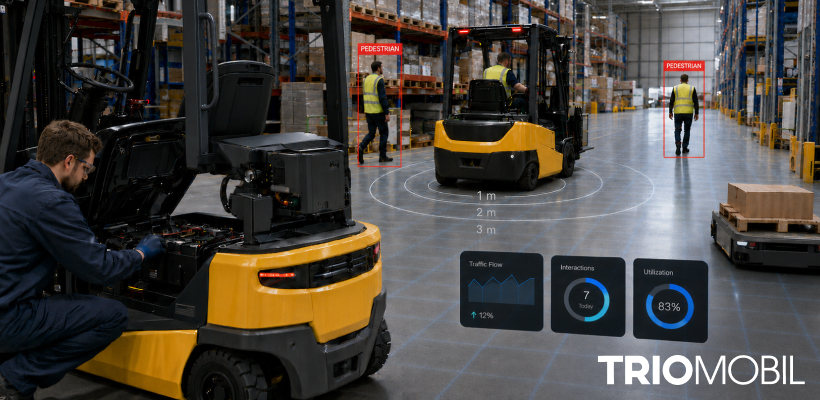
The terms forklift monitoring and forklift telematics are often used interchangeably, but they serve different purposes.
Forklift telematics primarily focuses on the vehicle itself, collecting information related to equipment health, maintenance, diagnostics, and utilization.
A forklift monitoring system takes a broader view by combining vehicle data with information about workplace activity, operational workflows, traffic patterns, and interactions occurring throughout the facility.
| Forklift Telematics | Forklift Monitoring Systems |
|---|---|
| Vehicle diagnostics | Operational visibility |
| Maintenance scheduling | Workplace activity monitoring |
| Equipment utilization | Traffic flow analysis |
| Engine and battery data | Pedestrian and vehicle interactions |
| Operator login records | AI-powered operational insights |
| Fleet management | Risk visibility and operational intelligence |
In many industrial environments, these technologies complement rather than replace one another. Telematics provides valuable information about the condition and performance of individual vehicles, while forklift monitoring systems help organizations understand how forklifts operate within the broader context of warehouse and manufacturing operations.
Increasingly, enterprise organizations are combining telematics, AI-powered video analytics, and RTLS technologies to create a more comprehensive picture of operational performance, workplace activity, and industrial safety.
How Does a Forklift Monitoring System Work?
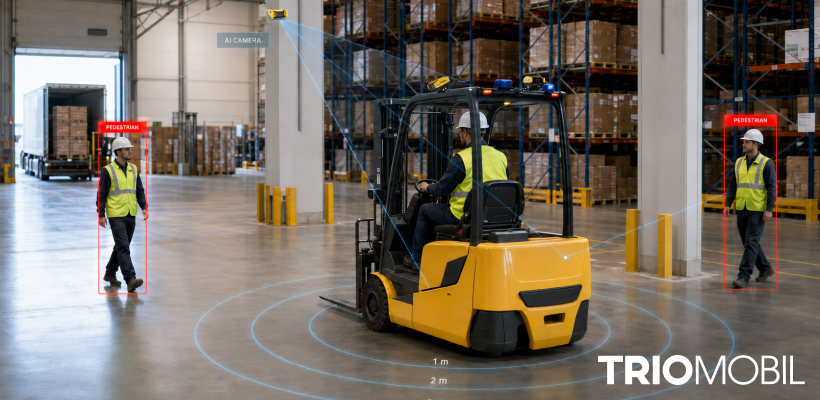
Although forklift monitoring systems vary by vendor and application, most modern platforms follow a similar process: they collect operational data, analyze it in real time, identify meaningful events, and present actionable insights to warehouse, operations, and EHS teams.
Rather than relying on a single technology, today's enterprise platforms increasingly combine AI-powered video analytics, real-time location systems (RTLS), IoT devices, and fleet telematics to create a more complete understanding of workplace activity.
1. Capturing Operational Data
The first step is collecting information from across the facility.
Depending on the deployment, a forklift monitoring system may receive data from:
- Existing CCTV cameras
- AI-enabled cameras
- UWB RTLS infrastructure
- Vehicle telematics
- IoT sensors
- Operator access systems
- Wearable devices
- Warehouse management or fleet management platforms
- Warehouse management or fleet management platforms
Combining multiple data sources allows organizations to move beyond isolated events and develop a broader understanding of how equipment, people, and operational processes interact throughout the facility.
2. Interpreting Activity with AI
Collecting data alone provides limited value unless organizations can understand what the data represents.
This is where AI-powered video analytics has become an important component of modern forklift monitoring systems.
Using industrial computer vision, AI continuously analyzes live video streams to recognize predefined objects, movements, and workplace activities. Instead of simply recording footage for later review, AI transforms video into structured operational data that can be analyzed in real time.
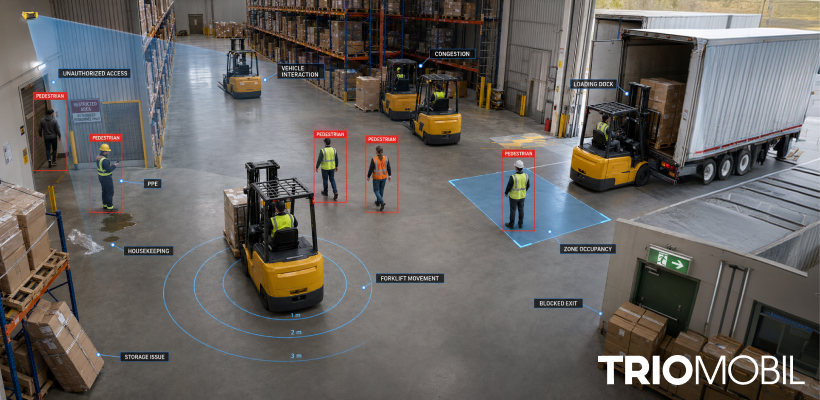
Depending on system configuration, AI may identify activities such as:
- Forklift movement
- Pedestrian presence
- Vehicle-to-vehicle interactions
- Congestion
- Loading dock activity
- Zone occupancy
- Unauthorized access
- PPE observations
- Housekeeping conditions
- Blocked emergency exits
- Material storage issues
Because AI continuously interprets activity as it occurs, organizations gain visibility into operational conditions that may otherwise go unnoticed during routine inspections.
This approach supports a shift from reviewing historical footage toward understanding workplace activity as it unfolds.
3. Monitoring Location and Movement with RTLS
While AI provides visual context, Real-Time Location Systems (RTLS) provide precise positional data for forklifts, people, and mobile assets.
Many industrial facilities use Ultra-Wideband (UWB) RTLS because it offers highly accurate indoor positioning where GPS is unreliable.
RTLS helps organizations answer questions such as:
- Where are forklifts operating most frequently?
- Which travel routes experience the highest traffic?
- How long do forklifts remain at loading docks?
- Where do congestion points consistently occur?
- Which assets remain underutilized?
Because RTLS continuously measures movement throughout a facility, it provides objective operational data that supports warehouse optimization, asset management, and process improvement initiatives.
Rather than replacing AI, RTLS complements it by adding location intelligence to visual observations.
AI Video Analytics and RTLS: Better Together
Organizations sometimes view AI video analytics and RTLS as competing technologies.
In practice, they solve different challenges.
| AI Video Analytics | RTLS (UWB) |
|---|---|
| Understands what is happening | Understands where it is happening |
| Uses existing or dedicated cameras | Uses positioning infrastructure |
| Detects workplace activity | Measures real-time location |
| Provides visual operational context | Provides precise indoor positioning |
| Supports behavioral and operational analysis | Supports movement and asset tracking |
Many enterprise deployments combine both technologies to create a more comprehensive picture of industrial operations.
For example, RTLS may identify that multiple forklifts frequently converge at a specific intersection, while AI video analytics helps explain why congestion occurs by analyzing traffic flow, pedestrian movement, or operational behaviors at that location.
Together, these technologies provide richer operational intelligence than either solution alone.
From Monitoring Forklifts to Monitoring Risk
Historically, forklift monitoring focused primarily on vehicle location, utilization, and maintenance.
Today, organizations are increasingly interested in understanding how operational conditions influence workplace risk.
Rather than asking only:
"Where is the forklift?"
many organizations now ask:
- Where are high-risk interactions occurring?
- Which operational areas experience recurring congestion?
- Where do forklifts and pedestrians frequently share the same workspace?
- Which traffic patterns change during shift transitions?
- Which locations consistently generate operational conflicts?
This broader perspective represents a shift from monitoring equipment toward improving risk visibility across industrial operations.
Instead of relying solely on incident investigations or periodic workplace observations, organizations can continuously analyze operational activity and identify patterns that may warrant further review.
To learn how AI helps organizations identify and address operational risks before they become serious incidents, read our article: How AI-Powered Risk Monitoring Reduces High-Risk Events in Industrial Operations.
Why Risk Visibility Matters
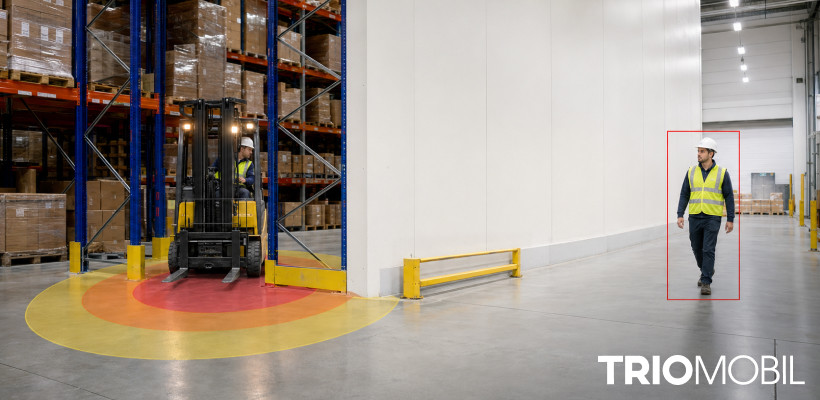
Every industrial facility contains areas where operational complexity naturally increases.
These may include:
- Blind intersections
- Loading docks
- Shipping and receiving areas
- Pedestrian crossings
- High-bay storage aisles
- Battery charging areas
- AGV crossing points
- Narrow travel lanes
- Staging zones
These locations are not inherently unsafe. However, they often involve higher volumes of vehicle movement, pedestrian activity, or operational complexity.
Continuous monitoring helps organizations understand how these environments function over time, making it easier to identify recurring trends, evaluate traffic patterns, and prioritize operational improvements.
Rather than focusing only on isolated incidents, organizations gain greater visibility into the conditions that shape day-to-day operational performance.
Supporting Leading Indicators Through Continuous Visibility
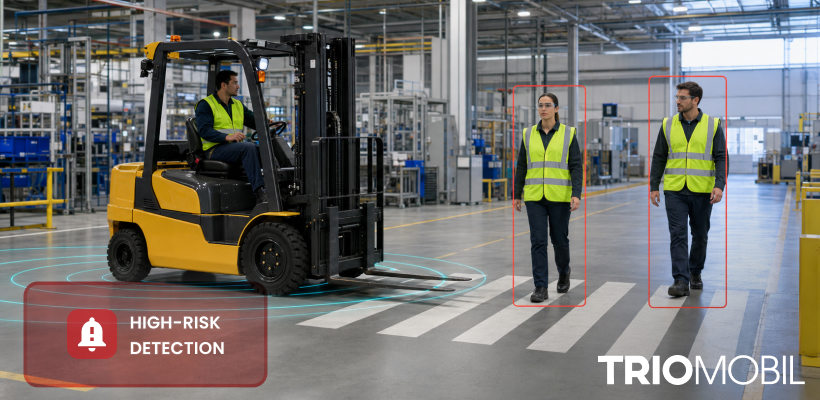
Many organizations are expanding their safety strategies beyond traditional lagging indicators such as recordable incidents or lost-time injuries.
Increasingly, EHS and operations teams are also monitoring leading indicators that provide earlier insight into workplace conditions and operational performance.
Examples may include:
- Traffic density trends
- Repeated congestion
- Frequent pedestrian-vehicle interactions
- Recurring zone entries
- Equipment idle time
- Travel route deviations
- Near-interaction frequency
- Operational bottlenecks
While these observations do not predict future incidents, they can help organizations better understand where operational complexity is increasing and where additional evaluation or process improvements may be appropriate.
Continuous visibility enables these trends to be monitored consistently across shifts, departments, and facilities.
Forklift Monitoring and SIF Prevention Initiatives
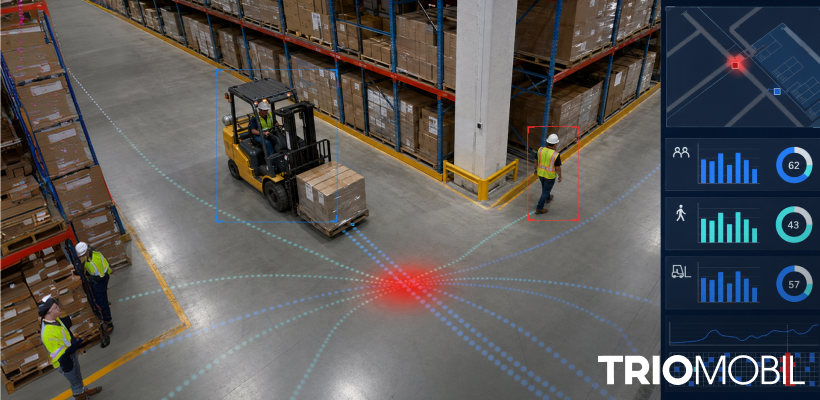
Many organizations are also strengthening their focus on Serious Injury and Fatality (SIF) prevention.
Although every workplace has unique operational risks, interactions involving industrial vehicles, pedestrians, and high-energy equipment are widely recognized as areas requiring careful management.
Forklift monitoring systems can support broader SIF prevention initiatives by helping organizations better understand where these interactions occur, how frequently they occur, and how operational conditions evolve over time.
Rather than relying solely on incident data, continuous monitoring provides additional context that may help organizations evaluate exposure, prioritize engineering or administrative controls, and support ongoing risk assessment processes.
It is important to recognize that monitoring technology is only one component of a comprehensive safety program. Effective SIF prevention also depends on workplace design, operational procedures, employee training, supervision, and organizational safety culture.
Benefits of a Forklift Monitoring System
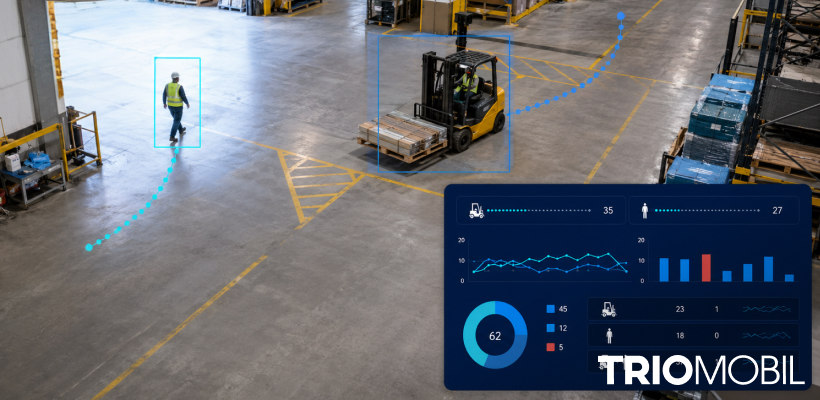
Organizations implement forklift monitoring systems for different reasons. Some begin with safety objectives, while others focus on improving operational efficiency, equipment utilization, or warehouse performance.
In practice, the greatest value often comes from combining these objectives through a single platform that provides continuous visibility into warehouse operations.
Improve Operational Visibility
One of the primary benefits of a forklift monitoring system is the ability to understand how operations function throughout the day.
Instead of relying on manual observations or periodic audits, organizations can continuously monitor equipment movements, traffic patterns, and operational activity across the facility.
This visibility enables operations teams to identify recurring bottlenecks, evaluate workflow changes, and make decisions based on objective operational data rather than assumptions.
Strengthen Risk Visibility
Industrial environments are constantly changing. Traffic density, production schedules, warehouse layouts, and staffing levels all influence how forklifts move throughout a facility.
Continuous monitoring helps organizations understand where operational complexity is increasing and where additional evaluation may be beneficial.
Rather than focusing solely on incident outcomes, organizations gain greater visibility into workplace conditions that evolve over time.
This broader understanding supports ongoing risk assessments and continuous improvement initiatives.
Support More Efficient Fleet Management
Forklifts represent a significant operational investment.
Without accurate utilization data, organizations may struggle to determine:
- Whether additional equipment is required
- Which forklifts are underutilized
- Which vehicles experience consistently high workloads
- How travel routes affect productivity
- Where idle time can be reduced
Monitoring systems provide objective operational data that supports better fleet planning and equipment allocation.
For a deeper look at how monitoring data supports utilization, maintenance, and fleet optimization, see our guide: What Is Forklift Fleet Management?
Optimize Warehouse Traffic Flow
Congestion is rarely caused by a single forklift.
More often, it develops gradually through a combination of traffic patterns, operational processes, warehouse layout, and equipment movements.
Monitoring platforms help visualize:
- High-traffic intersections
- Congested travel lanes
- Loading dock activity
- Waiting times
- Material flow patterns
- Shift-based traffic variations
These insights help warehouse teams evaluate layout improvements, adjust traffic rules, and improve operational efficiency.
Support Continuous Improvement Programs
Many organizations already use methodologies such as Lean Manufacturing, Operational Excellence, Kaizen, or Six Sigma to improve performance.
Forklift monitoring systems contribute to these initiatives by providing measurable operational data that helps teams evaluate process changes over time.
Rather than relying on isolated observations, organizations can assess the impact of improvements using consistent operational metrics.
Improve Multi-Site Visibility
For organizations operating multiple warehouses or manufacturing facilities, maintaining consistent operational standards can be challenging.
Enterprise forklift monitoring platforms help standardize visibility across sites by providing centralized dashboards, common reporting structures, and comparable operational metrics.
This enables corporate EHS, operations, and supply chain teams to identify recurring trends, share best practices, and support data-informed decision-making across the organization.
Industries That Benefit from Forklift Monitoring
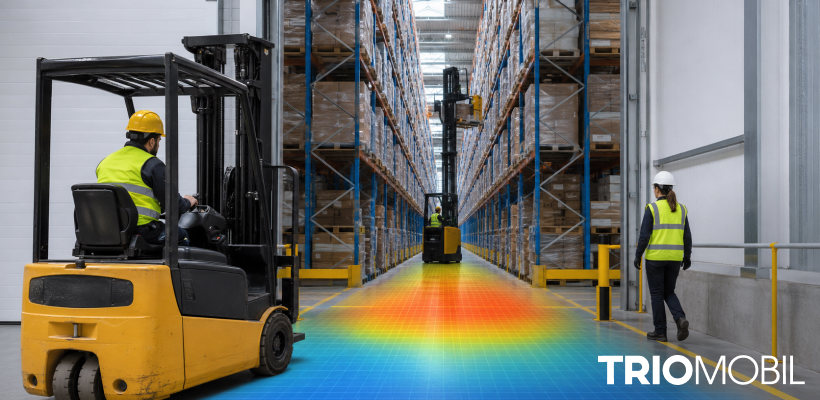
Forklift monitoring systems are widely used across industries where industrial vehicles play a critical role in material handling and logistics.
Common applications include:
- Manufacturing
- Warehousing and distribution
- Third-party logistics (3PL)
- Automotive
- Food and beverage
- Pharmaceuticals
- Consumer packaged goods (CPG/FMCG)
- Chemicals
- Cold storage
- Ports and terminals
- Building materials
- Paper and packaging
- Retail distribution centers
While operational requirements vary between industries, the need for better visibility into equipment movement, traffic patterns, and operational performance is increasingly common across industrial environments.
How to Choose the Right Forklift Monitoring System
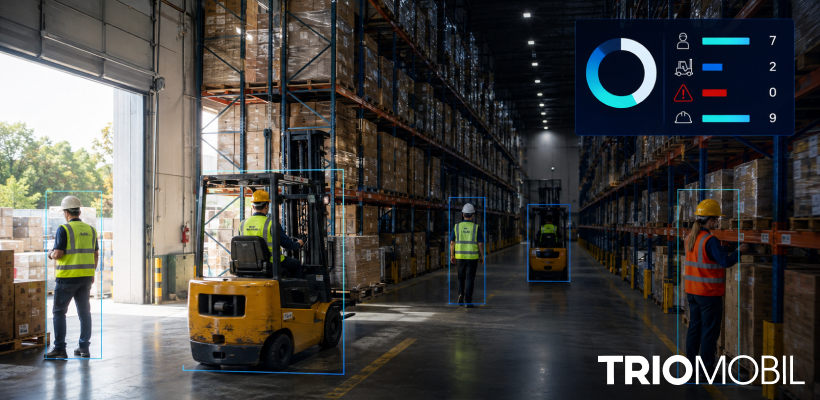
Not every forklift monitoring platform provides the same level of visibility or functionality.
When evaluating solutions, organizations should look beyond basic tracking capabilities and consider how the platform will support long-term operational objectives.
Questions worth asking include:
- Can the platform use existing CCTV infrastructure?
- Does it support AI-powered video analytics?
- Is RTLS available for precise indoor positioning?
- Can AI and RTLS work together?
- Does the system scale across multiple facilities?
- Can dashboards be customized for operations and EHS teams?
- Does it integrate with warehouse, fleet, or enterprise systems?
- Can it provide actionable operational insights rather than simply collecting data?
- Is the platform adaptable as operational requirements evolve?
Selecting a scalable platform allows organizations to build on today's investment while supporting future digital transformation initiatives.
Choosing the right technology is only part of the decision. To learn what to look for in a solution provider, including deployment expertise, support capabilities, and long-term partnership considerations, read our comprehensive guide: How to Choose Your Forklift Safety System Provider?
Explore AI-Powered Forklift Monitoring with Trio Mobil
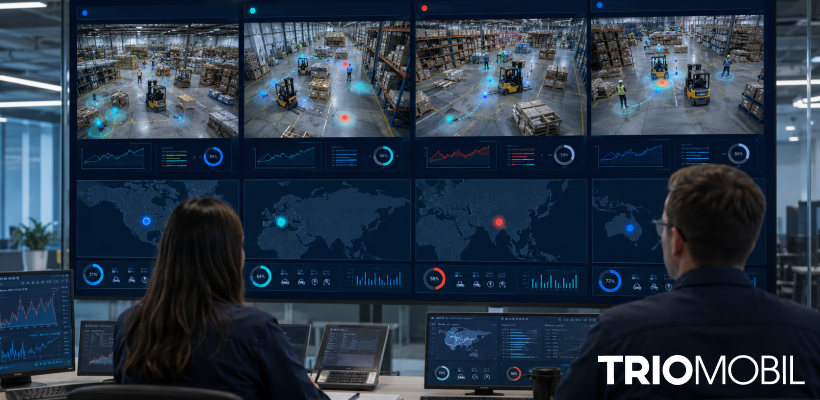
At Trio Mobil, we help manufacturers, warehouses, logistics providers, and industrial organizations improve operational visibility through AI-powered video analytics, UWB RTLS, and intelligent industrial safety technologies.
Our forklift safety systemprovides real-time insight into equipment movements, workplace interactions, traffic patterns, and operational conditions, helping organizations make better-informed decisions across safety, operations, and continuous improvement initiatives.
If you're exploring how AI-powered operational visibility can support your warehouse or manufacturing facility, contact our team to learn more about Trio Mobil's industrial AI solutions.
Frequently Asked Questions
A forklift monitoring system is a technology platform that collects and analyzes operational data related to forklift activity. Modern systems may combine AI-powered video analytics, RTLS, IoT devices, and telematics to improve visibility into equipment movements, workplace interactions, and operational performance.
Forklift telematics focuses primarily on vehicle diagnostics, maintenance, and equipment performance. Forklift monitoring provides broader visibility into operational activity, traffic flows, workplace interactions, and warehouse performance.
Yes. Many AI-powered forklift monitoring platforms can analyze video from existing CCTV cameras, allowing organizations to gain operational insights without replacing their current camera infrastructure.
Not always.
Some applications rely solely on AI-powered video analytics, while others use RTLS wearables to achieve precise indoor positioning. Many enterprise deployments combine multiple technologies depending on operational requirements.
Yes.
AI video analytics and RTLS provide different types of information. AI helps interpret workplace activity, while RTLS provides precise location data. Combining both technologies creates a more comprehensive understanding of warehouse operations.
Forklift monitoring provides continuous insight into equipment movement, traffic patterns, congestion, workplace interactions, and operational workflows, helping organizations better understand how industrial operations function throughout the day.
Many organizations use forklift monitoring data to better understand operational conditions associated with high-energy interactions involving industrial vehicles. Continuous visibility can support broader SIF prevention initiatives by providing additional information for risk assessments, engineering controls, and operational improvements as part of a comprehensive safety strategy.
Leading indicators are measurable operational observations that provide insight into workplace conditions before incidents occur. Examples include traffic density, recurring congestion, frequent pedestrian-vehicle interactions, repeated zone entries, and near-interaction trends.
Forklift monitoring is commonly used in manufacturing, warehousing, logistics, automotive, food and beverage, pharmaceuticals, ports, cold storage, retail distribution, and other industrial sectors where forklifts play a central role in daily operations.
No.
While forklift monitoring can support workplace safety initiatives, it is also widely used to improve equipment utilization, optimize warehouse traffic, increase operational visibility, support continuous improvement, and enhance overall warehouse performance.

Product Catalogue 2026
Download our catalog and gain access to a wealth of information on how to enhance industrial safety and efficiency. Our latest catalog features a diverse range of products and services that can help you achieve your goals.
Our Latest Blogs


Learn more about Trio Mobil's Solutions
Fill out the form and we'll contact you!