


Trio Mobil Global Technology Innovation Leader in AI-Based Industrial Safety
Read the Frost & Sullivan Analysis

What Is a Forklift Speed Limiter? A Key Tool for Safety and Compliance in High-Traffic Zones
 Aug 05, 2026
 3 min
3 min 444
444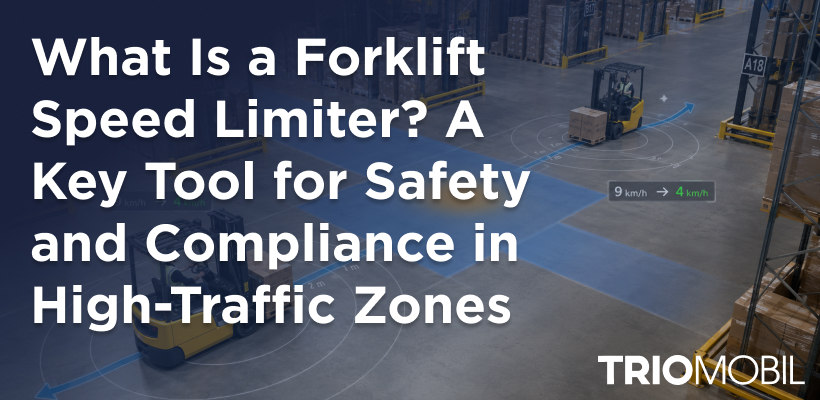
Forklift speed limiters help organizations manage vehicle speeds according to operational conditions rather than relying on a single fixed speed across an entire facility. Modern systems can automatically apply configurable speed reductions in areas such as pedestrian crossings, blind intersections, loading docks, and other high-traffic zones.
In this guide, we'll explain what a forklift speed limiter is, how intelligent speed management works, the technologies that support it, and how organizations can evaluate the right solution for their operations.
What Is a Forklift Speed Limiter?
A forklift speed limiter is a system that restricts or automatically reduces a forklift's travel speed according to predefined operating rules, operational zones, or real-time conditions.
Unlike a fixed mechanical speed restriction, intelligent speed management systems can adjust operating speed dynamically based on configured safety rules. When integrated with compatible vehicle controls, the system can automatically command a configured speed reduction when specified conditions are detected, reducing reliance on manual operator action in higher-risk areas.
Depending on system configuration, speed management may be triggered by:
- Entering designated operational zones
- Detecting nearby pedestrians
- Detecting nearby forklifts or other material handling equipment
- Approaching blind intersections
- Entering loading dock areas
- Other site-specific traffic management rules
The objective is not simply to reduce forklift speed. It is to help organizations operate forklifts at speeds appropriate for the surrounding environment and level of operational risk while supporting productivity.
Why Forklift Speed Management Matters
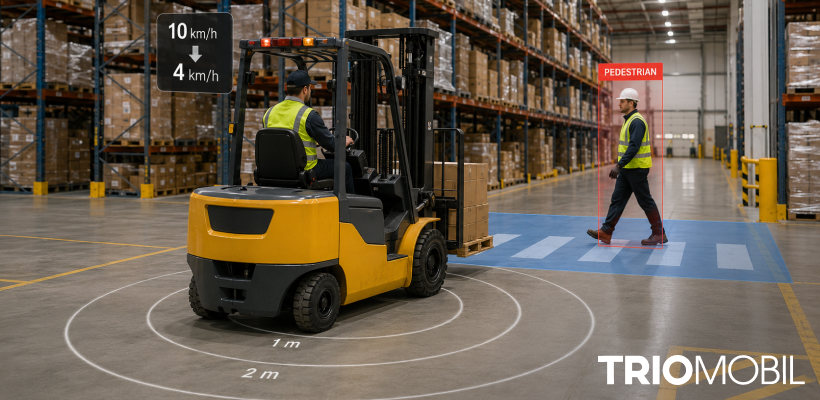
Vehicle speed directly influences reaction time, stopping distance, maneuverability, and collision energy.
As travel speed increases, operators generally have less time to recognize hazards and resp,,,,,,,,ond appropriately. In facilities where forklifts and pedestrians share operating areas, managing vehicle speed is one element of a broader workplace safety strategy.
Higher operating speeds may contribute to risks including:
- Forklift-pedestrian interactions
- Forklift-to-forklift collisions
- Blind corner incidents
- Reduced reaction time
- Load instability during turning
- Longer stopping distances
- Traffic congestion
Speed alone is rarely the sole cause of an incident. Most workplace events result from multiple contributing factors, including visibility, traffic flow, operator awareness, facility layout, and operating procedures.
For this reason, many organizations implement speed management alongside:
- Traffic management planning
- Pedestrian segregation
- Operator training
- AI-assisted hazard detection
- Real-time location visibility
- Near-miss monitoring
- Continuous safety improvement
Configurable speed management complements these measures by providing an additional layer of operational control.
OSHA and Industry Guidance About Forklift Speed Limits
OSHA's Powered Industrial Truck standard (29 CFR 1910.178) requires employers to operate forklifts safely and address workplace hazards through appropriate operating procedures, training, and supervision. While OSHA does not prescribe specific forklift speed limits or require speed limiting technology, many organizations implement configurable speed management as part of their overall risk reduction strategy.
Industry guidance such as ANSI/ITSDF B56.1 also emphasizes operating forklifts at speeds appropriate for workplace conditions and maintaining safe control of the vehicle.
Understanding the most common causes of forklift-related incidents can also help organizations strengthen their overall safety strategy. Learn more in our guide: What Are the Main Causes of Injuries When Using Forklifts?
Mechanical Speed Limiters vs Intelligent Speed Management
While traditional mechanical speed limiters enforce a single, fixed maximum speed, intelligent speed management dynamically applies configurable speed rules based on operational context, enabling safer and more flexible vehicle operation.
| Traditional Speed Limiter | Intelligent Speed Management |
|---|---|
| One fixed maximum speed | Multiple configurable speed profiles |
| Same speed everywhere | Zone-specific operation |
| No environmental awareness | Responds to configured operating conditions |
| Manual adjustments | Automated based on predefined rules |
| Limited flexibility | Easily adaptable as facilities evolve |
Where Are Forklift Speed Limiters Commonly Used?
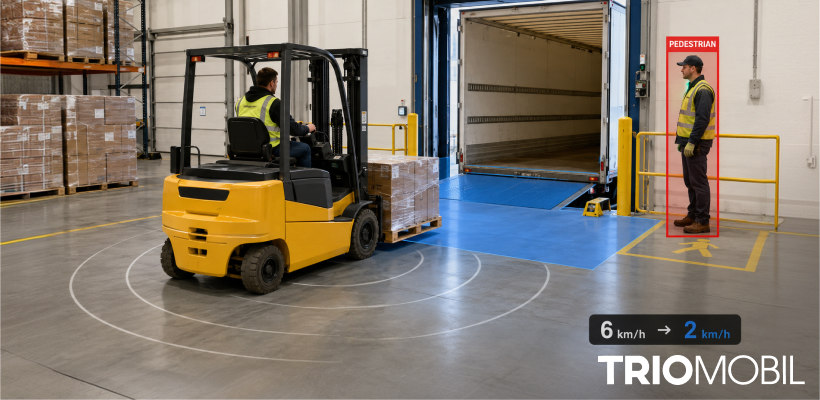
Modern facilities typically apply different speed management policies depending on operational risk.
These include:
- Pedestrian crossings
- Blind intersections
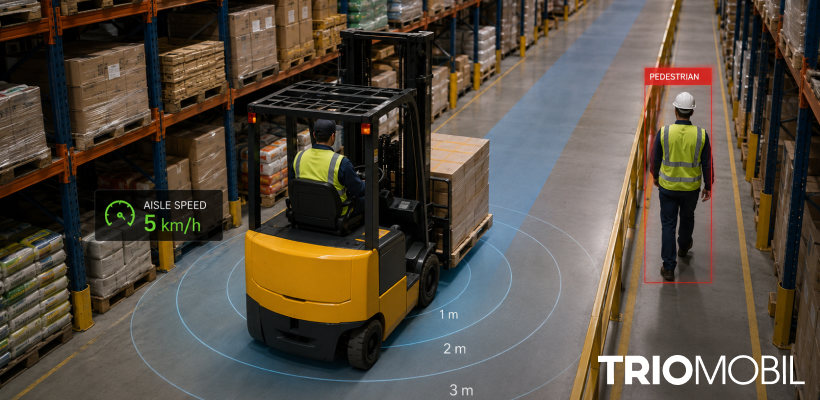
- Warehouse aisles
- Loading docks
- Production areas
- Temporary maintenance zones
For example, Trio Safe AI Camera can detect pedestrians within its monitored field of view and generate configurable alerts. When integrated with compatible vehicle controls, organizations may also configure controlled speed reduction when predefined intervention conditions are met.
Similarly, Trio Safe AI UWB enables proximity detection using wearable Ultra Tags, allowing organizations to support blind-spot protection in environments where direct visual line of sight may be limited.
Types of Forklift Speed Management
Fixed Speed Limiting
Applies one permanent maximum speed regardless of operating conditions.
Zone-Based Speed Management
Different speed profiles are automatically applied when forklifts enter predefined virtual zones using RTLS infrastructure and Zone Anchors.
Organizations can configure independent operating rules for:
- Warehouse aisles to help maintain safe operating speeds in narrow travel lanes with frequent vehicle movement.
- Loading docks where reduced speeds can support safer maneuvering during loading and unloading operations.
- Pedestrian crossings to encourage slower vehicle movement in areas where people and forklifts may share the same workspace.
- Production lines where controlled speeds can help accommodate changing traffic conditions around equipment and personnel.
- Restricted areas where access rules or operational requirements call for additional speed control measures.
Because these zones are software-defined, layouts and operating rules can be modified as facilities evolve.
Event-Based Speed Management
Rather than responding only to location, event-based systems can respond to configured operational events such as:
- Pedestrian detection, enabling configurable alerts and controlled speed reduction when pedestrians are detected within predefined monitoring zones.
- Forklift proximity, helping reduce speed when multiple forklifts operate within configured distances of one another.
- Entry into restricted zones, automatically applying site-specific speed rules when vehicles enter designated operational or controlled-access areas.
- Multiple vehicles approaching intersections, supporting safer navigation by reducing speed in high-traffic areas where collision risk may increase.
Within Trio Safe AI, these events can be supported using AI-powered computer vision, UWB positioning, RTLS technologies, and compatible vehicle integration.
How Trio Mobil Supports Intelligent Forklift Speed Management
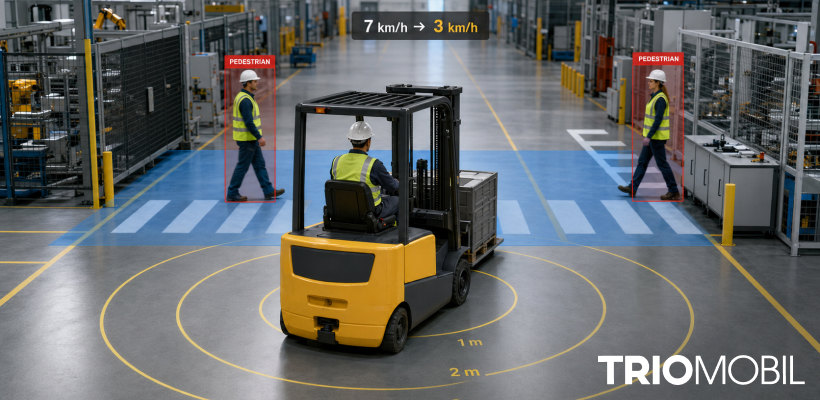
Trio Mobil provides configurable forklift speed management through the Trio Safe AI platform.
Depending on the deployed solution, this platform combines:
- AI-powered computer vision
- Ultra-Wideband (UWB)
- RTLS infrastructure
- Vehicle control integration
- Zone-based management
- Operational analytics
Rather than applying one fixed speed across an entire facility, organizations can configure operating rules according to their own traffic management policies and risk assessments.
Actual system behavior depends on the deployed technologies, vehicle compatibility, system configuration, and site-specific operating procedures.
AI-Powered Pedestrian Detection
The Trio Safe AI Camera continuously monitors predefined operating areas using AI-powered computer vision.
When pedestrians enter configured warning zones, the system can generate visual and audible alerts.
Where compatible vehicle integration has been enabled, organizations may also configure controlled speed reduction when predefined intervention criteria are met.
Warning distances, intervention distances, and vehicle responses are configurable according to site requirements.
To learn more about how AI-powered cameras detect pedestrians and support operator awareness, read our guide: How Do Pedestrian Detection Forklift Cameras Work?
Blind Spot Protection
Warehouses naturally contain blind spots created by racks, machinery, stored materials, and production equipment.
Trio Safe AI UWB provides proximity detection using Ultra Tags carried by pedestrians. Because UWB positioning does not rely on direct visual line of sight, the system can continue estimating proximity even when workers are obscured by many common warehouse obstacles, subject to deployment conditions.
Configured responses may include:
- Alerts to forklift operators
- Alerts to pedestrians
- Controlled speed reduction (with compatible vehicle integration)
- Event recording for later analysis
Controlled Vehicle Speed Reduction
When intervention is configured, Trio Mobil supports controlled linear deceleration through compatible vehicle integration.
Rather than relying on abrupt emergency stops, organizations can configure gradual speed reduction to support operator control while aligning with their operational procedures.
Actual vehicle response depends on forklift model, integration method, customer configuration, and site-specific safety policies.
Operational Insights
Speed management also generates operational data that safety teams can use for continuous improvement.
Depending on deployed solutions, organizations may review:
- Frequently activated safety zones
- Pedestrian interaction trends
- Forklift proximity events
- High-traffic intersections
- Zone activation frequency
- Areas that may benefit from traffic management improvements
These insights support data-driven decision-making rather than replacing formal workplace risk assessments.
These operational insights become even more valuable when combined with a comprehensive forklift monitoring strategy.
Benefits of Intelligent Forklift Speed Management
When properly configured and integrated into broader safety programs, intelligent speed management can help organizations:
- Support safer pedestrian-forklift interactions
- Apply site-specific traffic rules
- Improve operational consistency
- Reduce unnecessary blanket speed restrictions
- Improve visibility into traffic patterns
- Support continuous workplace safety improvement
As with any safety technology, effectiveness depends on appropriate deployment, system configuration, operator training, maintenance, and adherence to site operating procedures.
To learn how utilization data and operational analytics support better equipment allocation and long-term fleet performance, check our solution for forklift fleet management.
Choosing the Right Forklift Speed Limiter Solution
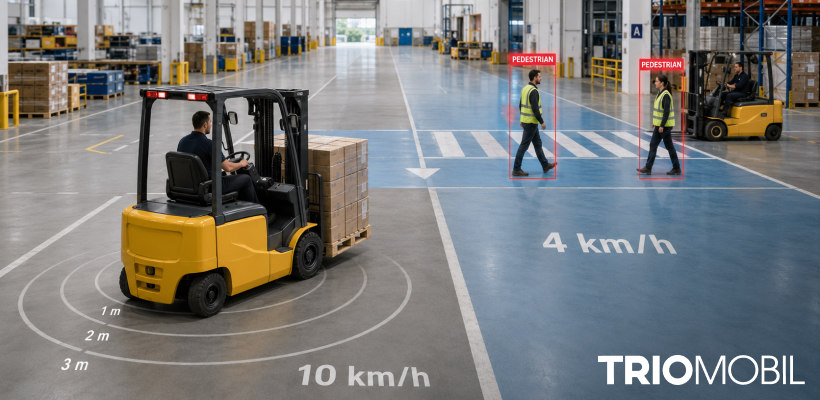
Organizations should evaluate whether a solution supports:
- Configurable operational zones
- AI-powered pedestrian detection
- UWB proximity detection
- Blind-spot protection
- Compatible vehicle integration
- Adjustable intervention distances
- Operational analytics
- Scalability across multiple facilities
The most suitable solution depends on the facility layout, operational objectives, equipment, and risk assessment.
Selecting the right technology is only part of the decision. Our guide, How to Choose Your Forklift Safety System Provider?, explains what to evaluate when comparing vendors, from deployment expertise and scalability to long-term support.
Modernize Forklift Speed Management with Trio Mobil
Intelligent forklift speed management is the most effective component of a forklift safety system when it is part of a broader workplace safety strategy. With Trio Safe AI, Trio Mobil combines AI-powered computer vision, UWB proximity detection, RTLS infrastructure, Zone Anchors, and compatible vehicle integration to support configurable speed reduction based on real-time operational conditions, including pedestrian interactions, blind spots, loading docks, restricted zones, and other predefined scenarios. Rather than applying a single speed across an entire facility, organizations can configure site-specific operating rules while gaining operational insights that support continuous improvement. Contact our team to learn how Trio Safe AI can help you implement intelligent forklift speed management tailored to your facility's operational requirements.
Key Takeaways
- A forklift speed limiter restricts or reduces forklift travel speed according to predefined rules.
- Intelligent speed management is more flexible than fixed mechanical speed limiting.
- AI cameras, UWB, RTLS, and vehicle integration each address different operational scenarios.
- Configurable speed management is most effective when combined with traffic planning, operator training, and workplace risk assessments.
- OSHA does not require forklift speed limiters but requires employers to manage powered industrial truck hazards appropriately.
- Intelligent speed management can support broader industrial safety objectives when properly configured and integrated.
Frequently Asked Questions
A forklift speed limiter is a system that restricts or automatically reduces forklift travel speed according to predefined rules or configured operating conditions.
Yes. When compatible vehicle integration is implemented and configured, speed reduction can be triggered automatically based on predefined conditions such as entering designated operational zones or detecting nearby pedestrians.
No. Trio Mobil provides configurable forklift speed management as part of the Trio Safe AI platform, combining AI-powered computer vision, UWB proximity detection, RTLS infrastructure, Zone Anchors, and compatible vehicle integration to support intelligent speed management.
Yes. When deployed with Trio Safe AI UWB and Ultra Tags, the system can support proximity detection even when direct visual line of sight is obstructed by many common warehouse obstacles, subject to deployment conditions.
Many organizations implement configurable speed management as one component of a broader workplace safety strategy. Combined with traffic planning, operator training, workplace risk assessments, and other safety measures, it can help support more proactive management of forklift and pedestrian interactions.

Product Catalogue 2026
Download our catalog and gain access to a wealth of information on how to enhance industrial safety and efficiency. Our latest catalog features a diverse range of products and services that can help you achieve your goals.
Our Latest Blogs


Learn more about Trio Mobil's Solutions
Fill out the form and we'll contact you!