


Trio Mobil Global Technology Innovation Leader in AI-Based Industrial Safety
Read the Frost & Sullivan Analysis

Why Traditional Safety Programs Struggle to Prevent Serious Injuries
 March 13, 2026
 2 min
2 min 499
499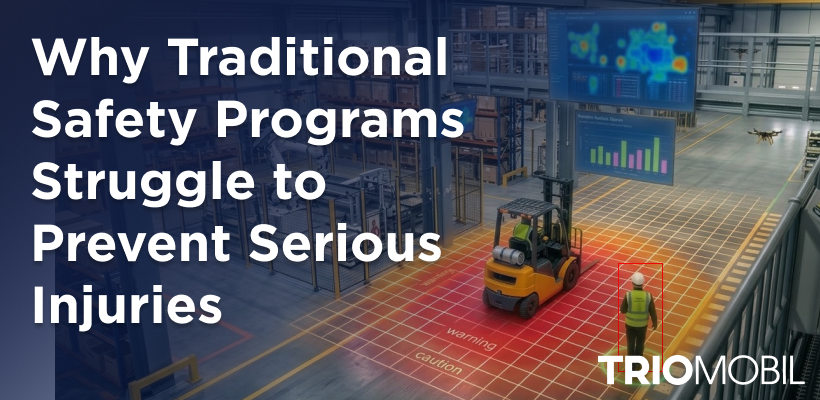
Over the past two decades, industrial safety programs have made enormous progress reducing recordable injuries. TRIR and LTI rates have declined across many sectors, and the discipline of occupational safety has matured significantly.
Yet serious injuries and fatalities still occur—even in organizations with excellent safety records.
Why?
Because most traditional safety programs were designed to reduce frequent, low-severity incidents—not rare, high-consequence events. Metrics like TRIR and LTI are important, but they are lagging indicators. They tell us what has already happened. They do not tell us whether the most dangerous exposures in an operation are actually under control.
The SIF Blind Spot
Serious injury and fatality (SIF) events typically arise from high-energy hazards—situations where the physics of the exposure make the difference between a near-miss and a life-altering outcome. Common SIF-critical hazard categories include:
- Pedestrian–equipment interactions — particularly in high-traffic zones where powered industrial vehicles share space with workers on foot
- Energy isolation failures — lockout/tagout deviations during maintenance
- Machinery and moving equipment hazards — struck-by, caught-between, and crush-point exposures
- Loss of containment or uncontrolled energy release
These risks exist largely independently of minor injury trends. An organization can drive its TRIR to historic lows while the frequency of high-energy near-misses in its forklift traffic zones remains unchanged—or even increases as production throughput rises.
In our work with large-scale industrial operations across multiple continents, we see this pattern consistently: the data that drives safety reporting often has very little overlap with the data that would reveal where the next serious event is most likely to occur.
From Counting Incidents to Controlling Exposure
This is why a growing number of organizations are shifting toward SIF Prevention Programs, built around frameworks developed by the National Safety Council, the Campbell Institute, and others.
The shift is conceptually straightforward but operationally demanding. Instead of focusing primarily on incident counts, the focus moves toward:
- Leading indicators that reveal risk before incidents occur
- SIF precursors (pSIF) — discrete events that, under slightly different circumstances, could have resulted in a serious injury or fatality
- High-energy exposure visibility across the full operation, normalized per equipment-operating hours
- Verification of critical safeguards — confirming that controls designed to prevent SIF events are functioning as intended
In other words, the question changes.
Traditional safety programs ask: “How many incidents occurred?”
SIF prevention asks: “Where could a life have been lost today?”
That shift—from counting incidents to controlling exposure—is where the next evolution of industrial safety is happening.
And it’s a shift we’re building for.

Product Catalogue 2026
Download our catalog and gain access to a wealth of information on how to enhance industrial safety and efficiency. Our latest catalog features a diverse range of products and services that can help you achieve your goals.

Our Latest Blogs


Learn more about Trio Mobil's Solutions
Fill out the form and we'll contact you!