


Trio Mobil Global Technology Innovation Leader in AI-Based Industrial Safety
Read the Frost & Sullivan Analysis

Understanding Forklift-Forklift Collision Avoidance Systems: Best Practices for Forklift Safety
 Apr 10, 2026
 4 min
4 min 411
411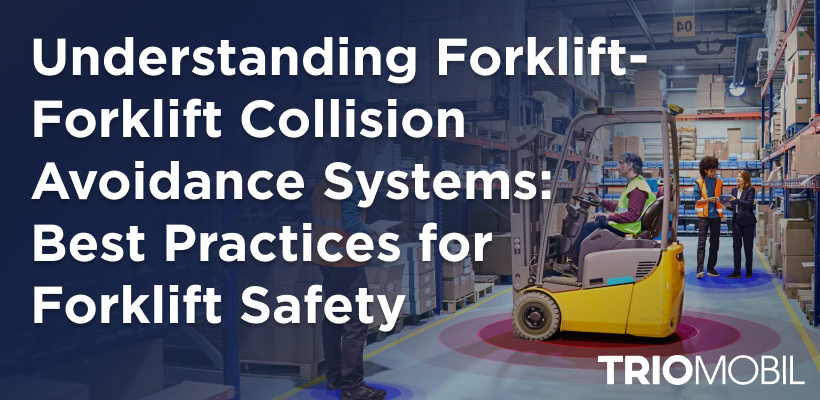
Forklift-forklift collisions in busy industrial environments like warehouses and manufacturing facilities can lead to significant equipment damage, operational disruptions, and severe injuries. As these facilities strive for efficiency and safety, adopting advanced collision avoidance systems has become essential.
This article explores the technological innovations and best practices in collision avoidance systems designed to prevent forklift-to-forklift accidents, focusing on integrating cutting-edge technologies that enhance forklift safety.
Why Forklift-Forklift Collisions Happen
Forklift-forklift collisions typically occur due to a variety of factors that can generally be categorized into environmental, operational, and human elements:
- Environmental Factors: Congested areas, poor warehouse layout, or inadequate lighting can severely limit visibility and maneuverability.
- Operational Factors: High operational tempo and pressure to meet deadlines can lead to rushed or unsafe forklift operations.
- Human Factors: Operator distraction, lack of training, or fatigue can lead to errors in judgment or delayed reactions.
Advanced Forklift-Forklift Collision Avoidance Systems
Forklift-forklift collision avoidance systems are designed to detect potential hazards, predict collision courses, and take preemptive actions to avoid accidents. Below, we explore various solutions that form the backbone of forklift collision avoidance systems and how they contribute to creating safer workplaces.
Sensor-Based Forklift-Forklift Collision Avoidance Solutions
Sensor-based technologies, such as ultrasonic and LIDAR sensors, improve detection and monitoring capabilities, significantly reducing the risk of collisions.
Below, we detail how these sophisticated systems work and their benefits for operators and forklifts alike:
Ultrasonic Sensors
| Features | How It Works | For Operators | For Forklifts |
|---|---|---|---|
| Proximity Detection | Emit sound waves that reflect off nearby objects, measuring distance based on echo timings. | Provides early warnings of nearby obstacles, allowing for timely reactions. | Reduces risk of impacts and wear from collisions. |
| Continuous Monitoring | Operate continuously to monitor the environment around the forklift, maintaining constant vigilance. | Maintains consistent safety awareness, reducing mental strain during long shifts. | Maintains continuous data flow for accurate environmental mapping. |
| Wide Detection Range | Can detect objects at various distances, providing layered safety alerts. | Allows operators to adjust speed and path according to proximity alerts. | Aids in strategic maneuvering, avoiding close encounters. |
LIDAR Sensors
| Features | How It Works | For Operators | For Forklifts |
|---|---|---|---|
| High-Resolution Mapping | Use laser beams to create detailed 3D maps of the surroundings. | Offers precise spatial awareness, enhancing navigation accuracy. | Prevents collisions by accurately detecting surroundings and obstacles. |
| Fast Data Processing | Process environmental data rapidly to provide real-time feedback to operators. | Facilitates quick decision-making in dynamic environments. | Facilitates responsive adjustments to environmental changes. |
| Long-Range Capability | Capable of detecting objects from a considerable distance, increasing reaction times. | Enhances safety by providing more time to react to distant objects. | Allows for advanced planning and safer route optimization. |
Tracking and Monitoring Technologies
For efficient tracking and monitoring in warehouse environments, RFID and GPS systems are critical technologies used to prevent forklift-forklift collisions. These systems provide real-time and precise location tracking of forklifts, enhancing navigation and safety.
Below, we detail how these sophisticated tracking and monitoring systems work and their benefits for operators and forklifts alike:
Ultra Wideband (UWB) Technology for Forklift Collision Avoidance
| Features | How It Works | For Operators | For Forklifts |
|---|---|---|---|
| Swift Detection and Speed Adjustment | UWB technology rapidly detects nearby forklifts and automatically adjusts speed to maintain a safe distance. | Enhances situational awareness, allowing operators to react swiftly and safely. | Prevents collisions, reducing wear and tear and extending the lifespan of equipment. |
| High-Precision Positioning | Utilizes UWB’s high-frequency signals to determine the exact location of forklifts with centimeter-level accuracy. | Provides accurate real-time location data, enhancing decision-making and maneuvering. | Facilitates precise navigation, reducing the risk of accidental damage. |
| Interference-Resistant Communication | Operates effectively in environments with significant signal interference, maintaining reliable communication between devices. | Provides consistent safety alerts even in challenging industrial conditions. | Maintains reliable performance and safety standards in complex environments. |
RFID Systems
| Features | How It Works | For Operators | For Forklifts |
|---|---|---|---|
| Precise Location Tracking | RFID tags are used to monitor the exact locations and movements of forklifts within a facility. | Enables sophisticated traffic management, enhancing route planning. | Helps manage operational flow and avoid traffic bottlenecks. |
| Instant Alert System | Generate instant alerts when forklifts come too close to one another. | Improves reaction times by notifying operators immediately of potential risks. | Supports proactive collision prevention strategies. |
| Integration with Other Systems | Can be integrated with warehouse management systems for holistic monitoring. | Provides a comprehensive view of all vehicle movements, enhancing strategic decisions. | Streamlines operations and enhances overall traffic efficiency. |
GPS Systems
| Features | How It Works | For Operators | For Forklifts |
|---|---|---|---|
| Area-Wide Monitoring | Track forklift movements across large or outdoor areas using satellite navigation. | Provides a broad overview of vehicle movements, aiding in strategic navigation. | Allows for dynamic path adjustments, enhancing operational efficiency. |
| Geofencing | Utilize GPS to create virtual boundaries that forklifts cannot cross, enhancing safety protocols. | Prevents forklifts from entering hazardous or restricted areas. | Reduces the risk of accidents in designated high-risk zones. |
| Historical Data Analysis | Stores and analyzes historical movement data to identify patterns and optimize routes. | Facilitates long-term improvements in operational strategies. | Enhances predictability and safety of forklift movements. |
Trio Mobil’s approach to forklift interaction safety is built on a multi-layered detection architecture that combines AI vision and Ultra-Wideband (UWB) proximity technology.
UWB enables high-precision, real-time detection of distances between forklifts, supporting early awareness of close-proximity interactions in dynamic environments. Rather than relying on line-of-sight alone, this allows consistent detection even in congested or obstructed areas.
When combined with AI-based vision systems, this architecture provides a broader understanding of operational movement, helping teams monitor how interactions form across shifts, zones, and traffic patterns.
The outcome is not limited to momentary alerts. It is continuous visibility into how Collision risk develops over time, enabling more structured and proactive safety management.
Vision and Detection Technologies
Cutting-edge vision and detection technologies have been developed to effectively mitigate the risks of operating forklifts in complex industrial environments. These technologies, including 360-degree cameras and advanced computer vision systems, enhance visibility and predictive safety measures.
360-Degree Cameras
| Features | How It Works | For Operators | For Forklifts |
|---|---|---|---|
| Elimination of Blind Spots | Provide a complete surround view via cameras positioned around the forklift. | Enhances visibility, reducing the risk of unexpected collisions. | Safeguards against accidental damage from unseen obstacles. |
| Real-Time Feedback | Deliver live video feeds to the operator, allowing for an immediate response to environmental changes. | Allows for quicker adjustment to surroundings, improving safety response times. | Helps prevent accidents by providing up-to-the-minute visual data. |
| Night Vision Capability | Incorporate infrared or low-light cameras to maintain visibility in poorly lit conditions. | Maintains operator visibility during all working hours, enhancing night and low-light operation. | Reduces incidents during nighttime operations, maintaining asset integrity. |
Computer Vision
| Features | How It Works | For Operators | For Forklifts |
|---|---|---|---|
| Movement Pattern Analysis | Analyzes video feeds to recognize and predict movement patterns of other forklifts. | Alerts operators to potential collisions, allowing for preventive maneuvers. | Reduces the likelihood of collision-related repairs and downtime. |
| Automated Threat Assessment | Utilizes algorithms to assess the severity of detected threats and prioritize alerts. | Helps operators focus on the most immediate risks, improving decision-making under pressure. | Enhances proactive maintenance by preventing severe impacts. |
| Integration with Other Systems | Syncs with navigation and collision avoidance systems to provide a holistic safety solution. | Streamlines multiple safety alerts into a coherent interface, reducing operator overload. | Coordinates safety measures across systems, optimizing overall protective actions. |
Trio Mobil integrates advanced AI cameras and detection technologies to significantly enhance operational safety and efficiency. Our AI cameras provide operators with a complete surround view, eliminating blind spots and delivering real-time feedback to allow immediate responses to environmental changes.
Trio Mobil’s AI cameras analyze video feeds to recognize and predict movement patterns of other forklifts, alerting operators to potential collisions and allowing for preventive maneuvers. These systems utilize algorithms for automated threat assessment, helping operators focus on immediate risks and improving decision-making under pressure. By integrating with navigation and collision avoidance systems, our solutions provide a holistic safety approach, streamlining safety alerts and coordinating protective actions across multiple systems.
Trio Mobil’s Approach to Forklift Interaction Safety
Managing forklift-to-forklift interactions requires more than single-point detection. It requires continuous visibility into how risk forms across the operation.
Trio Mobil’s safety architecture combines:
- AI Vision Systems to detect and analyze operational interactions
- UWB Proximity Detection to measure real-time distance between moving assets
- Risk Analytics to convert interactions into structured risk insights
This multi-layered approach enables organizations to identify SIF precursors, including:
- Repeated close-proximity interactions
- High-frequency exposure zones
- Uncontrolled equipment convergence points
Rather than focusing only on whether an incident occurred, this structure provides visibility into how often risk conditions are forming and where they concentrate.
Operators receive real-time alerts that support immediate awareness, while safety teams gain access to aggregated risk data that can be analyzed across time, shifts, and facility layouts.
The result is a shift from reactive incident management to proactive risk visibility, where forklift interactions can be monitored, understood, and continuously improved.
If you are evaluating how to improve visibility into forklift-to-forklift interactions and better understand how Collision risk develops across your operations, Trio Mobil’s AI-powered safety architecture provides a structured, data-driven approach.
Connect with the Trio Mobil team to explore how AI Risk Radar and integrated AI + UWB technologies can support your operational safety strategy and long-term EHS objectives.

Product Catalogue 2026
Download our catalog and gain access to a wealth of information on how to enhance industrial safety and efficiency. Our latest catalog features a diverse range of products and services that can help you achieve your goals.
Our Latest Blogs


Learn more about Trio Mobil's Solutions
Fill out the form and we'll contact you!