


Trio Mobil Global Technology Innovation Leader in AI-Based Industrial Safety
Read the Frost & Sullivan Analysis

Tag-Based vs. Tagless Pedestrian Detection Which Is Right for Your Facility?
 Nov 16, 2026
 5 min
 455

Tag-based and tagless pedestrian detection are two ways to identify when people enter defined risk areas around forklifts and other industrial vehicles. Tag-based systems use wearable devices that communicate with vehicle-mounted equipment. Tagless systems use cameras and computer vision to recognize people within a monitored field of view.
Both approaches can support earlier awareness during forklift-pedestrian interactions, but they respond to different operating conditions. A controlled warehouse has different requirements from a busy production site that receives contractors, drivers, and visitors. Visibility, layout, workforce routines, and alert logic all influence the decision.
This article explains how tag-based and tagless pedestrian detection work, compares their practical strengths and limitations, and outlines how to select the right configuration for a facility. It also explains when a layered system may provide more complete coverage.
What Are Tag-Based and Tagless Pedestrian Detection Systems?
A pedestrian detection system monitors defined areas around forklifts, vehicles, or fixed locations and can issue an alert when a configured interaction occurs. The detection method determines who can be identified, how proximity is assessed, and which environmental conditions may affect performance.
Tag-Based Pedestrian Detection
Tag-based pedestrian detection relies on active devices carried by pedestrians and corresponding units installed on forklifts or around the facility. Ultra-wideband, commonly called UWB, is one technology used for this purpose because it can measure proximity without depending on a camera view.
When an equipped pedestrian enters a configured warning zone, the system can alert the forklift operator, the pedestrian, or both. Depending on the system design and compatible vehicle integration, the event may also support actions such as controlled speed reduction. Detection depends on the pedestrian carrying a functioning tag and on correct system configuration.
Tagless Pedestrian Detection
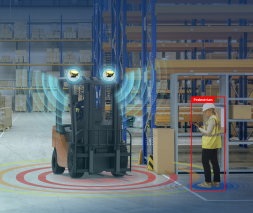
Tagless pedestrian detection uses cameras and computer vision models to recognize people without requiring them to carry a wearable device. Cameras may be mounted on forklifts or positioned at fixed locations such as intersections, doors, or loading areas, supporting loading dock safety by monitoring pedestrian and vehicle movements within defined zones.
The system analyzes images within its monitored field of view and applies configured rules to determine when an alert should be generated. Performance depends on camera placement, visibility, lighting, environmental conditions, model capabilities, and commissioning. Readers who want more technical detail can review How Do Pedestrian Detection Forklift Cameras Work?.
How Do Tag-Based and Tagless Detection Compare?

The most useful comparison begins with the facility's actual interaction patterns. The table below shows the main operational differences that affect coverage, deployment, and daily use.
| Decision factor | Tag-based detection | Tagless detection |
|---|---|---|
| Who can be detected | People carrying active, correctly configured tags | People visible to the camera and recognizable by the configured model |
| Line of sight | Does not rely on optical line of sight, though radio performance still depends on deployment conditions | Requires a usable camera view and cannot visually detect through solid obstructions |
| Distance information | Can support defined proximity zones and distance-based alerts | Estimates risk from visual position and context rather than direct radio ranging |
| Daily requirements | Tag assignment, charging or battery management, and consistent wearing | Clean lenses, suitable placement, and maintained camera visibility |
| Visitors and contractors | Must receive and wear compatible tags to be covered | May be detected without onboarding when visible within the monitored area |
| Typical advantage | Structured proximity awareness in controlled populations and visually obstructed areas | Broader human coverage where tag distribution is difficult or pedestrian populations change |
Where Does Each Approach Fit Best?
A suitable system aligns with the site's workforce, traffic design, and visibility conditions. The following scenarios show where each approach may offer a practical advantage. They should be validated through a site assessment rather than treated as universal rules.
Controlled Workforces and Consistent Tag Use
Tag-based detection can fit facilities where employees follow a controlled access process and wearable use can be managed consistently. It can support clear proximity zones around moving equipment and can alert both equipped pedestrians and operators, depending on configuration.
This approach requires an operating process for tag issue, charging, replacement, inspection, and compliance. A tag left in a locker or carried incorrectly creates a coverage gap, so the technology and the supporting routine must be designed together.
Visitors Contractors and Changing Pedestrian Populations
Tagless detection can be useful where people enter operational areas without a permanent wearable assignment. This may include delivery drivers, contractors, short-term workers, or visitors. A camera can identify a visible person within its configured coverage without first pairing that person with a tag.
The camera view still needs to cover the relevant approach path. Racks, loads, vehicle structures, poor positioning, dirt, glare, or difficult lighting can reduce visual coverage. Fixed and vehicle-mounted cameras should therefore be assessed against real traffic routes and changing load conditions.
Blind Corners and Solid Obstructions
Tag-based proximity sensing can add awareness where a pedestrian is hidden behind racks, stored materials, or a corner and therefore outside a camera's view. Radio performance can also be affected by the environment, so antenna placement, materials, reflections, and zone calibration should be tested on site.
Tagless systems can support visual confirmation and provide context when the person becomes visible. This distinction is also explained in What Is a Forklift Proximity Sensor? | Workplace Safety Guide.
Operations That Need Visual Context
A distance alert shows that two equipped parties are close. Visual analysis can add context about the direction of travel, the monitored zone, and the interaction captured within the camera view. This can help safety teams review recurring patterns and distinguish different types of exposure.
Video and tag data also require clear governance. Sites should define the purpose, access, retention period, and worker communication in line with applicable privacy rules and company policies.
How Should a Facility Choose?
Technology selection should begin with a documented risk assessment and observation of normal work. Review peak traffic, entry points, blind corners, temporary routes, vehicle speed, loads, and pedestrian groups.
Physical traffic controls remain fundamental. The UK Health and Safety Executive advises providing separate pedestrian and vehicle routes wherever reasonably practicable, supported by measures such as barriers, marked crossings, signs, and training. Detection technology can add another operator-assist layer where interaction risk remains, but it does not replace effective traffic management. Review the HSE guidance on separating pedestrians and vehicles.
During evaluation, teams should ask:
- Coverage: Which pedestrians must be detected, including employees, contractors, visitors, and drivers?
- Visibility: Where do racks, loads, corners, doors, or lighting conditions restrict the camera view?
- Wearable process: Can the site assign, charge, inspect, and replace tags consistently across every shift?
- Alert recipients: Should the operator, pedestrian, supervisor, or more than one party receive the warning?
- Vehicle response: Is an alert sufficient, or should compatible vehicle controls support a configured speed response?
- Data needs: Does the EHS team need event counts, video context, proximity trends, or zone-level analysis?
- Testing: How will the site validate coverage, false alerts, missed detections, and human response before wider deployment?
A pilot should include representative vehicles, loads, shifts, lighting conditions, and worker groups. Test alert thresholds against actual stopping behavior and site rules, then document the configuration and ownership for maintenance, training, and review.
When Does a Layered Approach Make Sense?
Some facilities have conditions that cannot be covered well by one detection method across every area. A layered architecture can combine tag-based proximity sensing with tagless visual detection so each method addresses a different part of the risk profile.
For example, UWB tags may support proximity awareness at an obstructed intersection, while an AI camera can identify an untagged visitor within its field of view. The data streams may support different alerts and reporting. Layering should address a clear coverage need because it adds hardware, commissioning, maintenance, and governance requirements.
Trio Mobil's forklift safety and collision avoidance platform supports configurations that combine AI-based tagless pedestrian recognition with UWB-based proximity detection. Depending on deployment conditions and compatible integrations, Trio Safe AI can provide operator alerts, pedestrian alerts, configured zones, and controlled vehicle responses. The technologies act as operator-assist layers within the facility's wider safety program.
How Layered AI + UWB Systems Improve Forklift Safety at Scale explains how visual context and radio-based proximity information can work together across complex operations.
Build Coverage Around the Facility
The right choice depends on who enters the area, what the operator can see, and how reliably the site can manage supporting processes. Tag-based systems can provide structured proximity awareness for equipped personnel, while tagless systems can extend detection to visible people without wearables. In mixed and complex environments, a carefully designed combination may address both requirements.
Contact our team to assess which pedestrian detection configuration fits your facility's traffic patterns, visibility conditions, and workforce needs.
Key Takeaways
The core differences can be summarized in the following points.
- Tag-based detection identifies equipped pedestrians through wearable devices and vehicle or site units.
- Tagless detection uses cameras and computer vision to recognize visible pedestrians without wearables.
- Tag-based systems can support proximity awareness without optical line of sight, subject to radio and deployment conditions.
- Tagless systems can cover visitors and changing pedestrian populations when they are visible within the monitored field of view.
- Selection should consider workforce control, obstructions, alert recipients, vehicle integration, maintenance, and data governance.
- A layered design may combine the complementary strengths of both methods when the site risk assessment supports it.
Frequently Asked Questions
Is tag-based pedestrian detection more accurate than tagless detection?
Accuracy depends on what is being measured and the deployment conditions. Tag-based systems can provide precise proximity zones between equipped devices, while tagless systems identify visible pedestrians through image analysis. Each should be validated against the site's required scenarios.
Can tagless pedestrian detection identify people behind racks or walls?
A camera cannot visually identify a person through a solid obstruction. Camera placement can reduce some blind areas, and a radio-based tagged system may add proximity awareness where optical line of sight is unavailable, subject to site conditions.
Do visitors need tags in a tag-based system?
Yes. Anyone who must be detected by a tag-based system needs a compatible, active tag that is carried correctly. Visitor onboarding should therefore include tag issue and return procedures when tag-based coverage is required.
Can one facility use both tag-based and tagless detection?
Yes. A facility may use both methods in the same area or assign different technologies to different zones. The design should define how alerts, coverage, maintenance, and data are coordinated.
Does pedestrian detection replace barriers training or safe routes?
No. Pedestrian detection is an operator-assist layer. Facilities still need appropriate separation, traffic design, procedures, supervision, training, and other controls based on their risk assessment.
These questions address the practical issues that often arise during system selection.
Disclaimer: Trio Mobil solutions are operator-assist aids. They do not replace safe working practices or prevent all incidents. Performance depends on operating conditions and configuration; see product documentation.

Product Catalogue 2026
Download our catalog and gain access to a wealth of information on how to enhance industrial safety and efficiency. Our latest catalog features a diverse range of products and services that can help you achieve your goals.

Our Latest Blogs


Learn more about Trio Mobil's Solutions
Fill out the form and we'll contact you!