


Trio Mobil Global Technology Innovation Leader in AI-Based Industrial Safety
Read the Frost & Sullivan Analysis

 Nov 16, 2026
 6 min
 0

Can an AI forklift safety system work across different forklift brands, models, and powertrains?
Yes. A brand-agnostic, or OEM-agnostic, forklift safety architecture can be designed for retrofit installation across different forklift brands, models and powertrains. This does not mean every vehicle supports the same safety functions or has the same manufacturer approvals. Compatibility must be confirmed for each installation.
Trio Mobil combines AI-powered pedestrian detection, Ultra-Wideband (UWB) proximity sensing, intelligent safety zones and configurable real-time intervention. Its mixed-fleet approach aims to provide consistent detection and warning capabilities across diverse vehicles, with intervention functions assessed against each vehicle's interface and manufacturer requirements.
For large warehouses, distribution centers, and manufacturing plants, the distinction matters. A system that can warn an operator on one forklift may require a different integration to enable automatic slowdown on another.
The objective is a common approach to forklift accident prevention across different OEMs, without assuming that every vehicle has identical interfaces or intervention capabilities.
Why Mixed Forklift Fleets Create Unique Safety Challenges
Large industrial facilities rarely operate a uniform vehicle fleet.
An operation may have electric counterbalance forklifts, diesel trucks, LPG-powered equipment, reach trucks, pallet trucks, and automated guided vehicles (AGVs) sharing the same traffic environment.
These vehicles may differ in age, manufacturer, braking characteristics, control interfaces, and onboard safety features.
As a result, warehouse managers face several challenges:
- Inconsistent safety capabilities: Different vehicles may have different warning, proximity detection, and speed-control functions.
- Shared pedestrian exposure: Operators, contractors, and visitors move through environments where equipment operates continuously.
- Blind intersections: Shelving, stored materials, and structural obstacles can restrict operator visibility.
- Mixed manual and automated traffic: Forklifts and AGVs may encounter one another at crossings and transition points.
- Operational pressures: Safety interventions need to work within high-throughput material-handling processes.
Traditional forklift safety measures such as marked pedestrian routes, physical separation, speed limits, and operator training remain essential.
OSHA's powered industrial truck guidance emphasizes separating pedestrian and forklift traffic wherever practical, particularly around intersections and areas with restricted visibility.
Connected warehouse safety technology can complement these controls by identifying hazardous interactions and supporting timely responses. A brand-agnostic safety approach is particularly valuable when facilities cannot rely on a single forklift manufacturer's technology across their equipment.
How Do AI Forklift Safety Systems Work Across Mixed Fleets?

An AI forklift safety system combines detection, risk assessment, alerts and, where supported, vehicle intervention to help reduce hazardous interactions. In a mixed fleet, a brand-agnostic architecture aims to apply these safety layers across multiple forklift manufacturers while validating vehicle-control functions individually.
A multi-layered architecture may include four functions.
1. Detect: AI Vision and UWB Proximity Sensing
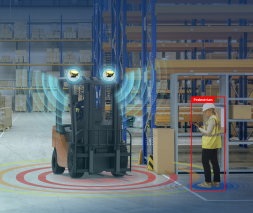
AI-powered forklift cameras use computer vision to identify pedestrians within their monitored field of view.
Unlike tag-based proximity systems, camera-based detection does not require pedestrians to wear dedicated devices.
UWB technology provides another type of awareness. It measures proximity between compatible equipped vehicles and tagged pedestrians without relying on visual identification.
The technologies serve complementary purposes:
| Capability | AI vision | UWB proximity |
|---|---|---|
| Detect pedestrians without tags | Yes, within camera coverage | No |
| Detect tagged pedestrians | Visually, when visible | Yes |
| Identify equipped forklifts without direct visibility | Not through visual obstructions | Can support this under suitable radio conditions |
| Support blind-intersection awareness | With suitable camera placement | With compatible equipped devices |
| Support warnings and vehicle intervention | With configured integrations | With configured integrations |
Neither technology should be treated as universally effective in every environment.
Camera performance depends on factors such as visibility, lighting, obstruction, and placement. UWB performance depends on the participating devices, radio environment, and installation.
Using complementary sensing technologies helps facilities address different detection conditions without relying on a single method.
2. Intervene: Connect Detection to a Safety Response
Detecting a pedestrian is not the same as slowing a forklift.
When a high-risk interaction is identified, the next step is determining what response the system can initiate.
Depending on the configuration, connected forklift safety systems can support:
- Visual and audible alerts for operators.
- Pedestrian warnings through compatible devices.
- Configured vehicle speed reduction.
- Zone-based speed restrictions.
- Connected warning lights and traffic-management infrastructure.
For example, when a tagged pedestrian approaches an equipped forklift, UWB proximity sensing can trigger a warning. If the forklift supports the necessary interface and the integration is appropriately authorized, the configured response may also include automatic speed reduction.
The objective is to reduce dependence on operator reaction alone during developing hazardous interactions.
3. Analyze: Identify Recurring High-Risk Interactions
A safety event can provide information beyond an immediate warning.
Near-miss and proximity data can help identify:
- Intersections with repeated pedestrian exposure.
- High-risk interactions during particular shifts.
- Changes in traffic patterns.
- Areas where corrective actions should be prioritized.
- Changes in exposure following safety improvements.
Analyzing these patterns helps EHS teams understand where potential serious injury and fatality (SIF) exposure is concentrated.
4. Improve: Use Risk Data to Refine Operations
Safety intelligence becomes useful when it informs operational decisions.
Facilities can review recurring interactions and consider improvements to pedestrian routes, speed rules, intersection controls, and traffic management.
This creates a connected process:
Detect the hazard → Support an appropriate intervention → Analyze exposure → Improve the operating environment.
Brand-Agnostic Forklift Safety: What Should You Verify About OEM Compatibility?
A brand-agnostic forklift safety system, sometimes described as an OEM-agnostic forklift safety system, is designed to work across equipment from different manufacturers rather than depend on one forklift brand. For mixed fleets, that flexibility is valuable, but it must not be confused with universal vehicle-control compatibility or OEM approval.
The same camera or proximity architecture may be deployable on different forklift types, while in-cab controls, automatic speed reduction and other vehicle-specific functions may require different interfaces and authorizations.
For procurement and engineering teams, the terms OEM-agnostic, OEM-compatible, OEM-compliant and OEM-approved should be distinguished:
- OEM-agnostic / brand-agnostic: Describes an approach intended for multiple forklift manufacturers. It is not a certification and does not mean every model supports identical functions.
- OEM-compatible: The safety technology can be installed or integrated with a manufacturer's equipment, subject to the specific vehicle and system configuration.
- OEM-compliant: The particular installation or modification meets the applicable manufacturer requirements and technical conditions.
- OEM-approved: The relevant manufacturer has provided approval for the specified integration or modification.
These terms are not interchangeable. In particular, an OEM-agnostic design does not automatically imply OEM compliance or manufacturer approval.
How Does Trio Mobil Support Brand-Agnostic Forklift Safety?

Trio Mobil's brand-agnostic forklift safety architecture is designed to support a broad range of forklift brands, models and powertrains, including electric, diesel and LPG equipment. The supported detection, warning and intervention functions depend on the vehicle and installation configuration.
This retrofit approach enables facilities to assess safety upgrades across existing vehicles without requiring a single-OEM fleet. It can also support future changes in fleet composition, subject to a new compatibility assessment.
However, compatibility must be assessed at the level of the intended function.
For example, installation of an AI camera and operator-warning display may involve different integration requirements from connecting automatic speed reduction to a forklift's vehicle-control system.
An OEM-agnostic architecture does not, by itself, establish universal OEM approval or compliance for every vehicle modification.
Each installation should be assessed for the available interfaces, manufacturer requirements, mounting constraints, safety functions and required authorizations before implementation.
When a facility replaces equipment or changes forklift brands, compatible Trio Mobil components may be transferable to other vehicles. Reinstallation is subject to technical assessment, suitable hardware and vehicle integration requirements. No identical capability across models is assumed.
What Do OSHA Requirements Say About Forklift Modifications?
In the United States, OSHA's 29 CFR 1910.178(a)(4) addresses modifications and additions that affect a powered industrial truck's capacity or safe operation.
The regulation requires prior written manufacturer approval for such modifications.
OSHA also describes circumstances in which written approval from a qualified registered professional engineer may be acceptable when a manufacturer does not respond or provides a negative response, subject to the applicable conditions.
These requirements should be considered when evaluating vehicle-control integrations.
For warehouses operating across different countries, local regulations, technical standards, and manufacturer instructions must also be reviewed.
Brand-Agnostic Forklift Safety: Compatibility Checklist
Before deploying a retrofit forklift safety system, engineering and operations teams should verify the following:
| Evaluation area | What to confirm |
|---|---|
| Forklift compatibility | Manufacturer, model, powertrain, year, and vehicle configuration |
| Hardware installation | Sensor mounting, power supply, and placement |
| Detection capability | AI camera coverage, UWB device requirements, and limitations |
| Operator alerts | Supported display, audio, and warning configurations |
| Speed-control integration | Available vehicle interface and supported intervention functions |
| OEM requirements | Applicable manufacturer instructions and approval requirements |
| Functional validation | Response behavior, fault handling, and site acceptance testing |
| Operational suitability | Traffic conditions, operator workflows, and maintenance needs |
This checklist helps distinguish an OEM-agnostic safety architecture from the supported and authorized functions of a particular vehicle.
How Trio Mobil Supports Brand-Agnostic Safety Across Mixed Fleets

Trio Mobil applies complementary technologies across different warehouse hazards. Detection and safety intelligence can follow a common architecture, while vehicle-specific interventions are configured and validated individually.
TRIO SAFE AI: AI-Powered Pedestrian Detection
TRIO SAFE AI combines forklift-mounted AI vision with UWB proximity technology.
It supports:
- Tagless pedestrian detection using AI cameras.
- Proximity awareness for tagged pedestrians and compatible equipped vehicles.
- Visual and audible safety alerts.
- Configured forklift speed reduction when supported by the vehicle integration.
- Safety event information for subsequent analysis.
This combination is particularly useful where tagged employees, untagged visitors, and forklifts share operating spaces.
TRIO SAFE: Forklift-to-Forklift and Forklift-to-Pedestrian Proximity
TRIO SAFE uses UWB proximity technology to identify interactions involving compatible equipped forklifts, tagged pedestrians, and other supported vehicles.
Applications include forklift-to-forklift awareness, forklift-to-pedestrian proximity alerts, zone-based forklift safety and supported forklift-to-AGV interactions.
Smart Safety Zones: Location-Specific Risk Controls
High-risk areas do not all require the same intervention.
Facilities can configure safety zones around intersections, narrow aisles, shared crossings, and other identified hazards.
Depending on the infrastructure and vehicle configuration, these zones can trigger warnings, connected traffic signals, or speed restrictions.
FleetBridge: Supporting Data for Safety Reviews
FleetBridge provides operator access records, impact monitoring and fleet activity information that can add context to safety reviews.
Fleet Status shows which forklifts are moving, stationary or switched off. Teams can view status by site and group, then open a vehicle's activity history to see when each status started and ended and how long it lasted over a selected period.
- Forklift 01Moving
- Forklift 02Stationary
- Forklift 03Ignition off
- Moving duration
- 2 hrs
- Stationary duration
- 1 hr
- Ignition off duration
- 5 hrs
These records complement, rather than replace, forklift collision detection and vehicle-specific intervention systems.
AI Risk Radar: Facility-Level Safety Intelligence
AI Risk Radar analyzes supported video sources, including compatible CCTV and AI camera systems, to identify recurring safety risks.
It helps EHS teams review recorded events, analyze high-risk locations, and prioritize preventive action.
Together, these solutions support a connected approach to forklift accident prevention and warehouse safety management.
Real-World Applications: Forklift Safety Across Industrial Operations
Enterprise deployments provide useful examples of how different detection and intervention technologies can be applied.

Audi AG: Forklift and AGV Collision Avoidance
At Audi AG, manually operated forklifts and AGVs share active production and intralogistics areas. Audi implemented Trio Mobil's TRIO SAFE solution to support proximity awareness between forklifts and AGVs. The UWB-based system provides warnings and controlled slowdown when configured proximity conditions are met.

Saint-Gobain: AI and UWB Pedestrian Detection Across US Facilities
Saint-Gobain deployed TRIO SAFE AI across 12 facilities in the United States, using three AI-powered cameras per forklift alongside UWB proximity technology. This configuration combines tagless pedestrian detection with tag-based awareness of pedestrians and equipped forklifts.

The Magnum Ice Cream Company: Multi-Site Safety and Fleet Management
The Magnum Ice Cream Company deployed Trio Mobil technologies across 10 facilities, including TRIO SAFE, TRIO SAFE AI, and FleetBridge. The implementation combines proximity detection, AI-powered pedestrian awareness, and forklift fleet management.
These are examples of deployed capabilities, not evidence that every vehicle model supports identical functions. Further details are available in Trio Mobil's customer success stories.
How to Evaluate a Brand-Agnostic AI Forklift Safety System
The next step is to verify what a proposed OEM-agnostic safety architecture can actually deliver across your specific forklift models. Warehouse managers and EHS leaders can begin with three practical steps.
Step 1: Map OEMs, Models and Integration Requirements
Create a vehicle inventory covering manufacturer, model, age, powertrain, operating location, and intended safety functions. Identify which vehicles require alerts only and which applications may benefit from supported automatic intervention.
Step 2: Identify the Highest-Risk Interactions
Evaluate forklift-pedestrian crossings, reversing areas, obstructed intersections, mixed AGV traffic, and other recurring hazards. Select AI vision, UWB proximity sensing, and zone controls according to the actual risk scenarios and technical limitations.
Step 3: Validate Performance Before Scaling
Pilot the solution with representative vehicle models and operating conditions. Assess detection coverage, alert relevance, intervention response, OEM requirements, operator acceptance and performance under real traffic conditions.
Then use the pilot evidence to inform a phased rollout.
For larger organizations, establish consistent safety-event definitions and fleet-level reporting while validating site-specific vehicle configurations.
Frequently Asked Questions About AI Forklift Safety Systems
Can AI forklift safety systems be installed on existing forklifts?
Yes. Retrofit-capable systems can add AI cameras, UWB proximity sensing, and operator-warning technology to existing forklifts. Automatic vehicle-control functions require additional assessment of the supported interfaces and applicable approval requirements.
Does Trio Mobil offer an OEM-agnostic forklift safety system?
Trio Mobil uses a brand-agnostic approach to forklift safety across mixed-brand operations, including electric, diesel and LPG equipment. OEM-agnostic describes the multi-brand system approach; it does not mean every model supports identical intervention functions or has blanket manufacturer approval. Vehicle compatibility must be checked individually.
What does OEM-agnostic mean in forklift safety?
OEM-agnostic means a forklift safety solution is designed for use with equipment from multiple manufacturers rather than only one brand. It is an architectural compatibility approach, not proof that a specific vehicle modification is OEM-compliant or OEM-approved.
Is Trio Mobil OEM-compliant?
Trio Mobil designs forklift safety solutions for integration across different manufacturers and vehicle configurations. OEM compliance or approval must be established for the specific installation or modification. Broad mixed-brand compatibility alone does not constitute a manufacturer-specific approval.
Can AI forklift cameras detect people without tags?
Yes. AI vision can identify pedestrians without wearable tags within the camera's configured field of view. Performance depends on visibility, camera positioning, environmental conditions, and system configuration.
Can forklift safety systems automatically slow vehicles?
Yes, when the solution supports automatic intervention and the forklift has an appropriate, validated, and authorized integration. Other configurations may provide visual or audible alerts without vehicle speed control.
What is the difference between AI forklift detection and UWB proximity sensing?
AI vision identifies pedestrians and other configured hazards using camera imagery, without requiring wearable tags. UWB uses compatible devices to determine proximity between equipped vehicles and tagged pedestrians, including in certain visually obstructed conditions. Combining the technologies supports different safety use cases.
How can mixed-fleet operators measure forklift safety performance?
Operators can track high-risk interactions per 100 operating hours, near-miss trends, intervention frequency and recurring hazard locations. Consistent definitions across OEMs and sites improve comparability, while traffic conditions and detection coverage must be considered when interpreting trends.
Brand-Agnostic Safety, Vehicle-Specific Validation
Different forklift manufacturers, equipment generations, and vehicle-control systems are a reality for large industrial operations.
A brand-agnostic approach does not require making every vehicle identical.
It aims to establish consistent hazard detection, appropriate interventions and measurable safety performance across different forklift manufacturers, while recognizing each vehicle's technical and OEM requirements.
Trio Mobil's combination of AI-powered pedestrian detection, UWB proximity sensing, smart safety zones, and risk analytics helps organizations address forklift collision risk across complex industrial environments.
For warehouse managers, the opportunity is to apply one connected safety strategy to mixed equipment without assuming one universal integration for every forklift.
Mixed fleets. Brand-agnostic safety architecture. Vehicle-specific validation.
Explore AI Forklift Safety for Your Fleet
Operating forklifts from different OEMs?
Explore Trio Mobil's Forklift Safety System to learn how AI vision, UWB proximity detection, and compatible vehicle interventions can support warehouse safety.
Request a mixed-fleet compatibility assessment and safety demonstration to confirm which detection, warning and intervention capabilities are available for your specific vehicles.
Related reading: Forklift Safety System for Intralogistics Operations.
Technical References
- OSHA: Powered Industrial Trucks, 29 CFR 1910.178
- OSHA: Forklift Attachments and Modifications
- OSHA: Forklift and Pedestrian Traffic Safety
- UK HSE: Workplace Transport Safety
- Trio Mobil: TRIO SAFE AI Technical Overview
- Trio Mobil: Customer Success Stories
Technical note: The solutions described are operator-assistance and risk-management technologies. They do not replace required traffic controls, operator training, or safe operating procedures. Detection, intervention, and integration capabilities depend on specific vehicle configurations and site conditions.

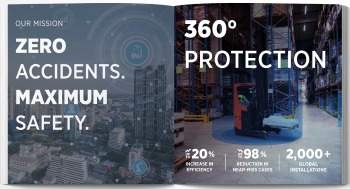
Product Catalogue 2026
Download our catalog and gain access to a wealth of information on how to enhance industrial safety and efficiency. Our latest catalog features a diverse range of products and services that can help you achieve your goals.
Our Latest Blogs


Learn more about Trio Mobil's Solutions
Fill out the form and we'll contact you!