


Trio Mobil Global Technology Innovation Leader in AI-Based Industrial Safety
Read the Frost & Sullivan Analysis

How AI Safety Systems Distinguish Real Hazards From Normal Workplace Activity
 Nov 16, 2026
 4 min
 473

AI safety systems use cameras, sensors, and configured software to help identify selected workplace conditions that may require attention. Their usefulness depends on a crucial ability: separating an ordinary event from an interaction that represents meaningful exposure.
A person walking through a warehouse is normal activity. The same person entering the projected path of a moving forklift can create a hazard. A pallet in a staging area may be expected, while the same pallet obstructing an emergency route may require action. Location, movement, timing, and the surrounding work change the risk.
This article explains how AI safety systems combine detection with operational context, why false alerts and missed events occur, and how facilities can validate performance before using the information to guide safety decisions.
What Are AI Safety Systems?
AI safety systems are technologies that analyze information from cameras, connected sensors, location devices, or operational records to help recognize specified hazards and risk patterns. Depending on the application, they may generate an alert, record an event, or place an item in a dashboard for review.
The system works within a defined scope. A computer vision model may identify a visible person, vehicle, item of personal protective equipment, or obstruction. Additional logic can then assess where the object is located, how it is moving, and whether the event meets a configured rule. The broader introduction in What Is AI for Workplace Safety? Revolutionizing Accident Prevention with Smart Technology explains how these applications fit within an established safety program.
Why Can Normal Activity Resemble a Hazard?
Industrial environments contain constant motion, temporary materials, changing light, and overlapping work. Many visual patterns associated with risk also appear during ordinary tasks, so the system must consider the circumstances around each observation.
| Observed activity | Routine context | Potentially hazardous context |
|---|---|---|
| A pedestrian is visible | The person remains on a separated walkway | The person enters the path of a moving industrial vehicle |
| A forklift is near a doorway | The vehicle is stationary in an approved position | The vehicle and pedestrian approach a blind crossing at the same time |
| A pallet is on the floor | The pallet is inside a defined staging area | The pallet obstructs a monitored emergency route or traffic lane |
| A worker is inside a marked area | The zone is open for the task and equipment is inactive | The zone is restricted while compatible machinery is operating |
These examples show why object recognition alone provides limited value. A useful system needs clear definitions for monitored zones, operating states, allowed activities, and the conditions that make an interaction relevant. Those definitions should reflect the facility's own traffic plan and risk assessment. The Health and Safety Executive's workplace transport guidance emphasizes safe traffic routes and separation between people and vehicles, which provides important context for configuring and reviewing vehicle interaction use cases.
How Do AI Safety Systems Interpret an Event?

Most applications move through several connected stages. The details vary by supplier and deployment, but the distinction between perception, context, scoring, and response helps teams understand what an alert actually means.
1. Detect the Relevant Object or Condition
The first stage identifies a supported object or visual condition within the monitored field of view. Examples can include people, selected vehicle types, defined PPE items, or objects occupying a specified area. Sensor-based systems may instead measure proximity, equipment status, or location between equipped devices.
2. Add Spatial and Operational Context
The system then applies information about where the detection occurred and what was happening nearby. Configured polygons may represent pedestrian walkways, vehicle lanes, restricted areas, machine zones, emergency routes, or loading areas. Equipment state, direction of travel, or time of day may also affect how an event is interpreted when those inputs are available.
3. Evaluate Movement, Timing, and Persistence
A single frame can be ambiguous. Tracking an object across consecutive frames can help establish direction, duration, and whether two paths are converging. Persistence rules can also prevent a brief image artifact or momentary boundary crossing from creating an unnecessary event.
4. Apply Confidence and Risk Thresholds
Many AI models produce a confidence score that reflects how strongly the available input matches a learned category. Separate business rules may then consider proximity, speed, zone type, or event severity. These values serve different purposes and should not be treated as a universal probability that harm will occur.
5. Choose the Appropriate Response
Classification and response are separate decisions. A system may record a lower-severity event for trend analysis, route an uncertain event to a reviewer, or issue an audiovisual warning when configured criteria are met. What Does a Real-Time AI Safety Platform Actually Monitor? A 100-Risk-Category Breakdown explains how distinct event categories can be organized. Compatible integrations may support other responses, subject to the approved system design.
What Causes False Alerts and Missed Events?
No sensing or AI system has perfect coverage. False positives occur when routine activity is classified as a hazard, while false negatives occur when a relevant condition is not detected or does not meet the configured rule. Both deserve structured review because they affect trust and response behavior.
- Camera and sensor coverage: Blind areas, obstructions, range limits, or unsuitable mounting positions can leave an event partly observed.
- Environmental change: Glare, low light, rain, dust, steam, vibration, and changing backgrounds can affect the available signal.
- Unclear event definitions: A zone that does not match actual work routes can classify expected activity as a violation.
- Class and appearance variation: Unusual clothing, vehicle shapes, carried objects, or partial views may differ from validated examples.
- Threshold settings: Sensitivity, persistence, distance, and timing settings can change the balance between false alerts and missed events.
- Workflow changes: New staging practices, altered routes, seasonal lighting, or equipment changes can reduce the relevance of an earlier configuration.
How Should a Facility Validate Hazard Classification?
Validation should demonstrate that the system is useful for a defined purpose under representative operating conditions. The voluntary NIST AI Risk Management Framework Core describes AI risk management as a continuing process across governance, mapping, measurement, and management. Its approach supports practical questions about intended use, performance, ownership, and ongoing review.
- Define the hazard precisely: Describe the object, zone, movement, timing, and operating state that constitute the event.
- Create representative tests: Include relevant shifts, lighting, traffic levels, clothing, vehicles, temporary obstructions, and safe simulations of boundary conditions.
- Measure both error types: Record verified true events, false alerts, and missed events instead of reporting detection volume alone.
- Set response rules: Decide which classifications create immediate alerts, which support later review, and who owns each action.
- Document operating limits: State the monitored views, excluded areas, required device coverage, and conditions that can affect performance.
- Review after change: Reassess the configuration when routes, cameras, lighting, equipment, software, or work methods change.
Human review remains important, especially for trend data and events used in investigations. Reviewers can examine the sequence around an event, check whether the rule matched the work being performed, and distinguish a technical detection from a confirmed safety finding. Worker participation can also reveal normal task variations that were missing from the original configuration.
How Trio Mobil Supports Context-Aware Safety Monitoring

Trio Mobil's AI risk monitoring solution uses compatible camera feeds and configured video analytics to help identify selected workplace conditions within monitored views. AI Risk Radar can centralize supported event categories, including specified PPE conditions, vehicle proximity, and improper zone use, so EHS teams can review events and recurring patterns. Available capabilities depend on camera compatibility, coverage, event configuration, and deployment conditions.
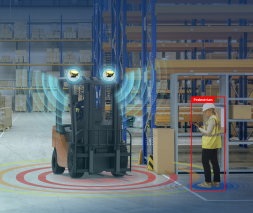
For mobile equipment, Trio Mobil's forklift safety and collision avoidance solutions can combine AI vision, UWB proximity options, smart zones, and operator alerts. AI vision can support tagless recognition within suitable camera views, while UWB functions rely on equipped devices and appropriate installation. Using more than one sensing layer can address different exposure scenarios, as discussed in How Layered AI + UWB Systems Improve Forklift Safety at Scale.
Configuration begins with the local use case. Teams should identify the monitored area, define the event and response, test representative conditions, and communicate the system's limits. These capabilities act as operator-assist and decision-support layers within a broader program that includes safe routes, guarding, procedures, training, supervision, maintenance, and worker involvement.
From Detection to Defensible Safety Decisions
AI safety systems become useful when a visible condition is interpreted through the reality of the work. Location, movement, timing, equipment state, confidence, and site rules help determine whether an observation represents normal activity, a developing exposure, or an uncertain event that needs review.
Contact our team to discuss how Trio Mobil can support context-aware AI safety monitoring for your facility.
Key Takeaways
These principles help facilities assess whether an AI safety system can distinguish relevant hazards from routine activity.
- Detection begins the process: Recognizing a person, vehicle, or condition does not by itself confirm a hazard.
- Context changes meaning: Zones, movement, timing, proximity, and equipment state help classify an interaction.
- Thresholds create tradeoffs: Sensitivity settings influence false alerts and missed events.
- Response should match severity: Systems can separate immediate warnings from review and trend analysis.
- Validation is local: Performance should be tested in representative operating conditions and reassessed after change.
- Human judgment remains essential: Reviewers interpret events, confirm findings, and connect information to corrective action.
Frequently Asked Questions
How does an AI safety system know when an activity is hazardous?
It applies configured logic to supported detections. Depending on the system, that logic may consider zones, proximity, direction, duration, equipment state, and confidence thresholds. The result applies only within the validated use case and coverage.
What is the difference between object detection and hazard detection?
Object detection identifies a supported object such as a person or vehicle. Hazard detection adds context about the object's location, movement, timing, and relationship to other activity before an event is classified.
Why do AI safety systems generate false alerts?
False alerts can result from unsuitable views, environmental conditions, ambiguous activity, inaccurate zones, or sensitivity settings. Testing and structured review can help teams identify the cause and refine the configuration.
Can AI safety systems detect every workplace hazard?
No. Each system supports defined event categories within specified sensing and configuration limits. Risk assessment, physical controls, training, supervision, maintenance, and safe working practices remain necessary.
How often should AI safety system settings be reviewed?
Settings should be reviewed during commissioning and at planned intervals, as well as after meaningful changes to routes, equipment, cameras, lighting, software, or work practices. Event quality and known gaps should inform the review schedule.
The following answers address common questions about AI hazard classification in industrial workplaces.
Disclaimer: Trio Mobil solutions are operator-assist aids. They do not replace safe working practices or prevent all incidents. Performance depends on operating conditions and configuration; see product documentation.

Product Catalogue 2026
Download our catalog and gain access to a wealth of information on how to enhance industrial safety and efficiency. Our latest catalog features a diverse range of products and services that can help you achieve your goals.
Our Latest Blogs


Learn more about Trio Mobil's Solutions
Fill out the form and we'll contact you!