


Trio Mobil Global Technology Innovation Leader in AI-Based Industrial Safety
Read the Frost & Sullivan Analysis

What Is a Forklift Proximity Sensor? | Workplace Safety Guide
 Jul 10, 2026
 4 min
4 min 549
549
Forklift proximity sensors are industrial safety technologies designed to detect the distance and relative position between forklifts, pedestrians, and other material handling equipment in real time. These systems support workplace safety by improving operator awareness, reducing blind spot exposure, and enabling faster responses to hazardous proximity situations in warehouses, factories, and logistics facilities.
As forklift traffic density increases across warehouses, factories, and logistics centers, maintaining visibility and situational awareness becomes more challenging. Modern proximity detection systems use technologies such as Ultra-Wideband (UWB), AI-powered video analytics, zone-based safety management, and real-time alerts to support safer intralogistics operations.
This article explains how forklift proximity sensors work, where traditional safety approaches face limitations, and how modern awareness technologies support safer and more controlled industrial operations.
What Is a Forklift Proximity Sensor?
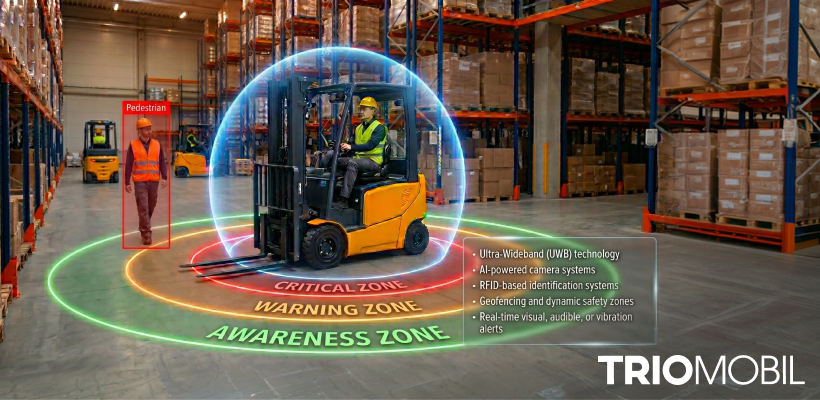
A forklift proximity sensor is a safety device or detection system that monitors the distance between a forklift and nearby objects, vehicles, or pedestrians. Its primary purpose is to increase situational awareness by identifying potential collision risks before they develop into incidents.
Unlike traditional warning methods that rely solely on operator visibility, proximity sensors continuously monitor the surrounding environment and provide real-time alerts when predefined safety distances are breached. Depending on the technology used, these systems can detect pedestrians, other forklifts, fixed infrastructure, or moving equipment within operational areas.
Modern forklift proximity sensing solutions may utilize:
- Ultra-Wideband (UWB) technology for precise distance measurement
- AI-powered camera systems for pedestrian detection
- RFID-based identification systems
- Geofencing and dynamic safety zones
- Real-time visual, audible, or vibration alerts
By continuously monitoring proximity conditions, these systems help operators react faster to developing hazards, particularly in environments where visibility is limited or traffic density is high. Rather than replacing existing safety procedures, forklift proximity sensors provide an additional layer of risk awareness that supports safer movement throughout industrial facilities.
Increasing Forklift Traffic Creates Higher Collision Exposure
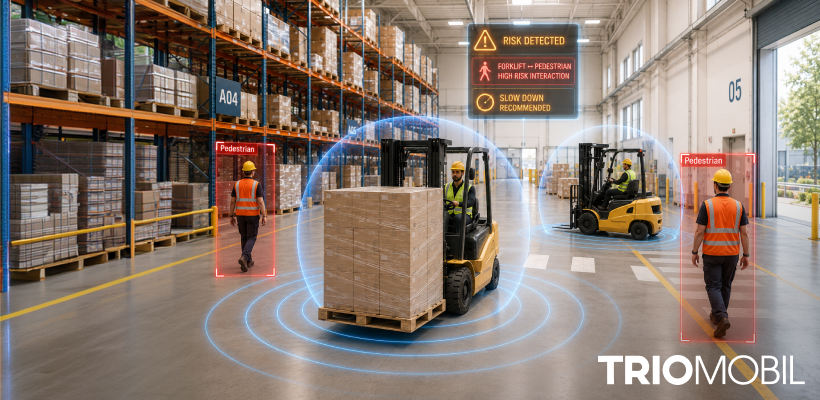
Industrial facilities operate in environments where forklifts, pedestrians, machinery, and vehicles continuously interact within shared operational spaces. As production demands increase, these interactions become more frequent and more difficult to manage using manual awareness alone.
Several operational factors increase collision exposure in warehouses and manufacturing plants:
- Blind spots caused by transported loads
- High forklift traffic density
- Shared pedestrian and forklift pathways
- Limited visibility at intersections and doors
- Human reaction time limitations
- Noise-heavy and congested environments
Many forklift-related incidents occur not because procedures are absent, but because situational awareness becomes difficult to maintain consistently under dynamic conditions.
High-Density Operations Increase Safety Complexity
Large-scale facilities often manage hundreds of simultaneous interactions between people and moving equipment.
For example:
- B/S/H implemented forklift safety systems covering 250 forklifts and more than 1,000 pedestrians within a 220,000 m² production environment.
- Beko deployed forklift and pedestrian safety systems across 35 production sites in 9 countries to reduce near-miss exposure in high-traffic operations.
These operational realities are driving increased adoption of real-time awareness technologies.
Forklift Proximity Sensors Improve Real-Time Operational Awareness
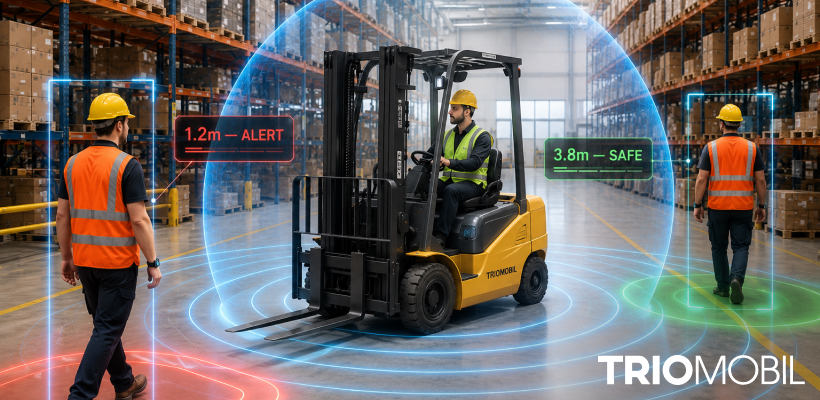
A forklift proximity sensor is a system designed to identify when forklifts, pedestrians, or other vehicles enter predefined distance thresholds that may represent elevated collision risk.
The primary purpose of these systems is to improve environmental awareness and support faster operational responses during hazardous proximity situations.
Core Functions of Forklift Proximity Systems
Modern systems typically perform four main functions:
- Detect nearby pedestrians, forklifts, or objects
- Measure relative distance and movement
- Trigger alerts when safety thresholds are exceeded
- Initiate configured safety responses when required
Proximity Exposure Increases in Shared Operational Zones
Collision risks increase significantly in areas such as:
- Blind intersections
- Narrow aisles
- Loading docks
- Pedestrian crossings
- Door transitions
- Congested staging zones
In these environments, available reaction time may become insufficient during sudden interactions between forklifts and pedestrians.
Blind Spots Remain a Major Operational Challenge
Visibility limitations remain one of the most significant operational safety risks in forklift environments.
Transported loads, shelving systems, machinery, and structural barriers can obstruct operator sightlines even during normal operations.
At Smurfit Westrock facilities, transported paper rolls created major visibility restrictions for forklift operators working near pedestrians.
Forklift proximity systems help address this challenge by creating an additional awareness layer around moving equipment.
Blind Spots and Reaction Time Limitations Remain Major Safety Challenges
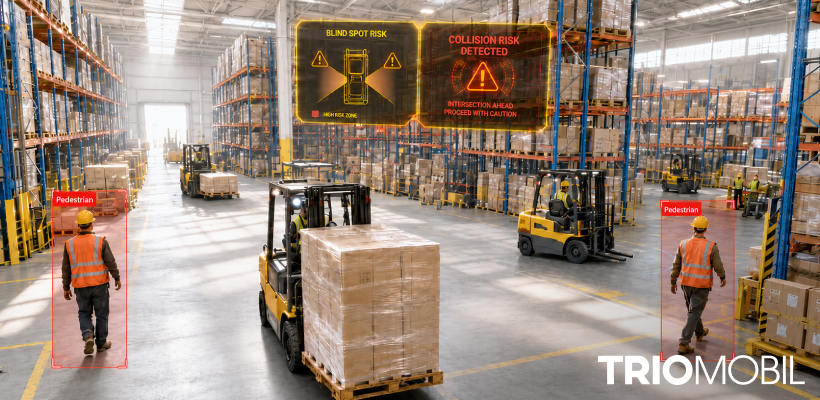
Traditional safety controls remain essential components of industrial safety programs.
These measures include:
- Operator training
- Floor markings
- Traffic separation
- Safety signage
- Mirrors
- Manual supervision
- Operational procedures
While highly valuable, these methods also face limitations in dynamic industrial environments.
Visibility Gaps Reduce Situational Awareness
Traditional visual controls cannot fully eliminate blind spots created by transported loads, shelving systems, or facility layouts.
Reaction Time Constraints Increase Operational Risk
Operators require time to identify hazards, process information, and react appropriately. In high-density environments, available reaction time may become insufficient during sudden interactions.
Operational Variability Challenges Static Controls
Industrial environments change continuously throughout shifts. Temporary obstacles, changing pedestrian density, and varying forklift speeds create conditions that static controls cannot always address effectively.
Excessive Alerts Can Reduce Responsiveness
Non-contextual warning systems may generate excessive alerts, reducing operator responsiveness over time.
Smurfit Westrock specifically required a solution capable of alerting operators only during dangerous proximity situations while minimizing unnecessary alarms in safe areas.
Limited Operational Data Restricts Risk Analysis
Traditional safety methods often provide limited visibility into:
- Near-miss frequency
- Traffic congestion patterns
- Repeated risk zones
- Interaction trends
This reduces the ability of HSE teams to proactively analyze operational exposure patterns.
UWB, AI Vision, and Zone-Based Systems Strengthen Hazard Detection
Modern forklift proximity technologies improve safety awareness by continuously monitoring interactions between forklifts, pedestrians, and infrastructure in real time.
These systems combine multiple technologies to create layered operational awareness.
Ultra-Wideband (UWB) Proximity Detection
UWB technology enables highly accurate real-time distance measurement between forklifts and surrounding entities.
The system continuously exchanges signals between:
- Forklift-mounted units
- Pedestrian safety tags
- Zone anchors
- Other connected equipment
This allows the system to calculate proximity thresholds and identify elevated collision risks with high precision.
According to Trio Mobil’s industrial safety framework, UWB-based systems support 360-degree proximity awareness in indoor and outdoor environments.
Audiovisual Alerts Improve Hazard Recognition
When safety thresholds are exceeded, the system can trigger:
- Audible alarms
- Visual warnings
- Directional proximity alerts
These notifications improve operator awareness in noisy and visually congested environments.
Automatic Forklift Speed Reduction Supports Controlled Movement
Some systems integrate with forklift speed management controls.
When forklifts approach pedestrians or high-risk areas, the system can automatically reduce vehicle speed based on predefined operational rules.
Zone-Based Safety Management Improves Control in High-Risk Areas
Zone-based safety systems automatically apply safety rules in designated operational areas such as:
- Blind intersections
- Loading docks
- Sectional doors
- Pedestrian crossings
- Narrow aisles
At Vaillant Group’s DemirDöküm facility, zone-based forklift speed control was implemented using fixed zone anchors to improve operational safety in higher-risk areas.
AI-Powered Monitoring Improves Visibility in High-Risk Areas
AI-powered camera systems provide additional awareness coverage using image processing and edge computing.
These systems can:
- Detect pedestrians in predefined zones
- Monitor blind spots
- Trigger contextual alerts
- Reduce unnecessary warnings in safe areas
At Smurfit Westrock facilities, AI-powered tagless pedestrian detection helped eliminate blind spots while reducing false alarms.
AI Video Analytics Expands Situational Awareness
AI-powered monitoring systems help safety teams gain improved visibility into operational interactions that may otherwise go unnoticed.
These systems can support:
- Risk zone monitoring
- Event-based analysis
- Operational visibility
- Continuous safety improvement initiatives
By combining AI analytics with proximity detection technologies, facilities can improve awareness consistency across dynamic industrial environments.
Real-Time Alerts and Automated Responses Support Safer Forklift Operations
Forklift proximity systems provide operational value by improving consistency, visibility, and awareness across industrial environments.
Benefits for HSE Teams
These systems help safety teams:
- Identify recurring risk zones
- Monitor near-miss exposure
- Improve operational visibility
- Support data-driven safety planning
Benefits for Operations Teams
Operations leaders benefit from:
- More controlled forklift movement
- Reduced operational disruption
- Improved traffic flow visibility
- Better coordination between forklifts and pedestrians
Support for High-Volume Operations
As facilities scale, maintaining manual situational awareness becomes increasingly difficult.
Modern awareness technologies help support safer interactions in operations involving:
- High forklift density
- Multiple operational zones
- Continuous material movement
- Shared pedestrian environments
At Beko facilities, large-scale deployment of forklift safety systems contributed to a significant reduction in near-miss incidents across multiple countries.
Trio Mobil Solutions Support Layered Industrial Safety Strategies
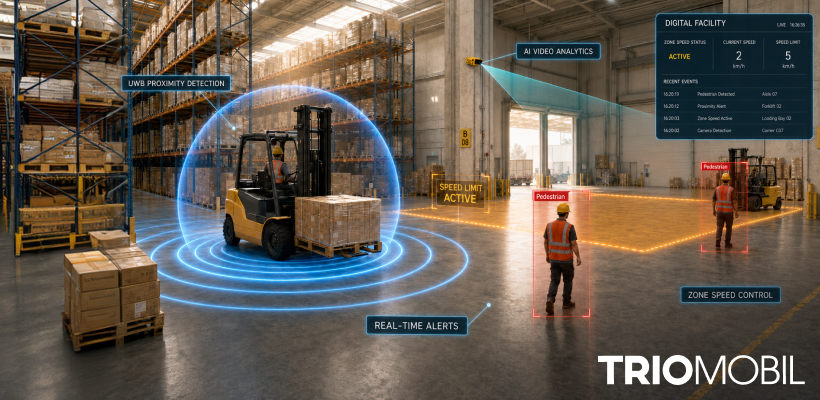
Trio Mobil develops industrial safety technologies designed to support awareness, visibility, and operational control in intralogistics environments.
Its solutions combine:
- UWB-based proximity detection
- AI-powered video analytics
- Zone-based forklift speed control
- Real-time audiovisual alerts
- Operational monitoring systems
These technologies are designed to function as part of a layered industrial safety strategy rather than standalone controls.
To better understand how modern AI-powered safety platforms identify, classify, and monitor workplace risks across industrial operations, you can explore our article What Does a Real-Time AI Safety Platform Actually Monitor? 100+ Risk Category Breakdown. The article provides a detailed overview of the wide range of risk categories that can be monitored in real time to support proactive safety management and continuous risk reduction.
Multi-Site Industrial Deployments
Trio Mobil solutions have been implemented across manufacturing and logistics facilities operating under high-density conditions.
Examples include:
- Smurfit Westrock’s multi-country AI-powered forklift safety rollout
- Ford’s real-time location tracking and forklift safety implementation
- B/S/H’s large-scale forklift and pedestrian safety deployment
These implementations reflect the increasing role of real-time awareness technologies in industrial safety strategies.
Scalable Awareness Technologies Are Shaping Modern Intralogistics Safety
Forklift proximity sensors represent a broader shift toward real-time operational awareness within industrial safety environments.
Traditional safety measures remain essential, but modern industrial operations increasingly require additional visibility and situational awareness support.
Modern proximity technologies help organizations:
- Improve awareness in blind spot conditions
- Support earlier hazard recognition
- Standardize safety responses in high-risk zones
- Enhance visibility into operational safety trends
- Scale safety management across multiple facilities
As industrial environments continue to evolve, layered safety strategies combining operational procedures, real-time sensing, AI analytics, and workforce awareness are becoming increasingly important components of long-term risk management.
Disclaimer: Trio Mobil solutions are operator-assist aids. They do not replace safe working practices or prevent all incidents. Performance depends on operating conditions and configuration; see product documentation.

Product Catalogue 2026
Download our catalog and gain access to a wealth of information on how to enhance industrial safety and efficiency. Our latest catalog features a diverse range of products and services that can help you achieve your goals.
Our Latest Blogs


Learn more about Trio Mobil's Solutions
Fill out the form and we'll contact you!