


Trio Mobil Global Technology Innovation Leader in AI-Based Industrial Safety
Read the Frost & Sullivan Analysis

 Jul 29, 2026
 3 min
3 min 443
443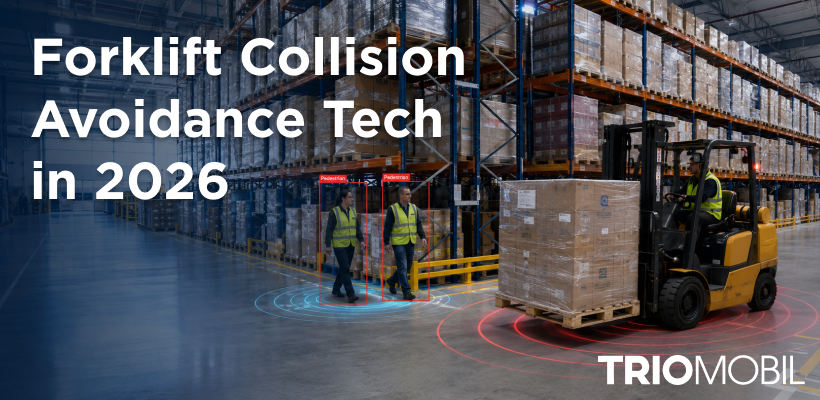
When a 10,000-pound forklift turns a blind corner in a busy warehouse, the margin between a safe pass and a serious incident can shrink to seconds. For warehouse managers and industrial safety teams, that reality drives a critical question: how do you protect pedestrians and operators without slowing down operations? The answer increasingly lies in forklift collision avoidance technology, which now combines AI vision, ultra-wideband (UWB) positioning, and smart zone controls into layered safety systems.
This guide walks you through the core collision avoidance technologies available in 2026, explains how each detection method works, and gives you practical criteria for selecting the right system for your facility. Whether you manage a distribution center, manufacturing floor, or cold storage warehouse, this information will help you make an informed decision that protects your people.
Key Takeaways: Forklift Collision Avoidance Tech in 2026
Multi-layered detection that combines AI vision with UWB proximity sensors offers more reliable protection than single-technology systems.
Trio Mobil unifies tagless AI detection, tag-based UWB alerts, and smart zone controls into one integrated platform.
Effective collision avoidance addresses blind spots, intersections, and loading docks, the three highest-risk areas in most facilities.
Real-time alerts and dynamic speed controls reduce reliance on operator reaction time alone.
OSHA regulations require pedestrian traffic management, making proactive collision avoidance a compliance priority.
What Is Forklift Collision Avoidance Technology?
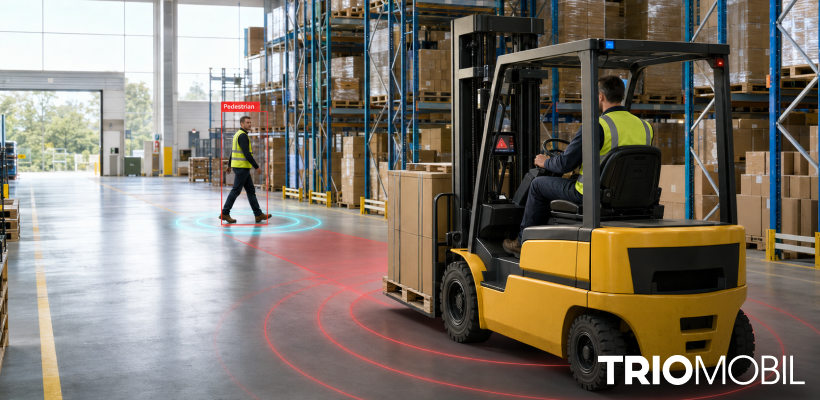
Forklift collision avoidance technology refers to electronic systems that detect people, vehicles, or obstacles near forklifts and alert operators before a potential collision. These systems work by using sensors, cameras, or radio frequency tags to monitor the area around each vehicle in real time.
When the system identifies a hazard, it triggers an alert. This could be an audible alarm, a visual warning on an in-cab display, or a vibration on a pedestrian wearable. Advanced systems can also automatically reduce the forklift's speed or restrict movement in designated high-risk zones.
The goal is straightforward: give operators and pedestrians more time to react. A forklift traveling at even moderate speeds cannot stop instantly, so early detection makes all the difference.
Why Collision Avoidance Matters for Warehouse Safety Teams
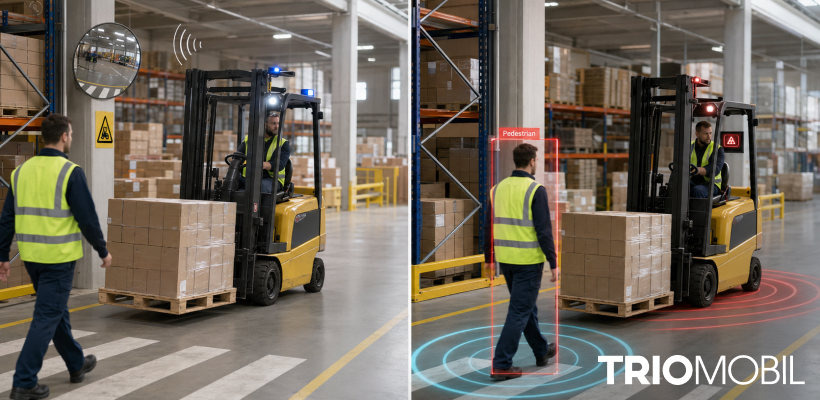
According to data from the National Safety Council, forklifts are involved in tens of thousands of workplace injuries each year in the United States alone. Pedestrians account for a significant portion of these incidents, often because they entered a blind spot or crossed a forklift's path at the wrong moment.
For EHS directors and warehouse managers, the costs extend beyond injury. Each serious incident brings potential OSHA citations, insurance claims, equipment damage, and operational downtime. Some facilities report that a single forklift collision can cost between $38,000 and $150,000 when you factor in medical expenses, lost productivity, and equipment repairs.
Traditional safety measures like floor markings, mirrors, and horns help, but they rely entirely on human attention. Collision avoidance technology adds an active layer of protection that monitors constantly and responds instantly.
How Do Forklift Collision Avoidance Systems Work?
Understanding the underlying detection methods helps you evaluate which approach fits your facility. Most modern systems use one or more of these technologies:
AI Vision and Camera-Based Detection
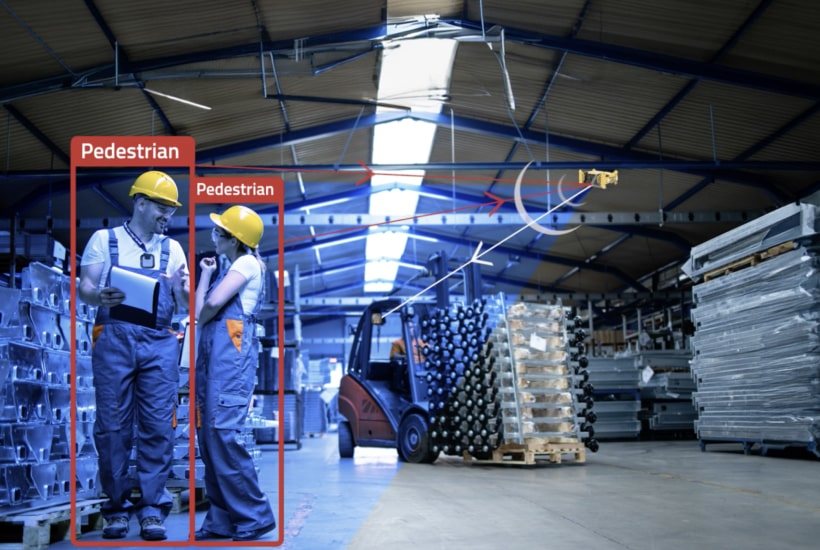
AI-powered cameras mounted on forklifts continuously analyze video footage to identify pedestrians based on their shape, posture, and movement patterns. These systems can distinguish between a person and an inanimate object like a pallet, reducing false alarms.
The key advantage of AI vision is tagless detection. Visitors, contractors, and anyone else walking through your facility can be recognized without wearing special equipment. Trio Mobil's AI pedestrian detection uses this approach to monitor forklift surroundings and provide real-time alerts to operators.
UWB Proximity Detection
Ultra-wideband (UWB) positioning uses radio signals between small tags worn by pedestrians and sensors on forklifts. UWB delivers high accuracy, typically within 10 to 30 centimeters, and works even when the line of sight is blocked by racks, walls, or loads.
This precision makes UWB valuable for tight aisles, blind corners, and areas where camera visibility is limited. The system can detect a tagged pedestrian approaching from behind a rack before either party has visual contact.
RFID and Bluetooth-Based Systems
Radio frequency identification (RFID) and Bluetooth Low Energy (BLE) systems also rely on tags, but typically offer wider detection ranges with less positional accuracy than UWB. These systems work well for alerting operators when anyone tagged enters a general danger zone around the forklift.
Hybrid Multi-Layer Detection
The most effective 2026 systems combine multiple detection methods into a single platform. Trio Mobil, for example, layers AI vision, UWB proximity, and zone-based controls together. This approach covers scenarios that any single technology might miss: tagless visitors in open areas, tagged workers behind obstructions, and dynamic speed control at intersections.
What Are the Main Types of Collision Avoidance Alerts?
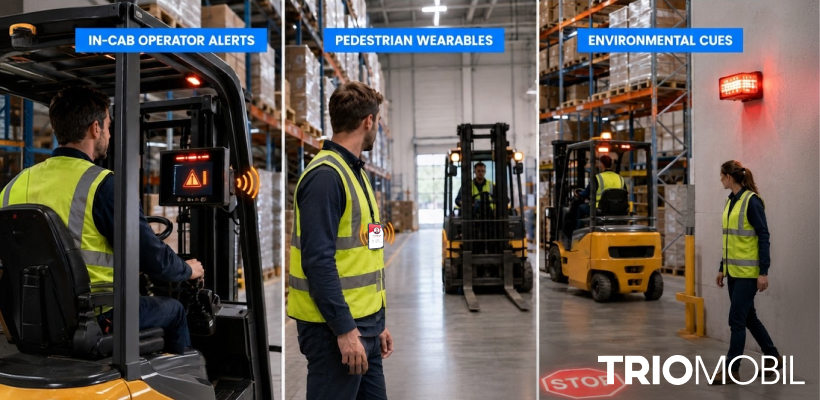
Detection is only useful if it leads to timely action. Collision avoidance systems deliver alerts through several channels:
In-Cab Operator Alerts
Most systems include a visual display or LED indicator that lights up when someone enters the detection zone. Audio alarms provide an additional layer, especially when the operator's eyes are focused on a load. Some systems combine both with a graduated warning: a soft tone for distant pedestrians, escalating to a louder alarm as the distance closes.
Pedestrian Wearables
Tags worn on vests, helmets, or wristbands can vibrate or beep to alert pedestrians directly. This two-way notification ensures that both parties receive the warning, not just the forklift operator.
Environmental Cues
LED lights mounted at intersections or on warehouse floors can flash when a forklift approaches, warning anyone in the area. These "smart intersection" systems activate automatically based on forklift proximity, adding a visible warning even for pedestrians who are not wearing tags.
How Dynamic Speed Control Supports Collision Prevention
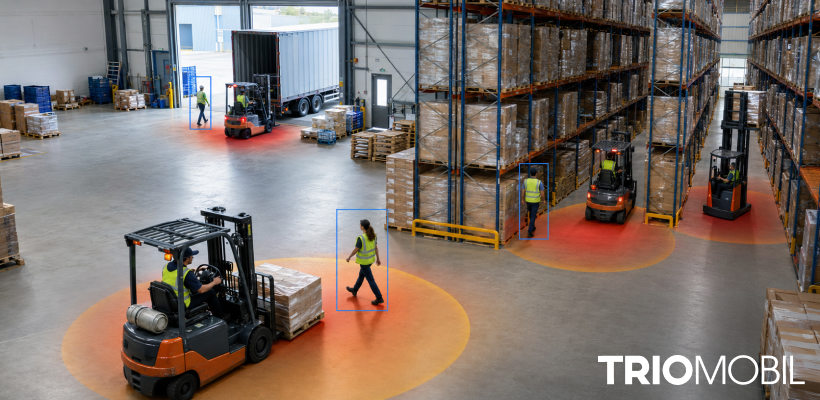
Alerts depend on humans noticing them and reacting in time. Dynamic speed control removes some of that uncertainty by automatically slowing the forklift when it enters a designated zone or when a pedestrian is detected nearby.
Trio Mobil's smart zone management lets facilities define specific areas, like intersections or loading docks, where forklifts automatically reduce speed. The forklift returns to normal operation once it exits the zone or when the pedestrian is clear.
This feature is particularly valuable at blind corners and dock doors, where pedestrian traffic can be unpredictable. Instead of relying solely on the operator to slow down, the system enforces safe behavior automatically.
Where Are the Highest-Risk Areas in a Warehouse?
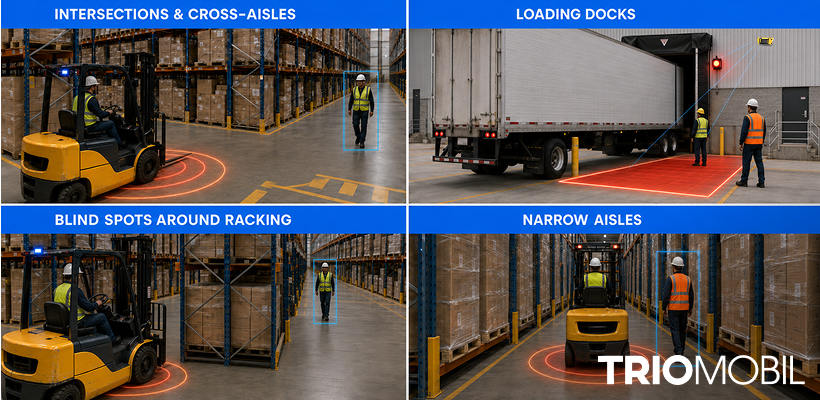
Knowing where incidents are most likely helps you prioritize technology deployment:
Intersections and Cross-Aisles
Any location where forklift paths cross pedestrian walkways creates a collision risk. Limited sightlines, combined with the speed at which forklifts travel, make intersections a top priority for detection systems and speed controls.
Loading Docks and Receiving Areas
Docks see constant traffic from drivers, warehouse staff, and sometimes visitors. The mix of moving vehicles, opening trailer doors, and pedestrians creates a high-density hazard zone. Systems like Trio Mobil's loading dock safety solution use cameras to monitor these areas and issue alerts when someone enters a danger zone.
Blind Spots Around Racking
Tall racks and stacked pallets create visual obstructions. A pedestrian stepping out from behind a rack may have zero warning before encountering a moving forklift. UWB and AI detection help cover these areas where mirrors and cameras alone fall short.
Narrow Aisles in High-Density Storage
Very narrow aisle (VNA) configurations leave little room for error. Any collision avoidance system deployed here needs high positional accuracy and fast response times.
What Features Should You Look for in a Collision Avoidance System?
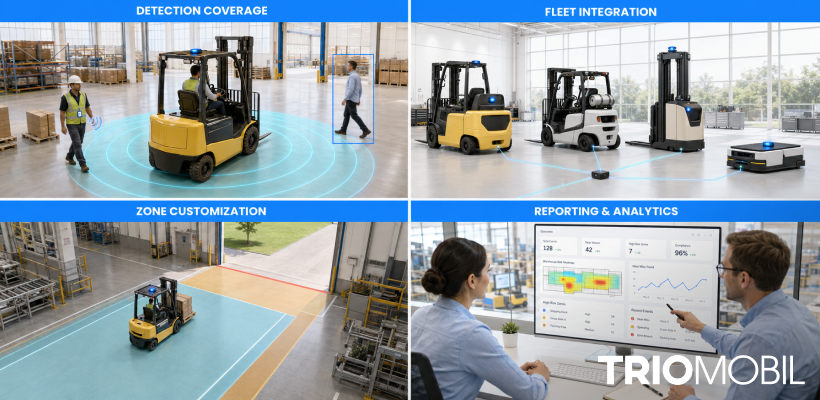
Not all systems are created equally. When evaluating options for your facility, consider these criteria:
Detection Coverage
Does the system cover 360 degrees around the forklift, or only certain angles? Can it detect pedestrians both with and without tags? Multi-layered systems that combine AI vision and UWB offer the most complete coverage.
Integration with Existing Fleet
The system should work with your current forklifts, regardless of brand or model. Trio Mobil, for instance, is vehicle-agnostic and integrates with electric, diesel, and LPG forklifts as well as AGVs and AMRs.
Zone Customization
You need the ability to define different rules for different areas: slower speeds at intersections, full stops at dock doors, and standard alerts elsewhere. Configurable zone management is essential for tailoring the system to your workflow.
Reporting and Analytics
Safety data helps you identify patterns and address risks before incidents occur. Look for systems that log near-miss events, generate trend reports, and highlight high-risk zones. Trio Mobil's fleet management platform delivers operational and safety insights in one dashboard.
Ease of Installation
Complex installations mean longer downtime. Systems designed for plug-and-play deployment minimize disruption. Most forklifts can be equipped within a few hours without pulling them from service for extended periods.
How Do AI and UWB Technologies Compare?
Facilities often ask whether they should invest in AI vision, UWB proximity, or both. Here is how the two technologies stack up:
AI Vision Strengths
Tagless detection means you can identify any pedestrian, including visitors and contractors who do not wear tags. AI also enables behavior recognition, such as detecting when someone is walking toward a forklift path versus standing stationary.
AI vision performs best in open areas with clear sightlines. It can struggle in low-light conditions or when objects heavily obstruct the camera's view.
UWB Proximity Strengths
UWB works through physical obstructions, detecting tagged pedestrians even when walls or racks block the line of sight. Its high positional accuracy enables tiered alerts: a softer warning at 10 meters, a more urgent warning at 3 meters.
The limitation is that everyone in the detection zone must wear a tag. This requires discipline around tag distribution and battery maintenance.
Why Multi-Layered Detection Works
Combining both technologies covers the gaps that each has individually. Trio Mobil's approach uses AI to detect untagged visitors in open areas while UWB protects tagged employees in obstructed zones. The system cross-references both inputs to minimize false alarms and maximize detection reliability.
What Role Does Real-Time Risk Monitoring Play?
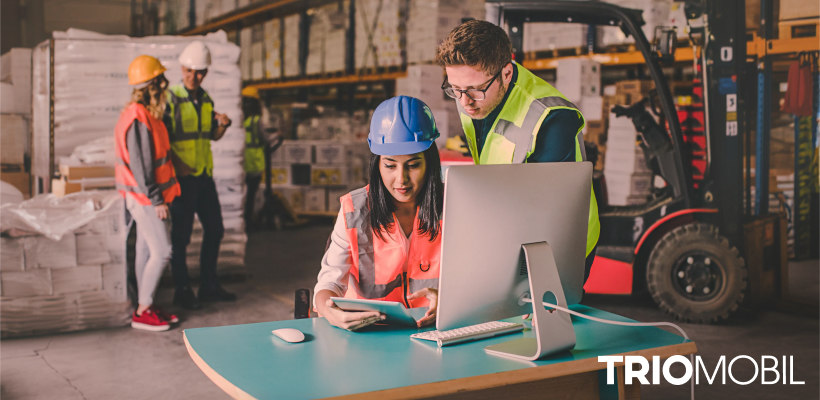
Collision avoidance addresses the immediate moment of danger, but real-time risk monitoring extends protection to the bigger picture. Platforms like Trio Mobil's AI Risk Radar analyze video feeds across your facility to identify unsafe behaviors, PPE violations, and near-miss patterns over time.
This data helps EHS teams move from reactive incident response to proactive risk management. You can see which zones have the most close calls, which shifts show higher risk activity, and where additional controls might be needed.
How to Evaluate Your Facility's Needs
Before selecting a collision avoidance system, conduct a site assessment that covers:
Traffic Flow Analysis
Map out where forklifts travel, where pedestrians walk, and where those paths intersect. This identifies your highest-risk zones.
Existing Safety Measures
Document what controls you already have: mirrors, floor markings, speed limits, training programs. Collision avoidance technology should supplement these measures, not replace them.
Operational Constraints
Consider factors like aisle width, lighting levels, temperature extremes (for cold storage), and the mix of forklift types in your fleet. These affect which technologies will perform reliably.
Workforce Considerations
How many visitors and contractors enter your facility each week? If a significant portion of pedestrian traffic is untagged, tagless AI detection becomes more important.
Understanding OSHA Requirements for Pedestrian Safety
OSHA's powered industrial truck standard (29 CFR 1910.178) includes requirements for managing pedestrian traffic around forklifts. Key provisions include:
Operators must yield right of way to pedestrians.
Horns must be sounded at blind corners, doorways, and aisles.
Permanent aisles and passageways must be appropriately marked where mechanical handling equipment is used.
Employers should consider separating pedestrians from forklifts using walkways, barriers, or floor striping.
Collision avoidance technology supports compliance by adding detection and alerts that go beyond what horns and markings alone can achieve. Some facilities use these systems as part of their documented pedestrian traffic management program.
Implementation Steps for Collision Avoidance Technology
Rolling out a new safety system involves more than just installing hardware. A successful implementation typically follows these steps:
Step 1: Conduct a Baseline Assessment
Document your current incident rates, near-miss frequency, and existing safety measures. This baseline lets you measure improvement after deployment.
Step 2: Select Technology Based on Site Needs
Choose systems that address your specific risks. A facility with many untagged visitors needs strong AI vision. A VNA warehouse with blocked sightlines benefits from UWB. Most facilities do best with a layered approach.
Step 3: Plan Installation Around Operations
Work with your vendor to schedule installations during low-activity shifts. Trio Mobil's plug-and-play design keeps most installations to a few hours per forklift.
Step 4: Train Operators and Pedestrians
Technology works best when everyone understands it. Train operators on how to interpret alerts and respond appropriately. Brief pedestrians on what the alerts mean and how wearables work.
Step 5: Monitor and Adjust
Use the system's analytics to review near-miss events, adjust zone settings, and refine alert sensitivity. Safety performance should improve over the first weeks as the system is calibrated to your facility.
Measuring Return on Investment for Safety Technology
Safety investments deliver value through several channels. The most direct savings come from avoided incidents: fewer injuries mean lower medical costs, workers' compensation claims, and OSHA penalties.
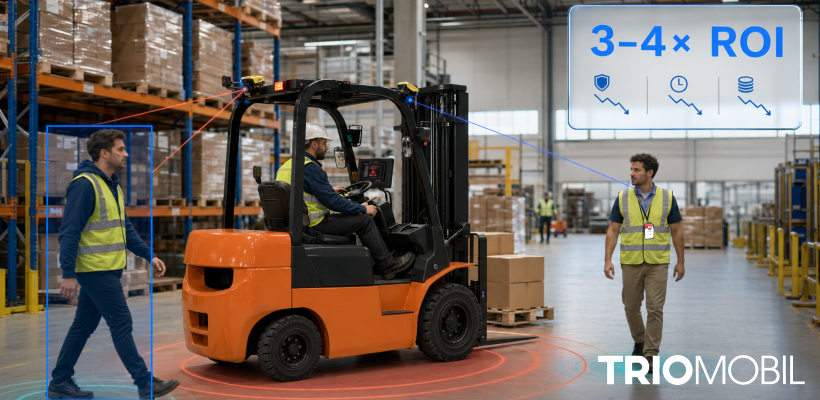
Operational benefits also contribute. When collisions damage racking, products, or forklifts, downtime follows. Preventing these incidents keeps your operation running smoothly. Trio Mobil reports that customers achieve an average 3 to 4 times return on their safety technology investment across global deployments.
Insurance carriers increasingly recognize collision avoidance systems as risk-reduction measures, which may support lower premiums over time. And from an ESG perspective, demonstrating investment in worker safety strengthens your company's reputation and supports recruitment in competitive labor markets.
FAQs about Forklift Collision Avoidance Tech in 2026
What is the most effective forklift collision avoidance system?
Multi-layered systems that combine AI vision with UWB proximity detection deliver the most reliable protection. Trio Mobil's platform integrates both technologies along with smart zone controls, covering scenarios that single-technology systems can miss.
How does AI pedestrian detection work on forklifts?
AI cameras analyze video footage in real time to recognize human shapes and movement. When someone enters the detection zone, the system alerts the operator through in-cab displays and audio alarms. Trio Mobil's AI detection identifies pedestrians without requiring them to wear tags.
Can collision avoidance systems work with any forklift brand?
Quality systems are designed to be vehicle-agnostic. Trio Mobil integrates with electric, diesel, and LPG forklifts from any manufacturer, as well as AGVs and automated mobile robots, without requiring fleet replacement.
What is UWB and why is it used for forklift safety?
UWB stands for ultra-wideband, a radio technology that provides precise positioning down to centimeters. It detects tagged pedestrians even through walls and racking, making it valuable in areas where camera visibility is limited. Trio Mobil uses UWB alongside AI for layered detection coverage.
How quickly can collision avoidance technology be installed?
Most forklifts can be equipped within a few hours. Trio Mobil's plug-and-play design minimizes downtime, and installation can be scheduled around existing operations to avoid disrupting productivity.
Does collision avoidance technology replace operator training?
No. Collision avoidance is an assistive layer that enhances operator awareness and supports faster response. OSHA still requires forklift operator training, and technology works best when paired with a strong safety culture.
What should I look for when choosing a system for my warehouse?
Prioritize 360-degree detection coverage, integration with your existing fleet, customizable zone management, and analytics capabilities. Trio Mobil offers all of these features in a unified platform designed for complex industrial environments.

Product Catalogue 2026
Download our catalog and gain access to a wealth of information on how to enhance industrial safety and efficiency. Our latest catalog features a diverse range of products and services that can help you achieve your goals.
Our Latest Blogs


Learn more about Trio Mobil's Solutions
Fill out the form and we'll contact you!