


Trio Mobil Global Technology Innovation Leader in AI-Based Industrial Safety
Read the Frost & Sullivan Analysis

What Is a Forklift Impact Sensor and How Does It Help Track and Prevent Costly Incidents?
 Sep 04, 2026
 5 min
5 min 469
469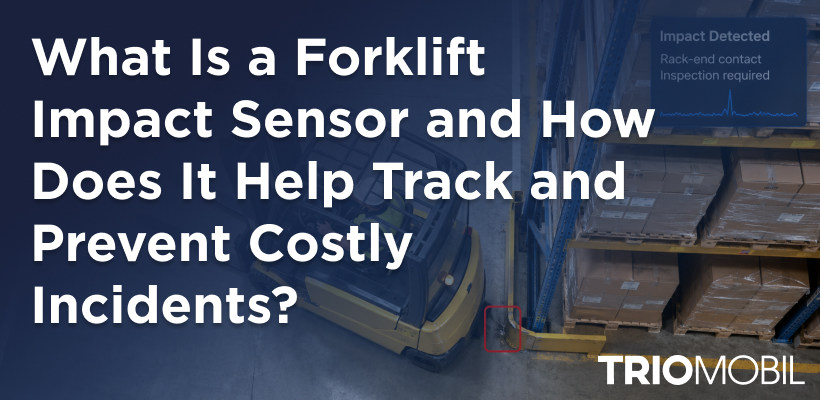
Forklift damage is not always discovered when it happens. It is often discovered when the operational consequences become visible.
A forklift can make contact with a rack, doorway, pallet, product, or another vehicle in a matter of seconds. The visible damage may appear minor, but the consequences can extend much further. A small impact can affect equipment condition, compromise a load, damage facility infrastructure, interrupt a shift, or reveal a recurring risk that has remained hidden from supervisors.
The challenge is that many low-speed impacts are never formally reported. Operators may not notice light contact, damage may only become visible later, and supervisors cannot observe every movement across a busy facility. Without objective event data, teams are often left trying to determine when the damage happened, which forklift was involved, and whether the same type of event has occurred before.
A forklift impact sensor helps close that visibility gap. It shifts the question from “When was this damage discovered?” to “When did the impact occur, and what can the event tell us?”
In this guide, we explain how forklift impact sensors work, what their data can reveal, how they differ from collision-avoidance systems, and how connected impact monitoring can support preventive action.
What Is a Forklift Impact Sensor?
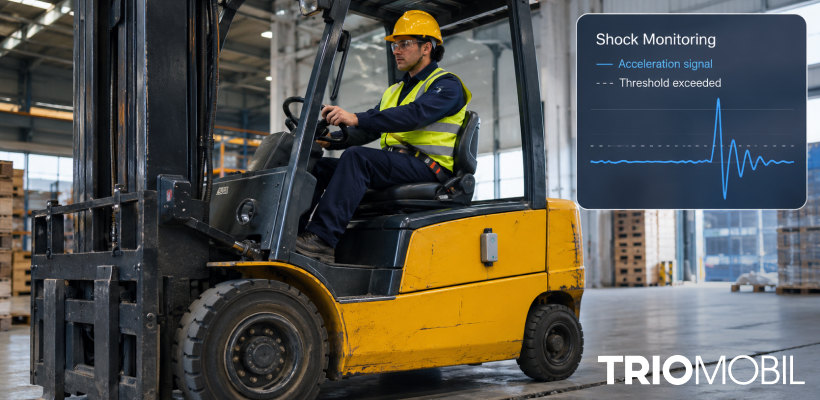
A forklift impact sensor is a vehicle-mounted device that detects sudden changes in motion associated with a collision, shock, or forceful contact. It typically uses an accelerometer to measure acceleration across multiple axes. When the measured force exceeds a configured threshold, the system records an impact event.
In a connected deployment, the sensor does more than register that movement occurred. It can send the event to a cloud-based platform, associate it with a particular forklift and time, alert designated managers, and support a documented review process.
A typical forklift impact monitoring system may capture:
- The forklift or device involved
- The date and time of the event
- The measured impact severity
- The direction or axis of the force
- The operator identity, when access control is integrated
- The vehicle location, when positioning technology is available
- The forklift's operating status around the event
- Whether the event was acknowledged or investigated
This information turns an otherwise isolated shock into a traceable operational record. For a broader view of the connected data behind this process, see What Is Forklift Telemetry and How Does It Improve Forklift Safety?.
How Does a Forklift Impact Sensor Work?
The process usually begins with a compact sensor installed on the forklift. As the vehicle operates, the sensor continuously measures changes in acceleration and vibration. Normal activity, such as traveling across an uneven floor or placing a load, produces motion signals. A potential impact creates a different signal pattern.
The system evaluates that signal against predefined settings. When the event meets the configured criteria, it can follow a connected workflow:
- Detect: The sensor measures an abrupt force or vibration.
- Classify: The system evaluates the event against impact thresholds.
- Record: The event is assigned to a forklift, timestamp, and severity level.
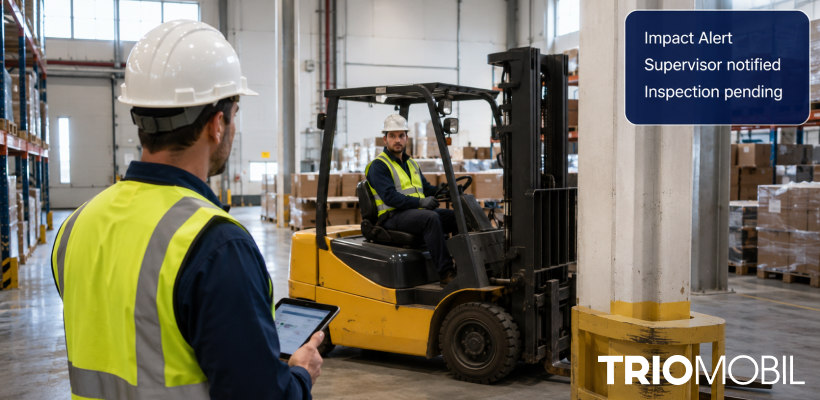
- Alert: A notification is sent to the relevant supervisor or fleet manager.
- Respond: The site follows its inspection, escalation, or maintenance procedure.
- Analyze: Historical data is reviewed to find recurring forklifts, locations, shifts, or event types.
Some systems can also activate an audible or visual warning, request supervisor acknowledgement, or connect the impact event to vehicle-control logic. These functions should be configured around the site's risk assessment, operational rules, and equipment compatibility.
What Can a Forklift Impact Sensor Detect?
An impact sensor is designed to detect physical shock transmitted through the forklift. Depending on installation, calibration, and system configuration, it may help identify events such as:
- Contact with racks, columns, walls, doors, or barriers
- Forklift-to-forklift contact
- A forceful pallet or load interaction
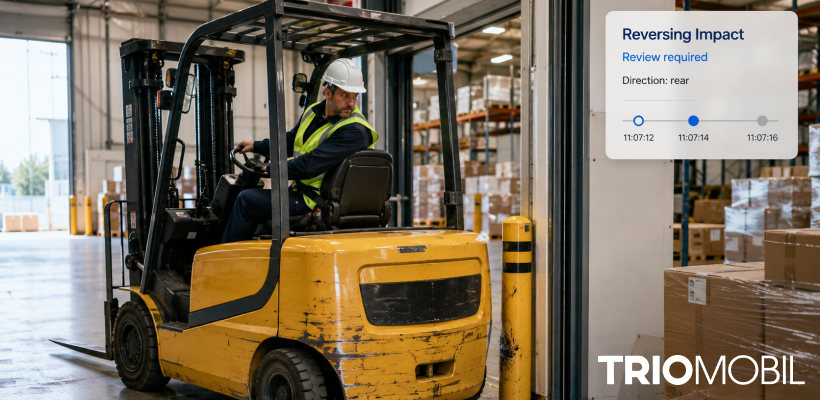
- Contact during reversing or turning
- A significant bump caused by poor floor conditions
- A dropped load or sudden mechanical shock
- Repeated low-level impacts that may indicate a developing operational issue
An impact event does not automatically explain its cause. A strong signal could result from a collision, a floor defect, harsh load handling, or another operating condition. The sensor provides an objective trigger for review. Teams should combine the event data with inspection findings, operator input, location information, maintenance history, and any available video or operational context.
This distinction matters because an impact sensor is not the same as a proximity or pedestrian-detection system. A proximity system is intended to identify a developing interaction before contact, while an impact sensor detects force when contact or a significant shock has already occurred. To understand the preventive role of distance-based technologies, read What Is a Forklift Proximity Sensor?.
Why Untracked Forklift Impacts Become Costly
The cost of a forklift impact is rarely limited to a repair invoice. Even where no injury occurs, one event can create several direct and indirect consequences.
Equipment and infrastructure damage
Impacts may damage the forklift body, forks, mast, attachments, wheels, or onboard components. Contact can also affect racks, dock doors, guardrails, columns, product, and other vehicles. Some defects are immediately visible. Others may develop or worsen during continued use.
Operational downtime
A forklift taken out of service can reduce available fleet capacity and disrupt material flow. Maintenance teams may need to inspect the vehicle, source parts, arrange an alternative truck, or reschedule work. If a rack or doorway is involved, the affected area may also need to be isolated.
Incomplete investigations
When a damaged asset is discovered hours or days later, the investigation often begins with limited evidence. Supervisors may need to compare shift records, speak with several operators, and inspect multiple forklifts. A timestamped alert gives the team a defined event to examine.
Recurring exposure
One unrecorded impact may seem isolated. A pattern of events near the same rack end, doorway, charging area, or loading zone can reveal a layout, visibility, traffic, training, maintenance, or process issue. Without consistent data, that pattern remains difficult to see.
For more on turning fleet signals into operational insight, see What Are Forklift Monitoring Systems and Why Are They Essential for Modern Warehouses?.
How Impact Monitoring Helps Track and Prevent Future Incidents
Impact detection is reactive at the moment of contact, but the data it creates can support prevention over time. Its value comes from what the organization does after an event is detected.
1. Faster response after an impact
Real-time alerts reduce the delay between an impact and the site's response. A supervisor can locate the forklift, check the operator and surrounding area, inspect the vehicle or infrastructure, and determine whether the equipment should remain in service. Earlier review can help contain damage and reduce the likelihood of a compromised asset continuing to operate.
2. More consistent incident documentation
A centralized record gives teams a common source of event information. Instead of relying only on memory or delayed damage discovery, managers can review the forklift, timestamp, severity, and related context. This supports more consistent investigations and follow-up.
3. Pattern-based corrective action
The strongest preventive value appears when teams analyze impact history rather than treating each alert as an isolated case. Useful questions include:
- Are events concentrated around a particular aisle, dock, doorway, or rack end?
- Do impacts rise during specific shifts, breaks, or peak shipment periods?
- Is one vehicle producing more alerts because of its route, condition, or sensor settings?
- Are repeated events associated with reversing, turning, load handling, or floor conditions?
- Did the event rate change after a layout adjustment, maintenance action, or refresher training?
The answers can guide targeted measures such as repairing a floor, changing traffic flow, improving lighting, protecting infrastructure, adjusting storage positions, reviewing work sequencing, or providing focused operator coaching. Data-driven forklift safety analytics can help teams move from individual events to recurring risk patterns.
4. Better maintenance and operator support
Impact history gives maintenance teams another input when deciding which forklifts require inspection. A vehicle associated with a significant shock can be assessed promptly, while repeated lower-level events may support closer examination of wheels, tires, attachments, or operating surfaces.
Impact data should complement scheduled maintenance and the operator's daily inspection. It does not replace the required checks that confirm a forklift is safe before use. Review Forklift Inspections and Pre-Operation Checklist Best Practices for a structured approach to daily equipment checks.
The same records can support fair, evidence-based operator conversations. A timestamp and event profile help supervisors discuss the conditions surrounding an incident and distinguish an isolated event from a repeated operational pattern.
When operator identification is connected through authorized access, the organization can also confirm who was using the forklift at the time. This strengthens traceability while supporting targeted coaching and consistent procedures.
5. Measurement of corrective-action effectiveness
After an intervention, teams can compare impact frequency and severity over time. If events decline after a route change or infrastructure improvement, the data provides evidence that the action is working. If the pattern continues, the site can investigate further.
Forklift Impact Sensor vs. Collision-Avoidance System
The terms are sometimes used interchangeably, but they describe different functions.
| Technology | Primary purpose | Typical timing | Typical output |
|---|---|---|---|
| Forklift impact sensor | Detects physical shock or contact | During or immediately after an impact | Event record, severity data, and alert |
| Proximity detection system | Measures closeness between equipped vehicles or pedestrians | Before potential contact | Audible, visual, or vibration warning |
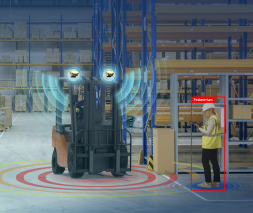
| AI pedestrian-detection camera | Identifies people or defined objects in the camera's field of view | Before a potential interaction | Real-time operator alert and event data |
| Zone-based control | Applies rules in configured areas | When a forklift enters or approaches a zone | Warning, speed-control request, or connected site action |
These technologies can contribute at different points in the risk cycle. Collision-avoidance technologies support awareness before contact. Impact monitoring documents the shock and initiates a response if contact occurs. Fleet analytics then helps teams understand whether the event reflects a broader pattern.
Facilities with mixed traffic or complex blind spots may benefit from combining impact data with a forklift safety and collision avoidance system. For a more detailed technology overview, read Everything About Forklift Collision Avoidance Systems.
How Trio Mobil Translates Impact Data into Action
Impact data becomes more useful when it is connected to the wider operating context. Trio Mobil brings these signals together through FleetBridge and related forklift monitoring capabilities.
FleetBridge Impact Detection and Management
The FleetBridge forklift fleet management platform can connect configured impact events with vehicle identity, timestamps, severity information, and real-time notifications. Depending on deployment conditions and system configuration, this supports a more structured response and investigation process.
Connected Fleet Context
Impact information can be reviewed alongside operator access records, pre-operation checklists, utilization data, and other fleet signals. This broader context can help teams determine whether an event appears isolated or belongs to a recurring vehicle, shift, or operational pattern.
Complementary Safety Layers
Impact monitoring records physical shocks. It does not replace technologies designed to support awareness before contact. Depending on the site's risk profile, Trio Mobil's forklift tracking and monitoring systems, proximity detection, AI cameras, or zone-based controls can add other layers of operational visibility.
What Features Should You Look for in a Forklift Impact Monitoring System?
The right configuration depends on fleet size, vehicle types, site layout, connectivity, and response procedures. When evaluating a system, consider the following capabilities:
- Adjustable thresholds: Settings should distinguish meaningful shocks from routine vibration while accounting for vehicle and surface conditions.
- Prioritized alerts: Severity levels and notifications should help the right people focus on events that need prompt review.
- Fleet, operator, and location context: Events should be connected to the correct vehicle and, where appropriate, the authorized operator and event location.
- Historical reporting: Dashboards should support comparisons across vehicles, areas, shifts, and periods.
- Integration: Impact monitoring is more useful when connected with telematics, access control, checklists, and maintenance processes.
- Scalability: The platform should support mixed forklift brands and expansion across multiple facilities where required.
- Clear investigation workflow: The site should be able to document acknowledgement, inspection, findings, and corrective action.
Teams evaluating broader visibility options can also review Choosing the Right Forklift Monitoring Systems for Your Business Needs.
How to Implement Forklift Impact Detection Effectively
Installing the sensor is only the first step. An effective rollout should connect the technology with clear response procedures, maintenance workflows, and operator communication.
A practical implementation can be organized into four stages:
Define the objective
Identify what the site wants to improve, such as faster damage detection, lower repair costs, better rack protection, or more consistent incident documentation. Use existing damage and maintenance records to establish a baseline.
Configure and validate thresholds
Adjust sensor settings for the forklift types, attachments, loads, and operating surfaces within the facility. Overly sensitive settings may generate alerts during normal activity, while thresholds that are too high may miss relevant events. Validate the configuration under controlled conditions and review it after deployment.
Create a clear response process
Define who receives each alert and what action should follow. A high-severity impact may require the forklift to be stopped and inspected immediately. Lower-severity events may be assigned for supervisor review within a specified period. Operators should also understand what the sensor records and how the information will be used.
Review performance regularly
Monitor impact frequency, severity, recurring locations, affected assets, response times, and corrective-action status. Where possible, compare trends by operating hours. This provides a fairer view of fleet performance because heavily used forklifts may record more events simply because they spend more time in service.
Turning Impact Events into Preventive Fleet Intelligence
A forklift impact sensor makes a moment of physical contact visible. Its greater value comes from connecting that event to a timely response, an objective investigation, and a longer-term view of fleet risk.
With the right thresholds and workflow, impact monitoring can help teams discover damage earlier, prioritize inspections, reduce uncertainty, and identify where repeated events point to a correctable operational condition. When combined with forklift telematics, access control, pre-operation checklists, location data, and preventive safety technologies, it becomes part of a more complete fleet-management strategy.
An impact should create more than a repair record. It should create information that helps the organization understand what happened and where preventive attention may be needed.
Trio Mobil helps organizations connect impact events with real-time alerts and fleet data. Contact our team to discuss how impact detection could fit your fleet and site-specific operating conditions.
Key Takeaways
The main points below summarize how forklift impact monitoring contributes to a broader fleet safety and maintenance strategy.
- Impact sensors detect physical shock: Accelerometer-based devices measure abrupt changes in motion and record events that exceed configured thresholds.
- Event data improves traceability: Records can include the forklift, timestamp, severity, direction, operator, and location, depending on system configuration.
- Alerts support faster review: Prompt notification can help teams inspect the vehicle, load, and surrounding infrastructure sooner.
- Historical patterns guide action: Repeated events can reveal locations, shifts, vehicles, or operating conditions that need closer attention.
- Impact detection is different from collision avoidance: It records contact or significant shock, while proximity and vision systems support awareness before potential contact.
- Connected data creates more context: Telematics, access control, checklists, and location information can strengthen investigation and follow-up.
- Technology remains one safety layer: Impact monitoring complements training, supervision, inspections, maintenance, and site procedures.
Frequently Asked Questions
It measures sudden changes in acceleration or vibration that may indicate a collision, shock, or forceful contact. The system compares the signal with configured thresholds and records qualifying events.
An impact sensor primarily detects an event during or after physical contact. Its historical data can support preventive improvements, but pre-contact awareness typically requires complementary technologies such as proximity detection, AI cameras, or zone-based controls.
Yes, when the impact-monitoring platform is integrated with operator access control. The event can then be associated with the authorized user logged into the forklift at that time.
No. They provide additional event visibility but do not replace pre-operation inspections, maintenance requirements, operator training, or site safety procedures.
Many systems allow threshold configuration by vehicle type or operating environment. Proper calibration is important because forklift models, loads, attachments, tires, and floor conditions can produce different vibration profiles.
The site should follow its defined response procedure. This may include stopping the forklift, checking the operator and surrounding area, inspecting the vehicle, load, and infrastructure, documenting findings, and authorizing return to service only when appropriate.
These questions address the practical points teams most often consider when evaluating forklift impact sensors.
Disclaimer: Trio Mobil solutions are operator-assist aids. They do not replace safe working practices or prevent all incidents. Performance depends on operating conditions and configuration; see product documentation.

Product Catalogue 2026
Download our catalog and gain access to a wealth of information on how to enhance industrial safety and efficiency. Our latest catalog features a diverse range of products and services that can help you achieve your goals.
Our Latest Blogs


Learn more about Trio Mobil's Solutions
Fill out the form and we'll contact you!