


Trio Mobil Global Technology Innovation Leader in AI-Based Industrial Safety
Read the Frost & Sullivan Analysis

Forklift Pedestrian Safety and Collision Avoidance in Industrial Operations
 Feb 06, 2026
 4 min
4 min 421
421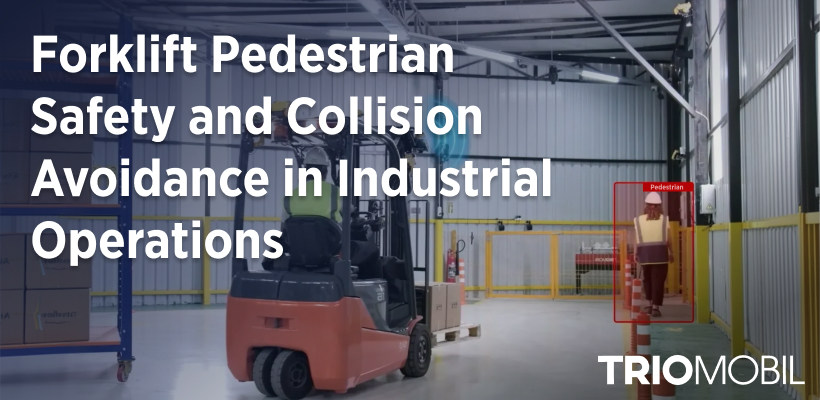
Forklift pedestrian safety and collision avoidance refers to the system-level ability to detect, understand, and manage unsafe interactions between forklifts and pedestrians in shared industrial environments by combining real-time visibility, contextual awareness, and data-driven insight.
This article focuses on how risk develops dynamically in industrial spaces and how earlier awareness supports safer operational decisions.
Industrial Operations Are Becoming More Complex
Industrial sites continue to evolve. Warehouses, manufacturing plants, and distribution centers now operate with higher throughput, denser layouts, and tighter timelines. Forklifts move continuously across shared spaces while pedestrians perform picking, inspection, maintenance, and supervisory tasks.
These interactions rarely occur in static or controlled conditions.
Traffic density changes by shift and season. Layouts evolve with temporary storage, new production lines, or expansion projects. Visibility fluctuates with racking height, loads, lighting, and intersections. Even experienced operators and pedestrians encounter moments where reaction time is reduced.
In this environment, pedestrian safety cannot rely solely on rules, signage, or training. Collision risk develops through overlapping factors that change continuously during daily operations.
Defining Pedestrian Safety in Forklift Operations
Pedestrian safety in forklift operations refers to the ability to manage and reduce risk when powered industrial vehicles and people on foot operate within the same environment.
This includes:
- Awareness of forklift presence and movement
- Recognition of pedestrian proximity in real time
- Understanding of blind zones and line-of-sight limitations
- Management of mixed traffic at intersections and crossings
- Early identification of high-risk interactions before an incident occurs
In summary, pedestrian safety depends on how multiple variables interact, not on isolated controls.
Why Forklift Pedestrian Incidents Still Occur
Most industrial sites already implement foundational safety measures, including:
- Forklift speed limits
- Marked pedestrian walkways
- Warning signs and mirrors
- Operator and pedestrian training
- High-visibility personal protective equipment
These controls are essential. However, incidents still occur in well-managed facilities because risk does not form in isolation.
- Blind corners and racking intersections: Limited line of sight in these areas reduces reaction time for both operators and pedestrians, increasing the likelihood of unexpected close interactions.
- Forklifts reversing with loads that obstruct view: Rearward travel with obstructed visibility makes it harder for operators to detect pedestrians until proximity becomes critical.
- Pedestrians stepping outside designated walkways under time pressure: Operational urgency can lead pedestrians to take shorter or unintended paths, placing them closer to moving vehicles.
- Temporary congestion during peak operations: Increased traffic density raises the number of simultaneous interactions, making coordination and awareness more difficult.
- Noise that masks audible warnings: High ambient noise levels can reduce the effectiveness of horns, alarms, and verbal cues intended to signal forklift movement.
Limitations of Traditional Forklift and Pedestrian Safety Measures
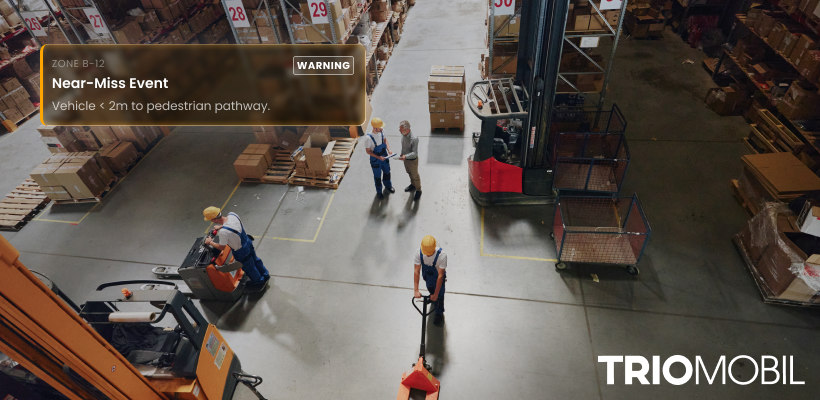
Traditional safety controls are largely static. They are designed around expected behavior and fixed layouts. Modern operations are neither static nor predictable.
Key limitations include:
- Limited real-time visibility: Floor markings and signage do not adapt to changing traffic density or temporary layout changes.
- Dependence on human attention: Mirrors, lights, and alarms require continuous attention and interpretation. Under pressure, attention can decrease.
- Reactive rather than proactive response: Many controls alert only when a forklift is already very close to a pedestrian.
- Lack of data and feedback: Traditional measures provide limited insight into where near-misses occur or how risk evolves over time.
In short, static controls struggle to keep pace with dynamic operational risk.
Understanding Forklift Pedestrian Collision Risk as a System
Forklift pedestrian collision avoidance requires viewing risk as a system rather than a single event.
Risk increases when:
- Distance between forklift and pedestrian decreases
- Line of sight is obstructed
- Speed increases
- Multiple vehicles converge at intersections
- Pedestrian movement becomes unpredictable
These variables change continuously. Managing them requires visibility into both position and behavior.
A system-level approach focuses on:
- Detecting proximity earlier
- Interpreting context, not just distance
- Supporting timely awareness for both operators and pedestrians
- Capturing data that reflects real site conditions
All these factors show that collision risk develops dynamically through interacting variables, not isolated actions.
How Modern Collision Avoidance Technologies Work
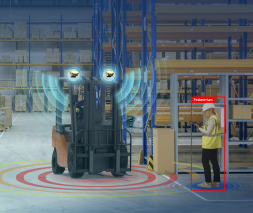
Modern forklift pedestrian collision avoidance technologies are designed to complement existing safety controls by adding real-time awareness and data-driven insight. These systems typically combine multiple layers:
Proximity Detection
Technologies such as Ultra-Wideband and similar sensing methods measure the distance between forklifts and pedestrians with high accuracy. This allows systems to recognize when predefined safety thresholds are approached.
Proximity detection operates regardless of visibility and supports complex layouts.
AI-Based Visual Detection
AI-powered vision systems analyze live camera feeds to identify pedestrians, forklifts, and movement patterns. Unlike basic motion detection, AI models interpret context such as direction of travel, speed, and potential interaction paths.
This layer helps identify risk in areas where proximity alone may not provide sufficient insight.
Intelligent Alert Logic
Modern systems apply logic that considers:
- Relative speed
- Direction of movement
- Duration of proximity
- Location-specific risk zones
Alerts are designed to support awareness without overwhelming operators or pedestrians.
Operational Value of Forklift Pedestrian Collision Avoidance Systems
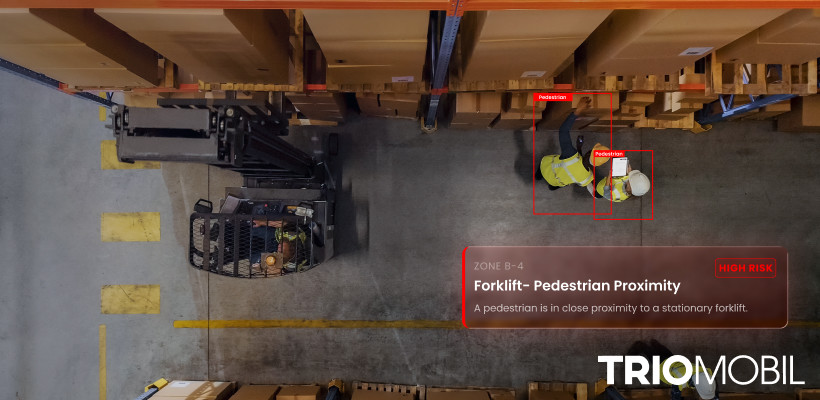
When implemented as part of a layered strategy, collision avoidance systems provide operational value beyond basic compliance.
Earlier Risk Awareness
By detecting interactions earlier, teams gain more time to respond. Earlier awareness supports safer decisions under real working conditions.
Reduced Near-Miss Exposure
Near-misses are leading indicators of potential incidents. Monitoring and managing these interactions helps reduce overall risk exposure.
Consistency Across Shifts and Sites
Technology-based systems support consistent behavior regardless of experience level, shift timing, or workload.
Data-Driven Safety Management
Collected data allows safety teams to:
- Identify high-risk zones
- Understand peak risk periods
- Validate the effectiveness of layout changes
- Prioritize corrective actions
For many HSE and operations teams, the next step is not selecting a product, but understanding where risk actually concentrates within their own sites. Visibility into real interaction patterns often becomes the foundation for more informed safety decisions.
Observed Risk Patterns in Industrial Environments
In large manufacturing and logistics environments, safety teams frequently observe that a small number of intersections, crossings, and loading zones account for a disproportionate share of near-miss interactions.
Identifying these patterns early allows corrective actions such as layout adjustments, traffic flow changes, or targeted controls to be prioritized more effectively.
Integrating Technology with Existing Safety Controls
Forklift pedestrian safety technologies are not replacements for foundational controls. They are extensions.
Effective integration includes:
- Maintaining clear walkways and signage
- Reinforcing training with real-time feedback
- Aligning alert thresholds with site-specific risk tolerance
- Reviewing interaction data regularly with HSE and operations teams
Technology adds a dynamic layer that reflects how work actually occurs during operations.
Pedestrian Safety as a Continuous Process
Forklift pedestrian safety is not a one-time project. It evolves as operations grow and change.
Continuous improvement requires:
- Ongoing monitoring of interaction patterns: Continuous observation of how forklifts and pedestrians interact helps reveal emerging risk trends before incidents occur.
- Regular review of near-miss data: Systematic analysis of near-miss events provides insight into where and when exposure is increasing.
- Adjustment of thresholds and zones as layouts evolve: Updating risk zones and alert thresholds ensures safety measures remain aligned with changing operational conditions.
- Collaboration between HSE and operations teams: Close coordination enables safety insights to be translated into practical, site-specific improvements.
Collision avoidance systems provide the visibility needed to support this ongoing process.
Strategic Takeaways for HSE and Operations Leaders
Pedestrian safety in forklift operations is shaped by dynamic, overlapping risks. Traditional controls remain essential, but they are not sufficient on their own in modern environments.
Key insights include:
- Most forklift pedestrian incidents result from system-level interactions, not single failures
- Static controls struggle to reflect real-time operational variability
- Layered safety approaches improve awareness without replacing existing measures
- Data-driven insight enables more targeted and effective safety actions
- Technology is most effective when aligned with operational reality and human behavior
Pedestrian safety improves when visibility increases, awareness is shared, and decisions are informed by real conditions.
Enhancing Pedestrian Safety with Trio Mobil Solutions
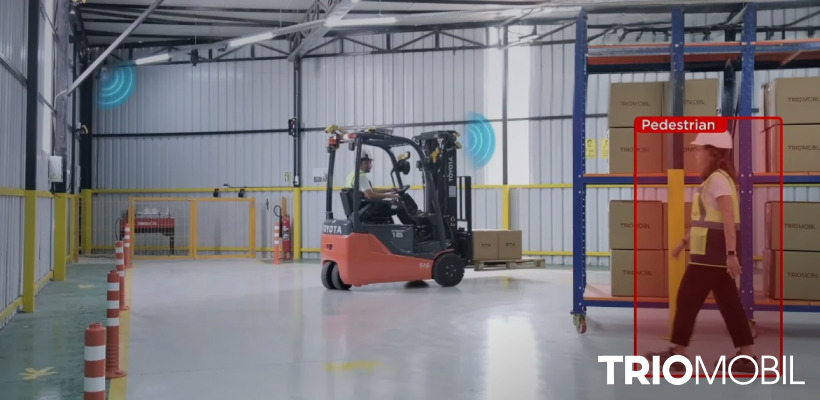
Trio Mobil supports forklift pedestrian safety through layered solutions designed to enhance awareness and visibility in real operational environments.
Trio Mobil solutions combine:
- Real-time proximity detection between forklifts and pedestrians
- AI-powered visual analysis for contextual understanding
- Configurable alert logic aligned with site-specific risk profiles
- Centralized data visibility for safety and operations teams
Rather than focusing on a single technology, Trio Mobil enables a system-level approach where multiple signals work together. This supports earlier recognition of high-risk interactions and more informed safety decisions.
Trio Mobil solutions are designed to integrate with existing safety programs and operational workflows, supporting continuous improvement rather than disruption.
For deeper insight into our modular, plug-and-play safety solutions, explore our website or request a demo to understand how our forklift safety system supports on-site operations.
Disclaimer:
Trio Mobil solutions are operator-assist aids. They do not replace safe working practices or prevent all incidents. Performance depends on operating conditions and configuration; see product documentation.

Product Catalogue 2026
Download our catalog and gain access to a wealth of information on how to enhance industrial safety and efficiency. Our latest catalog features a diverse range of products and services that can help you achieve your goals.
Our Latest Blogs


Learn more about Trio Mobil's Solutions
Fill out the form and we'll contact you!