

Trio Mobil Global Technology Innovation Leader in AI-Based Industrial Safety
Read the Frost & Sullivan Analysis

Manufacturing’s Talent Problem Is Also a Safety Perception Problem
 Jan 23, 2026
 3 min
3 min 420
420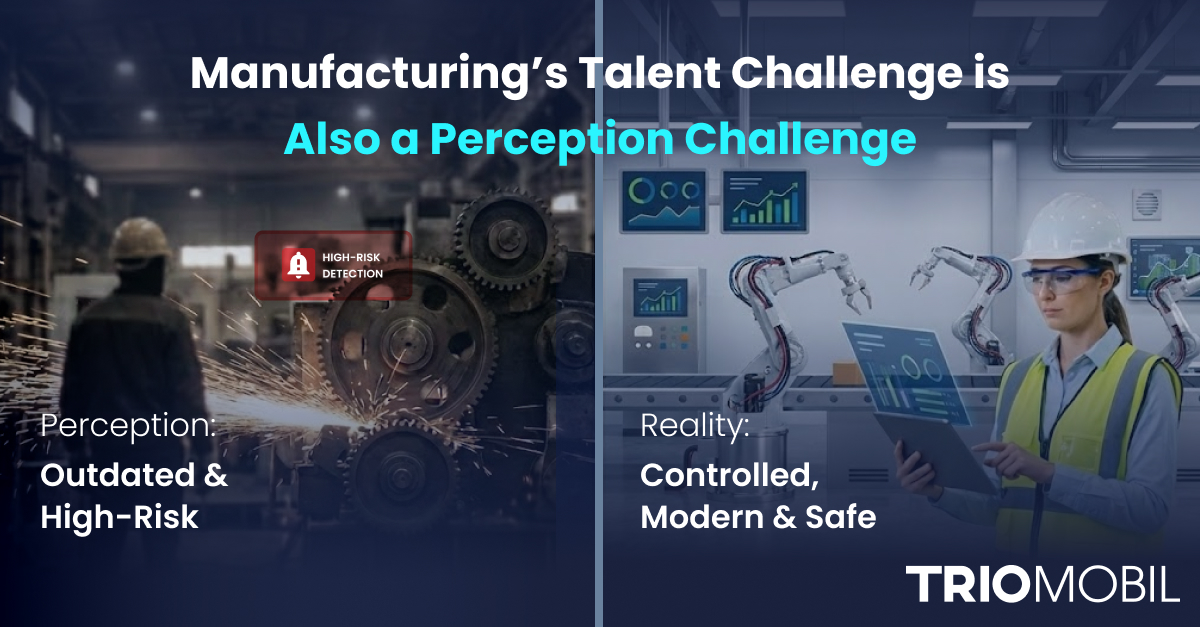
Manufacturing and heavy industry are facing a growing talent challenge.
But behind the familiar discussions about skills gaps, aging workforces, and competition with tech companies lies a less visible — and less discussed — issue:
Perception.
For many early-career professionals, manufacturing environments are not only unfamiliar — they are often perceived as higher-risk workplaces compared to other career paths. And in career decisions, perception matters as much as reality.
Perception Shapes Career Choice More Than Statistics
Career decisions are rarely driven by injury rate charts or safety reports.
They are shaped by what people believe a workplace will feel like.
Research and industry studies consistently show that when individuals lack exposure to modern manufacturing environments, they tend to underestimate:
- The level of automation and digitalization
- The sophistication of safety systems
- The degree of operational control present in today’s plants
In other words, absence of visibility creates outdated assumptions.
People cannot choose a path they cannot clearly see — and they are unlikely to choose one they believe may be unsafe.
Why Safety Has Become a Talent Signal
This is where safety leadership moves beyond compliance.
Organizations that consistently operate with:
- Lower incident rates
- Modern safety infrastructure
- Data-driven visibility into risk
- Real-time alerting and intervention capabilities
are doing more than preventing accidents.
They are sending a powerful signal to current and future employees:
This is a controlled, professional, and modern working environment.
In today’s labor market, safety performance is no longer just an internal metric.
It is part of the employer value proposition.
The Link Between Modern Safety and Modern Careers
Young professionals evaluating manufacturing careers are not only asking:
- What will I do?
- What will I learn?
They are also asking:
- Will I be safe?
- Will this environment feel modern and well-run?
Factories that rely solely on rules, training, and periodic audits struggle to communicate that message.
Factories that combine:
- Strong safety culture
- Continuous visibility into operational risk
- AI-supported detection of hazards and infrastructure gaps
- Real-time intervention when risk materializes
tell a different story — without saying a word.
The environment speaks for itself.
Safety, Trust, and Retention
Safety perception does not only affect recruitment.
It directly influences retention.
Employees who trust their environment:
- Engage more confidently with operations
- Develop stronger attachment to the workplace
- Are more likely to recommend their employer to peers
In this sense, safety is not just protective.
It is foundational to trust.
Reframing the Talent Conversation in Manufacturing
The manufacturing talent challenge is often framed as:
- An education problem
- A branding problem
- A compensation problem
In reality, it is also a visibility and trust problem.
When organizations modernize safety — not only in outcomes, but in how safety is experienced and demonstrated — they change how manufacturing itself is perceived.
This shift does not require marketing campaigns.
It requires operational credibility.
A Leadership Responsibility
Attracting the next generation of industrial talent is no longer only an HR initiative.
It is a leadership responsibility that sits at the intersection of:
- Safety
- Operations
- Technology
- Culture
Organizations that treat safety as a strategic system — rather than a compliance function — will have a structural advantage in the years ahead.
Modern manufacturing is not unsafe.
But it must be seen, experienced, and demonstrated that way.

Product Catalogue 2026
Download our catalog and gain access to a wealth of information on how to enhance industrial safety and efficiency. Our latest catalog features a diverse range of products and services that can help you achieve your goals.
Our Latest Blogs


Learn more about Trio Mobil's Solutions
Fill out the form and we'll contact you!