


Trio Mobil Global Technology Innovation Leader in AI-Based Industrial Safety
Read the Frost & Sullivan Analysis

Beyond the “Zero Accident” Trap: Why Safety Must Be Actively Operated
 Feb 19, 2026
 3 min
3 min 399
399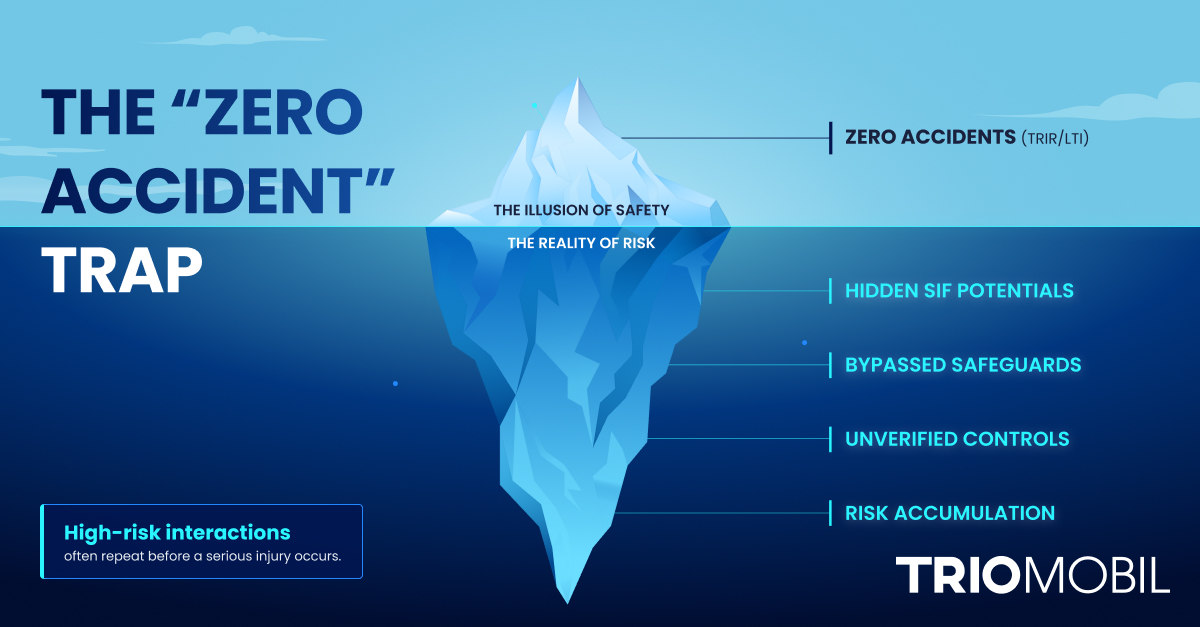
For decades, the “Zero Accident” banner has defined industrial safety ambition. It became the gold standard. The ultimate KPI.
But absence of injury is not the same as presence of safety.
Zero accidents does not automatically mean a facility is safe. In many cases, it means risk has not yet converted into harm. In other cases, it means exposure signals are not fully visible within the organization’s current safety monitoring systems.
This is the Zero Accident trap.
The Structural Limitation of Lagging Indicators
Most industrial safety programs rely on lagging indicators such as:
- Total Recordable Incident Rate
- Lost Time Injuries
- Severity rates
Lagging indicators measure outcomes after harm has occurred. They describe historical consequence.
They do not measure real-time exposure.
By the time these metrics change, the system has already failed.
Leading indicators, by contrast, measure conditions and behaviors that increase the probability of serious events before injury happens. A real-time safety operating model depends on leading exposure signals, not historical summaries.
Organizations that rely exclusively on lagging metrics are managing history. They are not actively operating risk.
From Outcome Reporting to a Safety Operating Model
A growing number of high-maturity organizations are reframing safety around a different operational question:
What is happening right now?
This shift aligns with the philosophy embedded in ASTM E2920-24, a standard that emphasizes safeguard effectiveness, exposure identification, and verification of protective controls rather than solely tracking injury outcomes.
In this model, safety becomes a continuously monitored operational condition. It is not a monthly report. It is an active control system.
Three structural pillars define a real-time safety operating model.
1. SIF-Potential Visibility
Not all incidents carry equal risk.
A minor first-aid case and a high-speed forklift–pedestrian interaction represent fundamentally different energy exposures. Traditional reporting systems often aggregate them statistically, masking severity differences.
Serious Injuries and Fatalities, often referred to as SIF events, are typically preceded by identifiable high-energy precursors.
A real-time safety operating model prioritizes visibility into those precursors: unsafe proximity, high-risk movement, degraded segregation, or exposure to uncontrolled energy.
If safety data cannot reveal where catastrophic harm could have occurred today, it lacks strategic relevance.
SIF-potential visibility transforms safety from event counting into exposure intelligence.
2. Safeguard Verification
Many programs track unsafe acts. Fewer continuously verify the health of safeguards.
Safeguards include physical barriers, interlocks, proximity controls, and engineered separation systems. When these protections degrade, exposure increases silently.
Are interlocks functioning as designed?
Have barriers been bypassed or repositioned?
Are proximity alerts active and reliable?
A real-time safety operating model treats safeguards as dynamic assets requiring validation, not static installations assumed to work indefinitely.
Verification reduces the gap between perceived protection and actual protection.
3. The Closed Intervention Loop
Detection without rapid intervention limits impact.
If high-risk exposure is identified but addressed days later, the safety system is operating on delay.
A real-time safety operating model closes the loop between detection and response. Exposure triggers immediate alerting. Supervisors intervene at the floor level. Action precedes escalation.
Shortening the time between exposure and mitigation converts visibility into operational control.
Redefining Safety Leadership
The defining safety question is no longer:
How many days since our last accident?
It is:
How many high-risk exposures did we detect, analyze, and neutralize in the last 24 hours?
That shift distinguishes organizations that measure safety from those that operate it.
Zero remains a powerful aspiration. But without leading exposure indicators, safeguard verification, and a real-time intervention loop, it risks becoming a symbolic metric detached from operational reality.
Industrial safety is evolving from injury reporting toward continuous exposure management.
Stop managing history.
Start operating safety.

Product Catalogue 2026
Download our catalog and gain access to a wealth of information on how to enhance industrial safety and efficiency. Our latest catalog features a diverse range of products and services that can help you achieve your goals.
Our Latest Blogs


Learn more about Trio Mobil's Solutions
Fill out the form and we'll contact you!