


Trio Mobil Global Technology Innovation Leader in AI-Based Industrial Safety
Read the Frost & Sullivan Analysis


Trusted by 2,000+ Industrial Sites 150+ Fortune 1,000 Brands

AI-Powered Forklift Safety System for Pedestrian Detection and Collision Avoidance
Forklifts are involved in more than 90,000 workplace incidents each year, many caused by blind spots, limited visibility, and busy pedestrian areas.
Trio Mobil helps reduce these risks with a real-time forklift safety system that combines multi-layered detection technologies and intelligent operator alerts to support safer industrial operations.

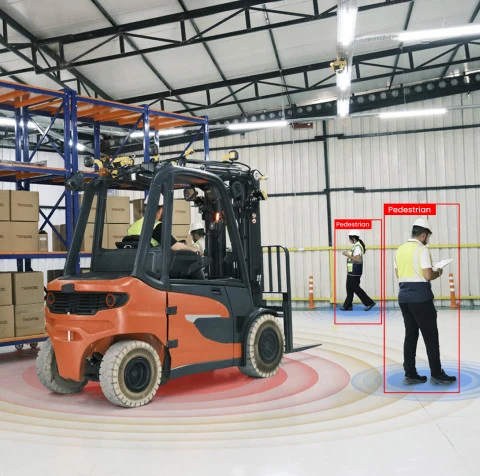
Blind Spot Awareness: Detects pedestrians and vehicles around forklifts, even in low-visibility areas and high-traffic environments.
Smart Zones: Creates dynamic safety zones that assist collision avoidance at intersections and high-risk traffic points.
Operator Alerts: Provides visual and audio alerts that help forklift operators react faster to nearby pedestrians and hazards.

Trusted By 2,000+ Leading Brands
AI-powered forklift and pedestrian safety platform, chosen by industry leaders to reduce risks and enhance workplace performance.
Smarter Industrial Safety.
Stronger Operational Control.
Modern industrial environments require more than passive safety measures. Continuous monitoring and real-time risk detection help organizations identify hazardous interactions early and prevent forklift-related incidents before they escalate.
Monitor
AI-powered systems continuously monitor forklift movement, pedestrian proximity, blind spots, and traffic patterns across the facility. This real-time visibility helps safety teams understand where interactions occur and where collision risks are most likely to develop.
Detect
Multi-layered technologies detect potentially hazardous interactions between forklifts, pedestrians, and other vehicles. When unsafe proximity or high-risk situations are identified, the system triggers instant alerts to help operators and pedestrians react before incidents occur.
Prevent
Data-driven insights and continuous monitoring help organizations reduce long-term exposure to risk. By analyzing near-misses, traffic behavior, and safety events, facilities can improve traffic flows, adjust safety zones, and strengthen a prevention-first safety culture.
Prevention-First Forklift & Pedestrian Safety Solutions
Trio Mobil provides a real-time forklift safety system designed to strengthen pedestrian protection, reduce collision risks, and improve operational visibility across industrial environments. By combining AI vision, proximity detection, intelligent safety zones, and continuous risk monitoring, the platform helps organizations prevent hazardous interactions before they escalate.

Near-miss
Incidents
Operational
Efficiency
AI-Powered Pedestrian Safety
Tagless and Tag-Based Detection for Maximum Protection

Real-Time Detection: Continuously monitors pedestrian and vehicle movements around forklifts to identify potential collision risks.
Proximity Alerts: Provides instant visual and audio alerts that help operators maintain safe distance from nearby pedestrians.
Smart Speed Control: Automatically limits forklift speed in high-risk areas to reduce the likelihood and severity of incidents.
Blind Spot Awareness
Multi-layered technology that helps operators see beyond blind spots.
All-Direction Monitoring: Detects movement from every angle, including pedestrians approaching from obstructed areas.
Layered Safety Detection: Combines AI vision and UWB proximity sensing for broader forklift collision avoidance coverage.
Seamless Integration: Works with all forklift brands and models without disrupting existing operations.
Intelligent Zone Safety Management
Smart zone safety management with visual alerts for high-traffic areas and critical intersections.
Real-Time Alerts: Triggers alerts when pedestrians or vehicles enter collision-risk zones.
LED Integration & Door Control: Improves visibility and awareness at blind intersections and entry points.
Dynamic Zone Adaptation: Adjusts safety logic based on traffic behavior and operational patterns.
AI Risk Radar
Your 24/7 digital EHS safety inspector.
100+ Risk Detection Scenarios: Continuously monitors collisions, compliance issues, and unsafe practices across operations.
Near-Miss Analysis: Identifies close-call events early to support proactive safety interventions.
Smart Insights: Delivers contextual insights and supporting video evidence to accelerate decision-making.
Trusted by Industry Leaders
Industrial facilities improve forklift and pedestrian safety with Trio Mobil across complex operations.
“A big step forward in safety innovation.”
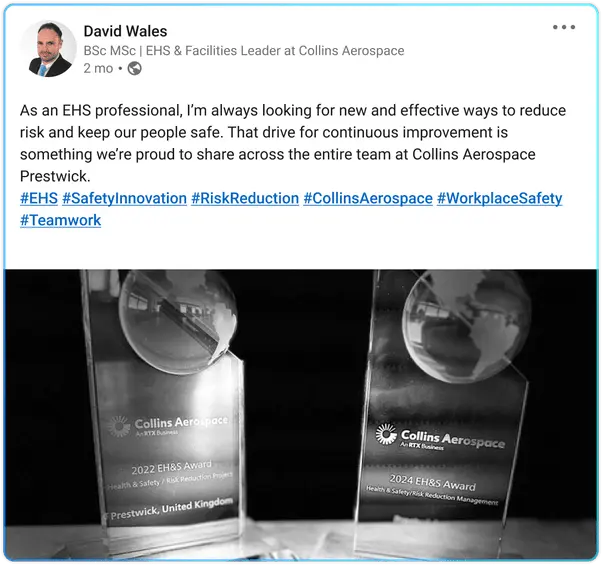
David Wales
EHS Leader at Collins Aerospace


“Improving PIV safety and operations significantly.”
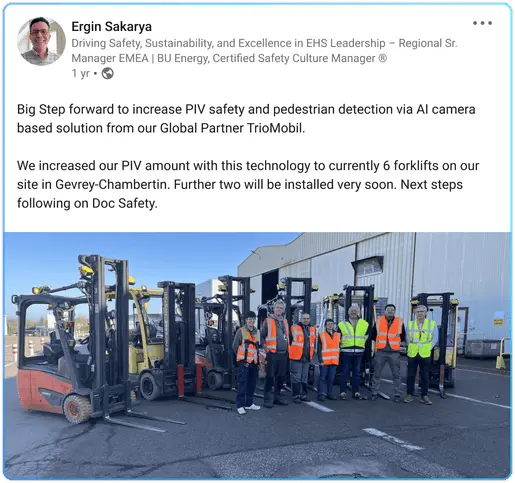
Ergin Sakarya
EHS Manager at TE Connecitivity

“Starting a New Era in Industrial Safety”
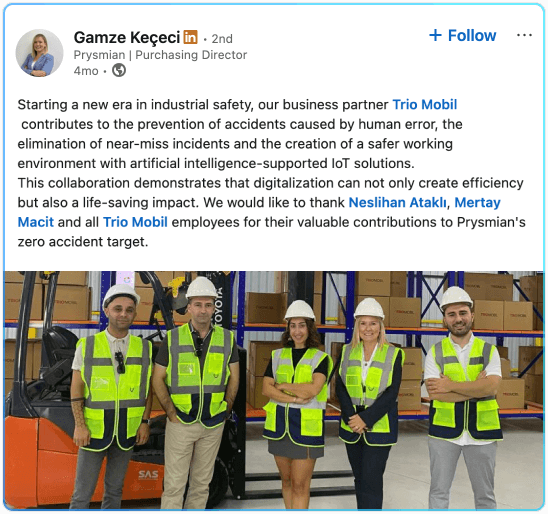
Gamze Keçeci
Purchasing Director at Prysmian

Measurable Impact That Pays Off
Trio Mobil’s Prevention-First Safety Platform delivers an average 3-4x return on investment across global deployments, helping organizations reduce forklift collisions, improve pedestrian safety, and strengthen operational performance.

Incident Cost Avoidance
Helps prevent severe forklift and pedestrian incidents that can cost $500K-$1M+ per event in medical expenses, equipment damage, and operational disruption.

Operational Efficiency
Reduces downtime, equipment damage, and traffic congestion while improving the flow of vehicles and pedestrians across facilities.

Compliance and ESG Alignment
Supports safety reporting, strengthens sustainability metrics, and helps organizations meet evolving workplace safety standards.

Insurance & Damage Savings
Data-driven risk reduction can lower insurance exposure and reduce facility repair and equipment replacement costs.
Global Coverage


Why Choose Trio Mobil?
Trio Mobil’s Prevention-First Safety Platform delivers an average 3-4x return on investment across global deployments, helping organizations reduce forklift collisions, improve pedestrian safety, and strengthen operational performance.

Layered AI and UWB Safety
Combines AI vision and UWB proximity detection to identify pedestrians, vehicles, and blind spot risks around forklifts in real time.

Prevention-First Safety Platform
Supports proactive safety by detecting hazardous interactions early and triggering alerts before forklift incidents develop.
Proven in Global Industrial Operations
Trusted by enterprise facilities worldwide to improve forklift safety, reduce near-miss incidents, and strengthen operational control.

Global Account Management
Dedicated enterprise support teams help align safety deployments with operational goals across multiple sites.

Continuous Risk Detection
Monitors more than 100 safety scenarios including pedestrian proximity, unsafe behaviors, and collision risks.

Smart Zone Safety & Traffic Control
Creates intelligent safety zones and dynamic alerts to improve forklift and pedestrian traffic flows in high-risk areas.

SIF Risk Reduction
Helps reduce Serious Injury and Fatality (SIF) exposure by identifying high-risk forklift interactions before incidents occur.

Customer Success Team
Works closely with operational teams to support deployment, adoption, and long-term safety improvements.
Trusted By 2,000+ Leading Brands
AI-powered forklift and pedestrian safety platform, chosen by industry leaders to reduce risks and enhance workplace performance.
Discover the Right Forklift Safety Solution for Your Operations
Our team helps you identify the right approach to increase forklift and pedestrian safety, strengthen workplace safety, and support safer daily operations.

Frequently Asked Questions
Forklift safety systems prevent collisions by continuously monitoring vehicle movement and pedestrian activity across the facility. Technologies such as AI vision, proximity sensing, and intelligent safety zones detect unsafe interactions early and alert operators before a collision develops. Some systems can also trigger speed limitations or intersection alerts, helping reduce risks in high-traffic areas.
Most forklift accidents occur due to limited visibility, blind spots, and interactions between vehicles and pedestrians. Incidents often happen at intersections, near rack aisles, or in busy loading zones where operators cannot easily see approaching workers or equipment. High traffic density and complex facility layouts can further increase the likelihood of near-miss events.
Modern pedestrian detection systems can achieve high accuracy by combining computer vision, proximity sensing, and real-time data analysis. AI-based detection can recognize pedestrians without tags, while proximity technologies measure distance between vehicles and personnel. Using multiple technologies together helps improve detection reliability and reduce false alarms.
Yes. By identifying unsafe proximity between forklifts, pedestrians, and other vehicles, safety systems can alert operators before incidents occur. Many platforms also track near-miss events and traffic patterns, allowing safety teams to identify recurring risks and improve site layouts or operating procedures.
Industries with heavy material handling operations benefit the most from forklift safety systems. This includes manufacturing, logistics, warehousing, automotive production, food and beverage processing, and large distribution centers where forklifts and pedestrians frequently operate in the same space.
Yes. In addition to reducing accidents, safety systems help improve operational efficiency by minimizing equipment damage, downtime, and traffic disruptions. Real-time visibility into forklift movement and safety events can also help facilities optimize traffic flow, reduce congestion, and support smoother daily operations.
The most effective forklift pedestrian detection systems use multiple complementary technologies, because no single method can reliably detect every risk in a busy industrial environment where forklifts and pedestrians share the same space.
Trio Mobil applies a multi-layered safety approach that combines several detection methods to improve visibility and operator awareness, including:
- AI-powered tagless pedestrian detection that identifies people around forklifts using computer vision
- UWB proximity sensing that measures precise distance between forklifts and tagged personnel
- Real-time operator alerts that provide visual and audio warnings during unsafe proximity
- Zone-based safety rules, such as automatic speed control in high-risk areas
By combining these technologies, the system helps operators detect pedestrians earlier and supports safer forklift operations without relying on a single detection method.
Safety strategies are evolving beyond basic alarms and standalone sensors. In 2026, organizations are prioritizing technologies that improve situational awareness, proactive risk detection, and operational visibility.
Key technologies include:
- Computer vision systems that identify pedestrians, vehicles, and unsafe behaviors in real time
- Proximity sensing technologies that detect unsafe distance between equipment and personnel
- Intelligent safety zones that automatically apply rules such as speed limitation or alerts in high-risk areas
- Near-miss detection and incident analytics that help safety teams identify patterns before accidents occur
- Integrated safety platforms that unify detection, alerts, and analytics across large facilities
Trio Mobil brings these capabilities together in a scalable platform designed to support complex industrial operations.
AI improves forklift safety by analyzing visual data and operational patterns in real time, allowing potential risks to be identified before incidents occur.
Instead of relying only on alarms or manual observation, AI systems continuously interpret activity across the work area and highlight situations that may lead to unsafe interactions.
Trio Mobil’s AI capabilities include:
- Pedestrian recognition that identifies people near moving equipment without requiring wearable tags
- Behavior and proximity analysis that detects unsafe interactions between vehicles and nearby personnel
- Real-time operator alerts that help drivers respond quickly when risks emerge
By improving situational awareness and identifying hazards earlier, AI acts as an assistive safety layer that supports safer decision-making during daily operations.
AI detection and UWB proximity systems address forklift safety in different ways.
AI-based detection uses cameras and computer vision to recognize pedestrians, vehicles, and movement patterns in real time. Because it does not require wearable tags, it can identify any person entering the area and improve operator visibility around equipment.
UWB proximity technology focuses on precise distance measurement between tagged personnel and vehicles. It works reliably even in situations where visibility is limited, such as:
- Blind corners
- Behind racks and shelving
- Low-light areas
- Dense or crowded layouts
By combining these approaches, facilities can benefit from both visual recognition and precise proximity measurement. Trio Mobil integrates AI vision and UWB sensing into a single platform, enabling tagless detection and tag-based proximity alerts within the same safety system.
Choosing the right safety system depends on the specific risks present in your facility, including traffic patterns, pedestrian exposure, and visibility conditions.
When evaluating solutions, consider questions such as:
- Are blind spots or obstructed intersections common in your facility?
- Are pedestrians equipped with wearable tags, or do you need tagless detection?
- Do certain areas require automatic speed limitation or safety zones?
- How many forklifts and pedestrians interact during peak operations?
- Do safety teams need incident analytics, reporting, or near-miss insights?
Trio Mobil offers flexible configurations that allow facilities to combine technologies such as AI vision, UWB proximity sensing, and intelligent safety zones, adapting the system to the exact risk profile of each operation.
Yes. Modern safety systems can detect pedestrians without wearables by using AI vision and computer vision algorithms that analyze live camera footage around vehicles.
Instead of relying on tags or badges, AI detection identifies:
- People entering the operating area
- Movement patterns near forklifts and equipment
- Unsafe approach distances between vehicles and personnel
- Behaviors that indicate elevated collision risk
Tagless detection works particularly well in open operational areas where pedestrians may not always carry wearables.
Blind spots and intersections are among the most common locations for forklift near-misses, because operators often have limited visibility in these areas.
Modern safety systems address these risks using multiple technologies that improve awareness around obstructed zones.
Trio Mobil helps manage blind spots and shared pathways through:
- AI cameras that monitor complex sightlines and detect movement around racks, corners, and crossing points
- UWB proximity sensing that identifies nearby personnel or vehicles even when they are not visible to the operator
- Intersection warning beacons that alert approaching forklifts when multiple traffic paths intersect
- Smart safety zones that trigger alerts or safety rules in high-risk traffic areas
Together, these tools help operators navigate complex facility layouts more safely and reduce the likelihood of collisions in obstructed areas.
Yes. Trio Mobil’s safety system is vehicle-agnostic and can be deployed across a wide range of industrial vehicles without requiring changes to the existing fleet.
It is compatible with:
- Electric, diesel, and LPG forklifts
- Stand-up and sit-down forklift models
- Automated vehicles such as AGVs and AMRs
- Mixed-brand or high-volume fleets operating in the same facility
Because the system is designed for flexible integration, organizations can enhance safety across their operations without replacing or standardizing their current equipment.