


Trio Mobil Global Technology Innovation Leader in AI-Based Industrial Safety
Read the Frost & Sullivan Analysis

Revolution in the Intralogistics Industry with IoT Technology Supported AGVs
 Oct 15, 2021
 5 min
5 min 192
192Automatic Guided Vehicles (AGVs) are unmanned electric vehicles that move materials from one point to another. AGVs travel on specific routes that require infrastructure and need pre-programmed software for operating instructions. These vehicles are one of the most flexible and practical systems developed for production areas that are not suitable for forklifts, with the equipment they contain. AGVs can increase throughput and production quality while reducing unnecessary manual operations and overcoming confusion during transport. In addition, while optimizing the residential areas of the enterprises, they can also reduce occupational accidents with the right safety measures.
Technology standards and the current need for automation have enabled AGVs to be introduced in almost all industries and production areas. Uninterrupted process improvement comes first among the differences that AGV systems bring with technology. With modular solutions that recognize and encourage this opportunity, enterprises realize the material flow and storage processes as accurately as possible, and therefore they have become an important component of today's intralogistics.

Importance of AGVs in Intralogistics
AGVs have historically been used in businesses to transport materials since 1950. AGV systems were operating at this technology level until the mid-1970s. The advent of solid-state controls (stable, long-lasting, modern electronic switches) has allowed systems to expand with the required capability and flexibility. In 1976, a company in the Netherlands started working on the development of an automatic and driverless control system for use in many industrial and commercial applications. The vehicles were now used not only to haul trailers in warehouses, but also in unit load delivery, in-process manufacturing systems, and automotive assembly systems. Shortly thereafter, a simple AGV in the style of a tow truck that followed a wire buried in the floor of a warehouse or factory began to be marketed. With the inclusion of Industry 4.0 in our lives, AGVs, whose usage rates and importance have increased, have been quite successful in fulfilling complex transfer tasks within the digitalization trend. In addition, AGVs are highly customizable, often developed for the demands of a particular application, and are therefore unique. In short, these tools have added great efficiency to the intralogistics operations known as flows inside industrial establishments. The main tasks of AGVs in intralogistics are:
- They take an active role in the processes of storing, commissioning, transporting, handling, and supplying goods.
- Thanks to their highly flexible structure, they can be easily adapted to almost any warehouse operation. In case of need, operators can search for AGVs with panels located next to the stations, and direct them centrally thanks to wireless modules.
- They can be easily controlled. The location, battery level, route, load status, cycle time and possible errors of each AGV can be checked at any time from the central control computer.
- They enable the delivery of data to support information flows, delivery of inventory and movement reports, pending order status, availability forecasts, and tracking. They support the decisions regarding the measures to be taken when necessary, the selection, and data transfer tools.
- They perform active/passive security, data management, goods and goods identification & transfer, image processing, classification commissioning, palletizing, and packaging techniques.
IoT and Artificial Intelligence technologies will have significant benefits on the operations of AGVs in the industry. AGVs that can be integrated with these technologies will make a difference in the following areas:
- Cost savings: IoT and AI applications will provide cost savings in robotic and automated intralogistics and transportation operations.
- Increase in earnings: With IoT and AI technologies, AGVs will increase their sales volume and income by enabling the transfer of stock products more efficiently.
- Increased speed: AGVs, which will gain an important dimension in the context of logistics and transportation, will be able to significantly reduce delivery times in operations and transportation processes (picking, production, packaging, etc.).
- Increased flexibility: With IoT & AI applications, the expectation for flexibility in logistics and supply chain operations will be met, and prioritization processes, especially between intensive programs, will be realized.
Although AGVs can operate in an automated way, they are not smart devices and need security solutions. It is necessary to choose the right AGV and application model in terms of safety, to make risk analyzes of the selected model and to implement the necessary systems in this direction within the scope of the project.
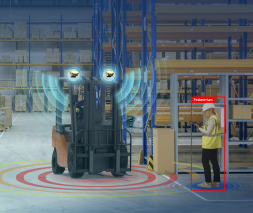
The occupational safety benefits of AGVs with the right safety solutions have now been proven. It can interact effectively with the environment and personnel thanks to planned routes and security systems. Thanks to the integrated sensors, it detects the approaching object and stops its movement when necessary
Trio Mobil is offered to users as a high-quality and comprehensive solution with security solutions specific to AGVs. With the AGV security solution, which is developed using the most advanced IoT and Artificial Intelligence technologies supported by data analytics, significant contributions can be made to both the occupational health and safety of the enterprises and the increase in productivity. With this solution, AGVs are automatically slowed down/stopped when they encounter each other or pedestrians, reducing the risk of possible occupational accidents and these processes can also be followed instantly. In this way, a safe working environment, which is very critical for all businesses in the world, can be provided.
If you also want to increase your occupational health & safety and productivity with the correct use of AGVs, you can visit our website and contact us.

Our Latest Blogs


Product Catalogue 2026
Download our catalog and gain access to a wealth of information on how to enhance industrial safety and efficiency. Our latest catalog features a diverse range of products and services that can help you achieve your goals.

Learn more about Trio Mobil's Solutions
Fill out the form and we'll contact you!