


Trio Mobil Global Technology Innovation Leader in AI-Based Industrial Safety
Read the Frost & Sullivan Analysis

3 Ways IoT Helps Achieve Forklift Safety with Forklift Collision Avoidance Systems
 Feb 2, 2022
 5 min
5 min 291
291Every year, about 95,000 people are injured and 100 workers are killed in forklift accidents, according to the Occupational Safety and Health Administration (OSHA). Nearly one out of every six workplace deaths involve a forklift, so forklift safety is paramount in warehouse operations.
The unique design of forklifts also makes them more susceptible to potential accidents. To balance loads in the front, forklifts are heavier in the rear, which can make for an uneven distribution of weight. Loads, carried in front, can block or limit the operator’s view.
For warehouse owners and operators, the best solution to these challenges to prevent forklift accidents requires a two-pronged approach: operator and worker training along with technology to mitigate safety concerns. OSHA estimated that with better workplace policies and practices, as much as 70% of forklift accidents could be prevented.
Training is an essential component (and legal requirement) of warehouse operations, but training alone isn’t enough to prevent forklift accidents. Fortunately, Internet of Things (IoT) technology from Trio Mobil can help make your warehouse safer.
1. Forklift Collision Avoidance Systems
A Forklift collision avoidance system can be installed that helps reduce workplace accidents. As forklifts move throughout the warehouse, devices installed on each forklift can detect the presence of another device. So, even if two forklift drivers can’t see each other, enter an intersection at the same time, or are negotiating a corner, if there’s another forklift nearby, the sensor will know that and sound an alarm.
Proximity warnings can be audio or visual. In cases where forklifts get too close, they will automatically slow down to preset speed levels. If a collision is imminent, the forklift can be stopped automatically.
At Trio Mobil, we use high-precision Ultra Wide Band (UWB) technology to keep forklifts in constant communication. Our systems provide 360 proximity detection and do not require Wi-Fi or cellular connections. AI-powered edge processing continuously calculates collision risk in real-time when machines are in proximity within the same zone.
A forklift anti collision system can be installed on any type or brand of forklift truck, Automated Guided Vehicle (AGV), or Automated Mobile Robot (AMR).
2. Pedestrian Forklift Safety
Warehouses are hubs of activity with workers moving in different directions at the same time — especially during peak times. Employees may be moving rapidly between areas as they pick, pack, and ship at the same time other workers are manning forklifts to haul and unload pallets.
Besides being busy places, there is often a lot of ambient noise in warehouses. Pedestrians may not see forklifts until it’s too late. They may also be caught unaware when turns or sudden stops occur. So, there’s a high potential for collisions between pedestrian and forklift accidents.
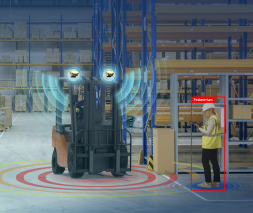
To maximize forklift safety, pedestrians can also carry special tags. When a tag comes in proximity to a forklift, it triggers audible and visual signals for forklift operations and a vibration alert for pedestrians. The closer a pedestrian is to a forklift, the more vibration they will feel.
With Trio Mobil, wearable tags are easy to configure and can be deployed using silicone watch bands, band holders, or as lanyards.
The Centers for Disease Control (CDC) says 20% of forklift accidents involve running into or over a worker’s foot. When there is a potential for a collision between a forklift and a pedestrian, the proximity detection system can force the forklift to slow or stop completely to help prevent an accident.
3. Zone-Based Forklift Speed Adjustment
A typical forklift can achieve speeds up to 18 mph. That might seem like a slow speed on a highway, but in a warehouse, it can be dangerously fast, especially when navigating turns.
One of the most common and deadly warehouse accidents occurs when forklifts roll over. This can happen in turns when there is excessive speed. Zone-based forklift speed adjustment can help by forcing a limit on speeds, such as risk zones at aisle intersections or other areas where congestion occurs.
After identifying risk zones, warehouse operators can install a router-like device for each zone and preset maximum speeds. With Trio Mobil, you can define and configure multiple zones and customize speed settings in each zone.
When forklifts are in a zone, the router can limit speeds, or force speed reductions automatically.
Other Benefits of Proximity Detection Systems in Warehouses
A typical forklift can achieve speeds up to 18 mph. That might seem like a slow speed on a highway, but in a warehouse, it can be dangerously fast, especially when navigating turns.
One of the most common and deadly warehouse accidents occurs when forklifts roll over. This can happen in turns when there is excessive speed. Zone-based forklift speed adjustment can help by forcing a limit on speeds, such as risk zones at aisle intersections or other areas where congestion occurs.
After identifying risk zones, warehouse operators can install a router-like device for each zone and preset maximum speeds. With Trio Mobil, you can define and configure multiple zones and customize speed settings in each zone.
When forklifts are in a zone, the router can limit speeds, or force speed reductions automatically.
Proximity detection systems also provide other benefits. For example, you can:
- Automatically open dock or warehouse doors upon approach
- Restrict forklift access to unauthorized areas
- Enforce speed restrictions or require a full stop at intersections
- Customize work zones to any layout
- Retrofit to any existing forklift
Another advantage of the Trio Mobil IoT platform is that the infrastructure for collision avoidance can also provide real-time indoor tracking of all of your machines. From a single dashboard, you can see and monitor all forklift traffic within the warehouse. Not only can this help you visualize potential danger zones, but Real-Time Location Tracking Systems (RTLS) can help optimize workflows and improve efficiency.
Prevent Forklift Accidents
Forklift accidents are always among the top infractions cited by OSHA inspectors. Besides the potential for injury or death, accidents can be costly. The National Safety Council reports that each injury requiring medical attention costs companies $42,000 and each workplace death averages more than $1.2 million in employer expenses. These numbers include lost wages, medical expenses, administrative and employer costs. On top of that, there may be property damage or damage to machines that require costly repairs.
By preventing forklift collisions, forklift-pedestrian accidents, and automatically managing speeds in danger zones, you can create a safer work environment for everyone. With an accident warning system from Trio Mobil in place, you can significantly reduce workplace accidents with forklifts.
To learn more about reducing forklift accidents, download our white paper: Reducing Forklift-Based Risks and Threats Utilizing IoT Technologies.

Our Latest Blogs


Product Catalogue 2026
Download our catalog and gain access to a wealth of information on how to enhance industrial safety and efficiency. Our latest catalog features a diverse range of products and services that can help you achieve your goals.
Learn more about Trio Mobil's Solutions
Fill out the form and we'll contact you!