

Award Recognition

Trio Mobil Recognized by Frost & Sullivan for Technology Innovation in AI-Based Industrial Safety

Read the Frost & Sullivan Analysis

CCTV vs. Trio Mobil

A camera records the risk. Trio Mobil acts on it, on-site, before the cloud even gets the clip.

<1s Trio Mobil on-site response
VS
60s+ Typical cloud CCTV notification
01
Reduces the accident risk from blind spots fixed cameras cannot see.
02
Intervenes in real time — CCTV only records it, Trio Mobil intervenes.
03
Cuts post-incident downtime, insurance, and legal risk costs.
04
Monitors and compares all sites live from a single dashboard.

Strategic Comparison

Trio Mobil — Full Stack System
vs. CCTV-Based Solutions

Trio Mobil runs detection, intervention, and reporting together in one full-stack safety architecture. Typical CCTV-based solutions remain limited to fixed-camera visibility and do not natively provide real-time intervention at the point of risk.
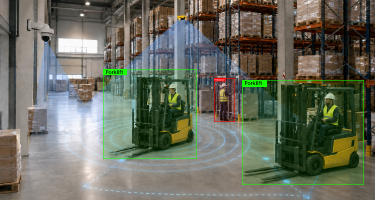
1
Coverage
TRIO MOBIL — FULL STACK
Trio Mobil full stack safety system with AI cameras, forklift detection, and UWB location layer

Static AI cameras, forklift-mounted cameras, existing CCTV, and the UWB location layer combine into one connected system, closing blind spots across the facility.
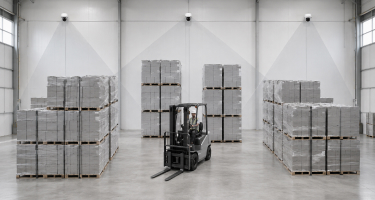
STANDALONE / CCTV-ONLY SOLUTIONS
Standalone CCTV-only solutions with fixed camera coverage and blind spots

Fixed camera coverage leaves blind spots and uncovered areas at risk.
2
Intervention Speed
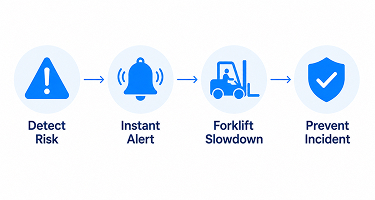
TRIO MOBIL — FULL STACK
Trio Mobil intervention flow: detect risk, instant alert, forklift slowdown, prevent incident

Intervenes on-site in under a second the moment a risk occurs: forklift slowdown and real-time alerts act before the incident can happen.
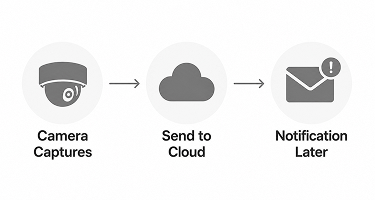
STANDALONE / CCTV-ONLY SOLUTIONS
CCTV-only flow: camera captures, send to cloud, notification later

Cloud-based deployments cannot provide dependable real-time intervention due to processing latency. Acting on a forklift or machine still requires additional integration and hardware investment.
3
Management Analytics
TRIO MOBIL — FULL STACK
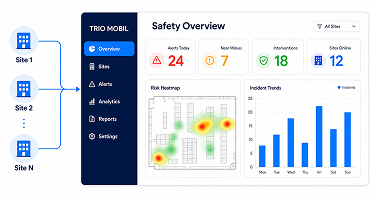
Trio Mobil centralized multi-site safety dashboard with real-time analytics

Real-time data from every source is unified with cloud-based risk trends, heatmaps, and KPIs in one centralized dashboard, giving safety and operations leaders instant multi-site visibility and analytics.
STANDALONE / CCTV-ONLY SOLUTIONS
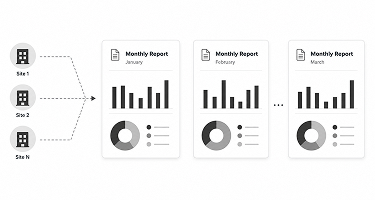
CCTV-only multi-site reporting with separate monthly reports per site

Multi-site analytics may be available, but insights remain limited to fixed-camera fields of view. Broader operational visibility typically requires additional coverage, data sources, and integration.

One connected system. End-to-end safety.
Full-stack visibility, faster action, and smarter analytics — all in one platform.
Request a Demo →

Intervention Speed

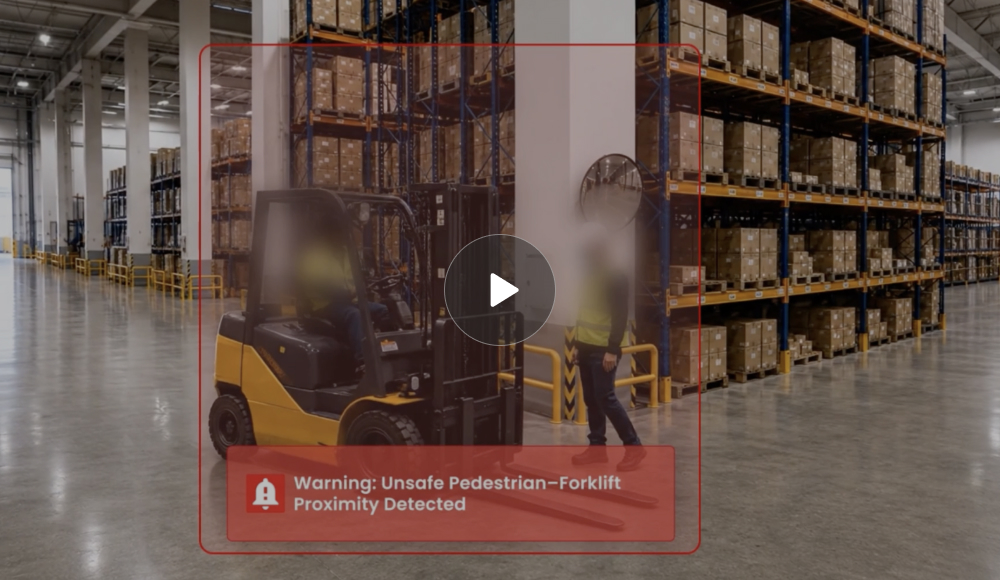
What happens in the seconds after a risk appears.

Same moment, two outcomes. Trio Mobil finishes acting on-site before a cloud-based system has even finished uploading the clip.
What happens in the seconds after a risk appears
Trio Mobil Done in under 1 second
T+0.0s
1
Risk detected

Static AI camera + UWB spot the pedestrian in the forklift's path — on-site, at the edge.

T+0.2s
2
Instant alert

Visual and audible warning fires immediately at the point of risk.

T+0.5s
3
Forklift slowdown triggered

A slowdown signal is sent directly to the specific forklift involved.

<1s
4
Incident prevented

All on-site — no cloud round trip required.

CCTV-Only (Cloud) Notification arrives after the fact
T+0s
1
Camera captures the footage

The event is recorded, but nothing happens on-site yet.

T+~15s
2
Footage uploads to the cloud

The clip has to leave the site before anything can be done with it.

T+~45s
3
Cloud processes the clip

Analysis happens remotely, adding further processing latency.

T+60s+
4
Notification sent

By the time it arrives, the risk moment has already passed.

The gap: by the time a typical cloud-based CCTV system finishes uploading the footage, Trio Mobil has already detected the risk, alerted the operator, slowed the forklift, and prevented the incident — on-site, in under a second.

How It Works

Trio Mobil's Hybrid Architecture

Trio Mobil combines edge-based detection and intervention with cloud-based analytics in one hybrid safety architecture.

Edge Layer
AI Cameras + Forklift Integration

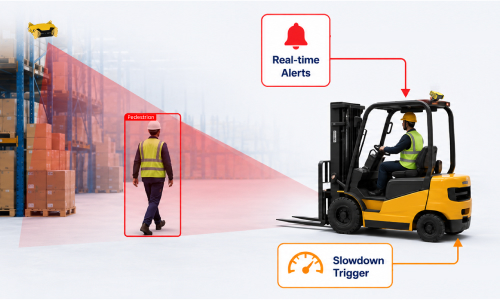
Trio Mobil's edge layer pairs AI cameras with real-time intervention, so risks are caught and acted on right where they happen.

  • 1. Static True AI operates at the edge, monitors predefined geofenced areas, and detects configured risk scenarios in real time.
  • 2. When a risk is detected, it immediately triggers predefined visual and audible alerts at the point of risk.
  • 3. Through integration with the relevant forklift kits, the system can send a slowdown trigger to the specific forklift involved in the risky interaction.
AI cameras with forklift integration: real-time alerts and slowdown trigger

This combines static-area intelligence with forklift-level intervention, enabling immediate preventive action without relying on a cloud round trip.

Cloud Layer
Multi-Source Reporting

While the edge layer acts in real time, the cloud layer turns every camera into a source of insight, building the visibility leaders need across sites.

  • Static True AI cameras used for real-time intervention also generate reporting data.
  • Existing CCTV camera feeds can be used for fixed-area AI monitoring and reporting.
  • Forklift-mounted AI cameras generate reporting insights while moving across operational areas.
  • All sources can be consolidated into dashboards, heatmaps, event review, and safety reports.
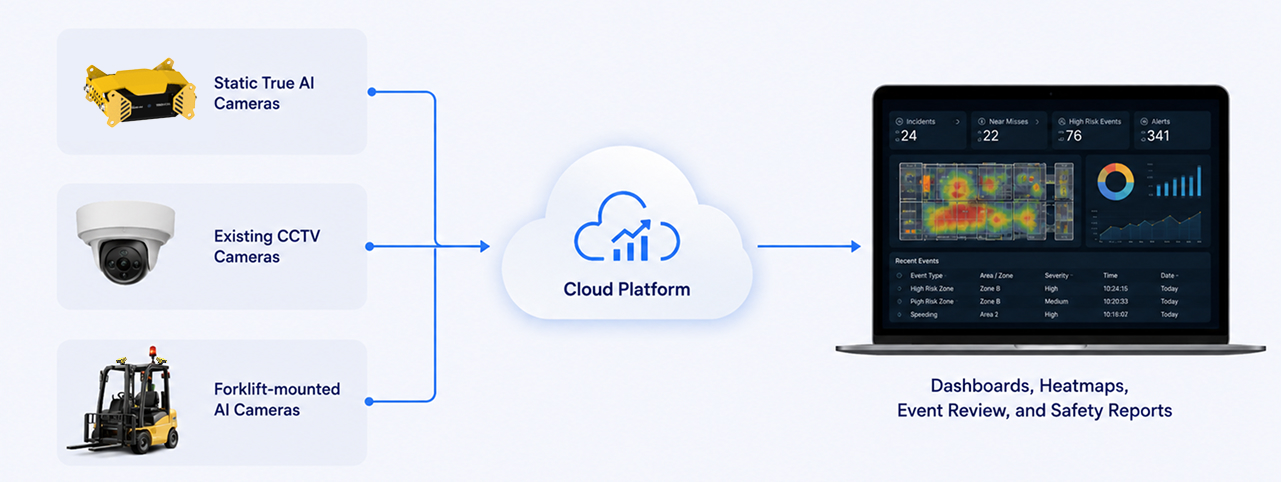
Multi-source reporting from AI cameras and CCTV to cloud platform dashboards and safety reports

Full Breakdown

Full Comparison: Detection, Intervention & Reporting

Every detection, intervention, and reporting capability — compared feature by feature. Filter by category, or leave it on "All."

Full capability Limited / not native
Detection 7 items
Requirement
TRIO MOBIL - FULL STACK
STANDALONE / CCTV-ONLY SOLUTIONS
■ Detection technology foundation
Static and Forklift Mounted AI Cameras (pedestrian detection), CCTV Cameras, UWB sensor layer (position data), and a cloud-based AI module (vehicle detection + proactive EHS reporting). Edge-based real-time intervention + cloud-based analytics, a hybrid architecture.
Fixed CCTV + AI analytics.
Cloud: all processing takes place in the cloud, no edge component.
On-Prem/Edge: processing takes place on a local server on site.
Pedestrian and forklift detection
Pedestrians are detected at the edge by static/Forklift Mounted AI Cameras; equipment position is known via UWB, and vehicle/truck detection is provided by the cloud AI module.
Detects pedestrians/vehicles within camera coverage. Cloud: processing takes place in the cloud. On-Prem/Edge: processing takes place on site, and maintenance must also be done on site.
Detection around blind racks and corners
UWB and blind spot management enable detection beyond direct camera visibility.
Limited by field of view and physical obstructions, regardless of cloud or on-prem/edge.
Detection throughout the forklift's operating route
The UWB tag and Forklift Mounted AI Cameras travel with the forklift; the camera detects pedestrians, UWB provides position/distance data.
Fixed cameras are installed at static locations; detection is limited to installed camera points, regardless of cloud or on-prem/edge.
False-alert control in dynamic aisles
AI-based pedestrian detection, UWB, and configurable zone logic help reduce nuisance alerts.
Camera-based detection is affected by angle, obstructions, and changing backgrounds. On-prem/edge processing only improves speed, not the underlying detection limits.
Yard-wide truck, forklift and pedestrian detection
Equipment position/distance is known via UWB; pedestrians are detected at the edge; truck/vehicle detection is supported by the cloud AI module, position-based alerts + cloud analytics.
Complete detection cannot be provided unless the entire yard is covered; blind spots remain outside camera view, regardless of cloud or on-prem/edge, since there is no UWB-like position layer.
Machine and restricted-zone safety detection
People entering machine hazard zones are detected at the edge; UWB-tagged equipment entry is determined via position data; the cloud AI module engages when vehicle detection is required.
Can detect violations if the area is clearly visible. On-Prem/Edge: can also generate a fast local trigger.
Real-Time Intervention 11 items
Requirement
TRIO MOBIL - FULL STACK
STANDALONE / CCTV-ONLY SOLUTIONS
■ Intervention technology foundation
True AI (edge) + forklift kit + UWB provide real-time intervention on site; the cloud AI module turns this into proactive EHS reporting, a hybrid architecture.
Uses CCTV analytics.
Cloud: analytics run entirely in the cloud, no edge component, additional integration is needed for intervention.
On-Prem/Edge: processing takes place on site, fast triggering is possible, but updates/maintenance must be done on site.
Immediate in-cab warning
Provides immediate visual and audible warnings directly to the forklift operator.
Requires separate in-cab hardware and integration, regardless of cloud or on-prem/edge.
Automatic forklift slowdown*
Can automatically slow the forklift when a configured risk is detected.
Not a built-in CCTV feature; even with on-prem/edge fast triggering, a separate forklift integration kit is required.
Intersection and blind spot warnings
Can activate beacons, LEDs, audio warnings, and other local alerts.
Cloud: footage must first be sent to and processed in the cloud, not real time.
On-Prem/Edge: processing takes place on site, the warning is generated locally, fast triggering.
Real-time intervention action set**
Applies predefined actions immediately: slow a forklift, real-time alarm in machine zone, open a door, change traffic lights, trigger visual/audio alerts.
Cloud latency prevents dependable actuation. On-Prem/Edge: simple alerts are faster, but complex actions like machine zone control/door opening still require additional integration.
Real-time yard safety intervention
Truck/forklift/pedestrian interactions are assessed using UWB position + AI pedestrian detection; warning/intervention rules trigger on site the moment a risk occurs.
Coverage gaps prevent dependable yard-wide intervention, regardless of cloud or on-prem/edge, since there is no UWB layer.
Integration with yard safety and control systems**
Integrates with traffic lights, barriers, industrial doors, wheel chocks, and pneumatic systems to execute rules immediately.
Fixed-camera dependency prevents dependable control. On-Prem/Edge: signal generation is faster, but system integration still needs additional hardware/engineering.
Real-time machine safety intervention**
A person's entry into a machine hazard zone is detected at the edge; UWB-tagged equipment entry is detected via position data; machine zone control, alarm, or access control can be triggered.
Monitoring may be possible within coverage; dependable intervention requires additional integration, regardless of cloud or on-prem/edge.
Sub-second response at the point of risk
Edge processing on the forklift/local device provides a sub-second response without a cloud round trip.
Cloud: does not provide a dependable sub-second response.
On-Prem/Edge: processing takes place on site, sub-second response is possible.
Behavior change at the moment of risk
Warns the operator and can intervene immediately when unsafe exposure occurs.
Primarily supports retrospective coaching; even with on-prem/edge immediate detection, there is usually no direct warning interface to the operator.
Real-time prevention and analytics in one platform
Immediate warning/intervention data generated on site is combined with cloud dashboards/heatmaps/trend analytics in one hybrid platform.
Primarily provides monitoring/analytics; real-time prevention needs additional integration. On-Prem/Edge: immediate intervention is possible, but a centralized dashboard still needs cloud integration.
Reporting 8 items
Requirement
TRIO MOBIL - FULL STACK
STANDALONE / CCTV-ONLY SOLUTIONS
■ Reporting data sources
Static and Forklift Mounted AI Cameras (pedestrian detection, edge), CCTV cameras, UWB position data, and continuous vehicle/truck detection from the cloud AI module.
Fixed CCTV feeds.
Cloud: all processing/reporting is in the cloud.
On-Prem/Edge: records are kept on site; additional integration is needed for centralized reporting.
Centralized dashboards, heatmaps and trend analysis
Provides site-level and multi-site monitoring, benchmarking, and analytics.
Cloud: site-level + multi-site monitoring/analytics are provided.
On-Prem/Edge: typically limited to a single site; multi-site needs additional cloud integration.
Video-based event review and investigation
Captures relevant risk events and short video clips for investigation, reporting, and corrective action.
Captures risk events and short clips. On-Prem/Edge: footage is stored on site; remote access/long-term archiving needs additional infrastructure.
Mobile monitoring capability
Forklift Mounted AI Cameras also collect monitoring insights as the forklift moves (pedestrian density, route risks, etc.).
Fixed cameras only monitor their predefined field of view, regardless of cloud or on-prem/edge.
Unsafe behavior, PPE and process-violation detection
Detects configured unsafe behaviors such as PPE non-compliance, work-at-height violations, restricted-area entry, running/climbing.
Detects PPE non-compliance and work-at-height violations within camera coverage, can be provided via cloud or on-prem/edge.
Ergonomic risk monitoring
Can identify configured ergonomic risks and unsafe working postures for reporting and investigation.
Can identify ergonomic risks where workers are clearly visible, can be provided via cloud or on-prem/edge.
Yard safety monitoring and reporting
UWB position + AI pedestrian detection + cloud vehicle detection together provide event review, risk trends, heatmaps, and reporting yard-wide.
Provides monitoring/reporting for risks within camera coverage. Cloud: consolidated on a centralized platform.
On-Prem/Edge: without a position layer, uncovered-area interactions cannot be reported.
Automated safety reporting
Converts detection events into safety KPIs, risk trends, area-level reports, and actionable insights.
Provides event reports/analytics based on monitored areas. Cloud: consolidated across multiple sites. On-Prem/Edge: consolidation typically needs additional cloud integration.

* Automatic slowdown is available where the relevant forklift model is technically compatible and the required integration has been completed.
** Real-time actuation depends on compatible equipment, site controls, and completed technical integration. CCTV capabilities may vary; this comparison reflects typical cloud-based CCTV AI monitoring configurations.
Note: Vehicle/truck detection is provided by the cloud-based AI module; forklift-mounted Mobil AI cameras perform pedestrian/human detection only and do not provide vehicle or forklift detection.

Deployed across enterprise sites in 65+ countries — automotive, food & beverage, building materials, logistics, manufacturing


audi
ford
mercedes-horizontal
cococola
unilever
beko
bsh
pirelli
pepsico
saintgobain
smurfit-kappa
toyota
goodyear
jw
knauf
haier
pg
daikin
jabil
cargill
forvia
ferrero
isuzu
dhl
pm
jti
nfi
maxion
nestle
henkel
audi
ford
mercedes-horizontal
cococola
unilever
beko
bsh
pirelli
pepsico
saintgobain
smurfit-kappa
toyota
goodyear
jw
knauf
haier
pg
daikin
jabil
cargill
forvia
ferrero
isuzu
dhl
pm
jti
nfi
maxion
nestle
henkel

Frequently Asked

Common questions

What's the main difference between Trio Mobil and CCTV-based AI monitoring?
CCTV-based AI monitoring detects and records events within fixed camera coverage. Trio Mobil combines static AI cameras, forklift-mounted cameras, existing CCTV, and a UWB location layer into one connected system that also intervenes at the point of risk — not just after the fact.
Does Trio Mobil replace our existing CCTV cameras?
No. Existing CCTV camera feeds can be used for fixed-area AI monitoring and reporting alongside Trio Mobil's static and forklift-mounted AI cameras — the CCTV layer becomes part of the connected system rather than being replaced.
How does automatic forklift slowdown work?
Automatic slowdown is available where the relevant forklift model is technically compatible and the required integration has been completed. When a risk is detected, the system sends a slowdown trigger to the specific forklift involved in the risky interaction.
Why can't cloud-only CCTV solutions intervene in real time?
Cloud-based deployments process footage off-site, which introduces latency that prevents dependable real-time intervention. Trio Mobil's edge layer processes detection and intervention on-site, in under a second, without a cloud round trip.
What does the reporting layer provide?
All sources — static AI cameras, CCTV, forklift-mounted cameras, and UWB — consolidate into dashboards, heatmaps, event review, and safety reports across every connected site.

Take the Next Step

Move from recording incidents
to preventing them.

See how Trio Mobil closes blind spots, intervenes in under a second, and unifies every site on one dashboard.

Request a Demo